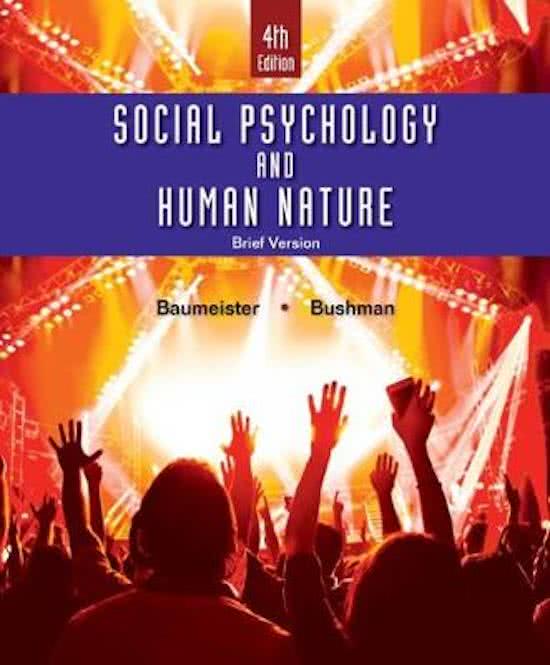
Social psychology and human behavior
CHAPTER 1 THE MISSION AND THE METHOD
Social Psychology: the scientific study of how people affect and are affected by others (real
or imaginary)
Late 1800
- Norman Triplett’s competition machine: the mere presence of others enhances
performance
- Max Ringelmann’s rope pulling experiment: as group size increases, individual effort
decreases
Long lasting influences of theories:
- Gordon Allport: attitudes
- Kurt Lewin: behavior is a function of person and situation
1950-1960: psychology divided into two camps:
- Behaviorism: learning principles
- Freudian psychoanalysis: interpretations of individual experiments
1970-1980: social cognition: how people think about people and the social world in general
- Attribution theory: attributions are explanations people come up with to explain the
behavior of others
1990-now: growing openness to biology
ABC triad:
- Affect
- Behavior
- Cognition
Social sciences:
- Anthropology: the study off human culture- the shared values, beliefs and practices
of groups of people
- Economics: the study of the production distribution and consumption of goods and
services and money
- History: the study of past events
- Political science: the study of political organizations and institutions, especially
governments
- Sociology: the study of human societies and the groups that form those societies.
Psychology subdisciplines:
- Psychology: the study of human behavior
- Biological psychology: Study what happens in the brain, nervous system, and other
aspects of the body.
, - Clinical psychology: Focuses on “abnormal” behavior, whereas social psychology
focuses on “normal” behavior.
- Cogniive psychology: The basic study of thought processes, such as how memory
works and what events people noice.
- Developmental psychology: Study of how people change across their lives, from
concepion and birth to old age and death.
- Personality psychology: Focuses on important diferences between individuals, as
well as inner processes.
Philosophy: “love of wisdom”; the pursuit of knowledge about fundamental matters such as
life, death, meaning, reality and truth
Applied research: research that focuses on solving particular practical problems
Basic research: research that focuses on a general understanding of basic principles that can
be applied to many different problems
Scientific method:
- State a problem
- Formulate a testable hypothesis
- Design study and collect data
- Test hypothesis with data
- Communicate study results
Hypothesis: an idea about the possibility nature of reality
Independent variable: manipulated variable that is assumed to lead to changes in the
dependent variable
Dependent variable: represents results of events and processes
Within-subject design: people are exposes to all conditions
Between-subject design: people are exposed to only one level of the independent variable
Experiment: manipulate an independent variable and random assignment
Quasi-experiment: manipulation but not random assignment
Field experiment: in real life
Confederate: a research assistant pretending to be another participant in a study
Construct validity of the cause: extent to which the independent variable is a valid
representation of the theoretical stimulus
Construct validity of the effect: extent to which the dependent variable is a valid
representation of the theoretical response
Random assignment: procedure whereby each study participant has an equal chance of
being in each treatment group
Demand characteristics: any clues in a study that suggests to participants what the
researcher’s hypothesis is
Deception studies: research studies that withhold information from participants or
intentionally mislead them about the purpose of the study
,Debriefing: an oral or written statement participants receive at the end of a psychological
study. It serves 2 main purposes:
- To fully inform participants about the study and answer any questions they have
- To reduce or eliminate any stress or harm the participant experienced by being in
the study
Correlation study: relationship between variables
Correlational approach: a nonexperimental method in which the researcher merely
observes whether variables are associated or related
Correlation coefficient: the statistical relationship or association between two variables
Meta-analysis: average statistics from all studies on the same topic
Survey research: questionnaire
Random sample: a sample wherein each person in the population has an equal chance of
being selected
Population: the total number of people under consideration
Qualitive: observe behavior
Quantitive: statistics
Validity: whether you measure what you aim to measure
Internal validity: the extent to which changes in the independent variable caused changes in
the dependent variable
External validity: the extent to which the findings from a study can be generalized to other
people, other settings, and other time periods
Reliability: whether you get the same result if you measure multiple times
Confounding: occurs when the two effects of variables cannot be separated
Stimulus sampling: using more than one exemplar of a stimulus
Reactance: an unpleasant emotional response that people often experience when someone
is trying to restrict their freedom
Replication: repeating a study to see if the effect is reliable
Experimental realism: the extent to which study participants get so caught up in the
procedures that they forget they are in an experiment
Mundane realism: refers to whether the setting of an experiment physically resembles the
real world
CHAPTER 2 CULTURE AND NATURE
Nature: physical world around us including all its laws and processes. It states that people
are born in a certain way
Psyche (mind): encompasses emotion, desires, perception and all other psychological
processes
Charles Darwin: evolution theory:
- How change occurs in nature
- Natural selection decides which traits will endure and which will disappear:
, o Survival: living long enough to reproduce
o Mutation: new genes
o Reproduction: producing babies that also reproduce
Social animals have bigger brains:
- They live longer, more complex social groups
- Bigger in key brain parts
- Being social improves survival and reproduction
Social animals accomplish things by means of social interaction
Culture: information-based system with shared ideas and values. It focuses on personal life
experiences
- It is an advanced way of being social
o Evolution is a proceeding system from simple creatures to social animals
o Cultural animals are a step further
- It enables us to talk with strangers, buy things in shops and to have opposite beliefs
Social animals: seek connections to others, prefer to live, work, play with other members of
their species
Cultural animals: an advanced way of being social humans depend on culture for their
survival
Praxis: practical ways of doing things
Differences between cultural and social animals:
- Cultural animals:
o Division of labor (specialization)
o Shared knowledge with group
o Ability to solve disagreement
- Social animals:
o Work together
o Learn things from each other
o May help kin
Nature and culture interact with each other to influence us. (example: ice-hockey players
often born in winter)
Nature and culture shape each other. (example: smart people less diseases)
Duplex mind: the human mind has two main systems
Automatic system Deliberate system
- Outside consciousness - Mostly in consciousness
- Simple tasks - Complex tasks
- Always on, even in sleep - Off during sleep
- Makes deliberate thought possible
CHAPTER 1 THE MISSION AND THE METHOD
Social Psychology: the scientific study of how people affect and are affected by others (real
or imaginary)
Late 1800
- Norman Triplett’s competition machine: the mere presence of others enhances
performance
- Max Ringelmann’s rope pulling experiment: as group size increases, individual effort
decreases
Long lasting influences of theories:
- Gordon Allport: attitudes
- Kurt Lewin: behavior is a function of person and situation
1950-1960: psychology divided into two camps:
- Behaviorism: learning principles
- Freudian psychoanalysis: interpretations of individual experiments
1970-1980: social cognition: how people think about people and the social world in general
- Attribution theory: attributions are explanations people come up with to explain the
behavior of others
1990-now: growing openness to biology
ABC triad:
- Affect
- Behavior
- Cognition
Social sciences:
- Anthropology: the study off human culture- the shared values, beliefs and practices
of groups of people
- Economics: the study of the production distribution and consumption of goods and
services and money
- History: the study of past events
- Political science: the study of political organizations and institutions, especially
governments
- Sociology: the study of human societies and the groups that form those societies.
Psychology subdisciplines:
- Psychology: the study of human behavior
- Biological psychology: Study what happens in the brain, nervous system, and other
aspects of the body.
, - Clinical psychology: Focuses on “abnormal” behavior, whereas social psychology
focuses on “normal” behavior.
- Cogniive psychology: The basic study of thought processes, such as how memory
works and what events people noice.
- Developmental psychology: Study of how people change across their lives, from
concepion and birth to old age and death.
- Personality psychology: Focuses on important diferences between individuals, as
well as inner processes.
Philosophy: “love of wisdom”; the pursuit of knowledge about fundamental matters such as
life, death, meaning, reality and truth
Applied research: research that focuses on solving particular practical problems
Basic research: research that focuses on a general understanding of basic principles that can
be applied to many different problems
Scientific method:
- State a problem
- Formulate a testable hypothesis
- Design study and collect data
- Test hypothesis with data
- Communicate study results
Hypothesis: an idea about the possibility nature of reality
Independent variable: manipulated variable that is assumed to lead to changes in the
dependent variable
Dependent variable: represents results of events and processes
Within-subject design: people are exposes to all conditions
Between-subject design: people are exposed to only one level of the independent variable
Experiment: manipulate an independent variable and random assignment
Quasi-experiment: manipulation but not random assignment
Field experiment: in real life
Confederate: a research assistant pretending to be another participant in a study
Construct validity of the cause: extent to which the independent variable is a valid
representation of the theoretical stimulus
Construct validity of the effect: extent to which the dependent variable is a valid
representation of the theoretical response
Random assignment: procedure whereby each study participant has an equal chance of
being in each treatment group
Demand characteristics: any clues in a study that suggests to participants what the
researcher’s hypothesis is
Deception studies: research studies that withhold information from participants or
intentionally mislead them about the purpose of the study
,Debriefing: an oral or written statement participants receive at the end of a psychological
study. It serves 2 main purposes:
- To fully inform participants about the study and answer any questions they have
- To reduce or eliminate any stress or harm the participant experienced by being in
the study
Correlation study: relationship between variables
Correlational approach: a nonexperimental method in which the researcher merely
observes whether variables are associated or related
Correlation coefficient: the statistical relationship or association between two variables
Meta-analysis: average statistics from all studies on the same topic
Survey research: questionnaire
Random sample: a sample wherein each person in the population has an equal chance of
being selected
Population: the total number of people under consideration
Qualitive: observe behavior
Quantitive: statistics
Validity: whether you measure what you aim to measure
Internal validity: the extent to which changes in the independent variable caused changes in
the dependent variable
External validity: the extent to which the findings from a study can be generalized to other
people, other settings, and other time periods
Reliability: whether you get the same result if you measure multiple times
Confounding: occurs when the two effects of variables cannot be separated
Stimulus sampling: using more than one exemplar of a stimulus
Reactance: an unpleasant emotional response that people often experience when someone
is trying to restrict their freedom
Replication: repeating a study to see if the effect is reliable
Experimental realism: the extent to which study participants get so caught up in the
procedures that they forget they are in an experiment
Mundane realism: refers to whether the setting of an experiment physically resembles the
real world
CHAPTER 2 CULTURE AND NATURE
Nature: physical world around us including all its laws and processes. It states that people
are born in a certain way
Psyche (mind): encompasses emotion, desires, perception and all other psychological
processes
Charles Darwin: evolution theory:
- How change occurs in nature
- Natural selection decides which traits will endure and which will disappear:
, o Survival: living long enough to reproduce
o Mutation: new genes
o Reproduction: producing babies that also reproduce
Social animals have bigger brains:
- They live longer, more complex social groups
- Bigger in key brain parts
- Being social improves survival and reproduction
Social animals accomplish things by means of social interaction
Culture: information-based system with shared ideas and values. It focuses on personal life
experiences
- It is an advanced way of being social
o Evolution is a proceeding system from simple creatures to social animals
o Cultural animals are a step further
- It enables us to talk with strangers, buy things in shops and to have opposite beliefs
Social animals: seek connections to others, prefer to live, work, play with other members of
their species
Cultural animals: an advanced way of being social humans depend on culture for their
survival
Praxis: practical ways of doing things
Differences between cultural and social animals:
- Cultural animals:
o Division of labor (specialization)
o Shared knowledge with group
o Ability to solve disagreement
- Social animals:
o Work together
o Learn things from each other
o May help kin
Nature and culture interact with each other to influence us. (example: ice-hockey players
often born in winter)
Nature and culture shape each other. (example: smart people less diseases)
Duplex mind: the human mind has two main systems
Automatic system Deliberate system
- Outside consciousness - Mostly in consciousness
- Simple tasks - Complex tasks
- Always on, even in sleep - Off during sleep
- Makes deliberate thought possible