PUBLIC RELATIONS AND REPUTATION
MANAGEMENT
Corporate communication: a guide to theory & practice
Lieke Brekelmans
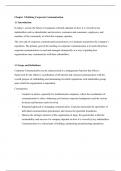
Chapter 1: Defining Corporate Communication
Protecting a company’s reputation is essential for its success.
Corporate communication practitioners
- Building, maintaining and protecting a company’s reputation
- Their role and contribution are often undervalued, leading to lack of understanding
Corporate communication
- A management function responsible for coordinating internal and external
communication to establish and maintain favourable reputations with stakeholders
- Strategic planning and tactical execution of communication activities
- Complex
- Requires an integrated approach that transcends individual specialities to align with
the organization’s strategic interests
- Focusses on the organization as a whole and its presentation to all stakeholders,
internal and external
Objectives
- Precise, short-term statements aligned with the vision and are achieved through
strategic initiatives or strategies
Stakeholder management
- Takes precedence over market-centric approaches, advocating for inclusivity and
balance in engaging with all stakeholders, not just shareholders or customers
Business and management communications
- More technical applied
- Focusing on individual skills and interpersonal situations within the organization
,Timeline role of communication
1. Restricting and integration (1980s):
a. Organizations underwent a restricting trend, consolidating separate
communication disciplines into more integrated departments or practices
b. Integration offered managerial benefits
c. Fragmentation of communication disciplines was recognized as
counterproductive, leading to sub-optimization
2. Strategic communication (1990s to early 2000s):
a. Organizations began focusing on corporate identity, reputation and branding
to strategically position themselves in stakeholders’ minds
b. Emphasis on fostering a favourable reputational position to influence
stakeholders’ decisions and preferences
c. This approach sometimes reinforced the notion of managing stakeholders’
perceptions linearly, neglecting stakeholders as active agents in
communication processes
Communication historically served a tactical support role but transitioned to a strategic
function focused on realizing organizational objectives and building reputational capital
Chapter 4: Stakeholder management and communication
Significance of stakeholder management
- Came about because of pressures from governments and the international
community promoting stakeholder perspective
Stakeholder management
- It requires that managers think strategically about their business overall
- About how they can effectively communicate with stakeholders (customers, investors,
employees, members of the communities in which the organization resides)
Neo-classical economic theory
- The purpose of organizations is to make profits in their accountability to themselves
and to shareholders
- Only by doing so can business contribute to wealth for itself as well as society at large
,Socio-economic theory
- The question of ‘who counts’ extends to other groups besides shareholders who are
considered to be important for the continuity of the organization and the welfare of
society
,
MANAGEMENT
Corporate communication: a guide to theory & practice
Lieke Brekelmans
Chapter 1: Defining Corporate Communication
Protecting a company’s reputation is essential for its success.
Corporate communication practitioners
- Building, maintaining and protecting a company’s reputation
- Their role and contribution are often undervalued, leading to lack of understanding
Corporate communication
- A management function responsible for coordinating internal and external
communication to establish and maintain favourable reputations with stakeholders
- Strategic planning and tactical execution of communication activities
- Complex
- Requires an integrated approach that transcends individual specialities to align with
the organization’s strategic interests
- Focusses on the organization as a whole and its presentation to all stakeholders,
internal and external
Objectives
- Precise, short-term statements aligned with the vision and are achieved through
strategic initiatives or strategies
Stakeholder management
- Takes precedence over market-centric approaches, advocating for inclusivity and
balance in engaging with all stakeholders, not just shareholders or customers
Business and management communications
- More technical applied
- Focusing on individual skills and interpersonal situations within the organization
,Timeline role of communication
1. Restricting and integration (1980s):
a. Organizations underwent a restricting trend, consolidating separate
communication disciplines into more integrated departments or practices
b. Integration offered managerial benefits
c. Fragmentation of communication disciplines was recognized as
counterproductive, leading to sub-optimization
2. Strategic communication (1990s to early 2000s):
a. Organizations began focusing on corporate identity, reputation and branding
to strategically position themselves in stakeholders’ minds
b. Emphasis on fostering a favourable reputational position to influence
stakeholders’ decisions and preferences
c. This approach sometimes reinforced the notion of managing stakeholders’
perceptions linearly, neglecting stakeholders as active agents in
communication processes
Communication historically served a tactical support role but transitioned to a strategic
function focused on realizing organizational objectives and building reputational capital
Chapter 4: Stakeholder management and communication
Significance of stakeholder management
- Came about because of pressures from governments and the international
community promoting stakeholder perspective
Stakeholder management
- It requires that managers think strategically about their business overall
- About how they can effectively communicate with stakeholders (customers, investors,
employees, members of the communities in which the organization resides)
Neo-classical economic theory
- The purpose of organizations is to make profits in their accountability to themselves
and to shareholders
- Only by doing so can business contribute to wealth for itself as well as society at large
,Socio-economic theory
- The question of ‘who counts’ extends to other groups besides shareholders who are
considered to be important for the continuity of the organization and the welfare of
society
,