ASNT Visual Testing Level 2 Exam Questions And Answers Solved 100% Correct!!
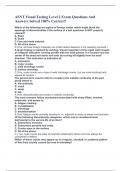
ASNT Visual Testing Level 2 Exam Questions And Answers Solved 100% Correct!! Which of the following are typical of foreign matter which might block the openings of discontinuities if the surface of a test specimen is NOT properly cleaned? A. Paint B. Scale C Core and mold material D. All of the above D (Yes, all three foreign materials can inhibit defect detection if not carefully removed.) A large forging is repaired by welding. Visual inspection of the repair weld reveals an irregular indication running parallel with the weld passes. It is located near the center of the bead and starts and ends by turning off slightly from the axial direction. This indication is indicative of: A. inclusions B. crater cracks C. weld shrinkage cracks D. surface checking C (Yes, crater cracks are a type of weld shrinkage cracks, but are more localized and appear at random.) The general term used to refer to a break in the metallic continuity of the part being tested is: A. discontinuity B. crack C. seam D. lap A (Yes, discontinuities are breaks in metallic continuity) The most common failure mechanism associated with sharp fillets, notches, undercuts, and seams is: A. fatigue cracking B. crystallization C. shrinkage D. decarburization A (Yes, fatigue cracks normally develop in, or, adjacent to areas of stress concentration. Of the following discontinuity categories, which one is considered most detrimental to the service life of an item? A. Subsurface inclusion B. Subsurface porosity and voids C. Cracks open to the surface D. All of the above C ( Yes, open cracks are sites of potential catastrophic failure and can always be considered a defect) Which of these cracks may appear as an irregular, checked, or scattered pattern of fine lines usually caused by local overheating? A. Fatigue cracks B. Grinding cracks C. Crater cracks D. HAZ cracks B (Yes, grinding of hardened surfaces can create overheating that results in fine shallow cracks) Which of the following is a defect commonly associated with the welding process? A. Lack of penetration B. Flacks C. Seams D. Laminations A ( Yes, lack of penetration is generally irregular and filamentary occurring at the root of the weld.) Which one of the following is not a discontinuity common to forged products? A. Laps B. Shrinkage C. Bursts D. Flakes B (Correct, shrinkage occurs in casting and in welds.) Which one of the following is not a discontinuity common to rolled products? A. Seams B. Laminations C. Cold shuts D. Cracks C (Correct, cold shuts result in ferrous or nonferrous cast material.) Forging laps occur in what relation to the axial direction of a part? A. May occur anywhere on surface and may bear no relation to axial direction of the part B. Always are found on thermal centerline C. Are found on surface of part at a 90 degree angle to long axis D. May occur anywhere in the part and always run in direction of working. A (Yes, forging laps may occur on any part of the article.) Discontinuities in plate, sheet, or strip caused by pipe, inclusion, or blowholes in the original ingot which after rolling are usually flat and parallel to the outside surface are called: A. seams B. laminations C. cracks D. laps B (Yes, laminations are separations or weaknesses generally aligned parallel to the work surface.) A rough forging discontinuity has the following characterisitics: can occur on surface or internally; is often caused by excessive working; and creates cavities varying in size. How would it be identified? A. Burst B. Shrinkage C. Pipe D. Lamination A (Yes, bursts can be at the surface or internal) The interpretation of visual indications may be aided by: A. observing with a magnifying glass B. observing the indications as they are formed. C. reproducing the indication residually D. both A and B. D (Yes, visual indications may be interpreted by both methods) An interruption in the normal physical structure or configuration of a part which produces a VT indication is called: A. a discontinuity B. a defect C. an indication D. a deformation A (Yes, discontinuities are structural aberrations in a material) A rough forging that has received no further processing is visually tested. An indication is observed to run in every direction. It appears to extend deeply into the part and perpendicular to the surface. It is very sharp. What is the probable identity of the indication? A. Forging burst B. Lap C. Flake D. Seam A (Yes, forging burst can occur as a result of rough forging.) A gear with case-hardened ground teeth and hub ends is VT tested. Individual indications are detected on five teeth and one end surface of the hub. The indications do not break over the part edges. What is the probable identity of the indication? A. Grinding cracks B. Inclusions C. Porosity D. Quench cracks A (Yes, grinding cracks are found in case hardened materials subjected to grinding (teeth and hub ends) and are very shallow) Which of the following casting defects is caused by non-uniform cooling resulting in stresses which rupture the surface of the metal? A. Shrink B. Hot tears C. Porosity D. Dross B ( Yes, hot tears originate where stresses are set up by the more rapid cooling of thin sections that adjoin heavier masses of metal) Which of the following discontinuities could be classified as a primary processing discontinuity often found in cast material?
Escuela, estudio y materia
- Institución
- ASNT Visual Testing Level 2
- Grado
- ASNT Visual Testing Level 2
Información del documento
- Subido en
- 16 de abril de 2024
- Número de páginas
- 10
- Escrito en
- 2023/2024
- Tipo
- Examen
- Contiene
- Preguntas y respuestas
Temas
-
asnt visual testing level 2 exam questions and ans

Documento también disponible en un lote