ASNT VT Theory Questions (Level II) Answered Correctly To Pass!!
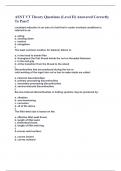
ASNT VT Theory Questions (Level II) Answered Correctly To Pass!! Localized reduction in an area of a bolt that is under overload conditions is referred to as: a. sizing b. necking down c. erosion d. elongation b The least common location for fastener failure is: a. in the head to shank fillet b. throughout the first thread inside the nut on threaded fasteners c. in the mid grip d. at the transition from the thread to the shank c Discontinuities that are produced during the hot or cold working of the ingot into rod or bar to make studs are called: a. inherent discontinuities b. primary processing discontinuities c. secondary processing discontinuities d. service-induced discontinuities b Service-induced discontinuities in bolting systems may be produced by: a. vibration b. over-tensioning c. corrosion d. all of the above d The fillet weld size is based on the: a. effective fillet weld throat. b. length of fillet weld. c. theoretical throat. d. length of fillet weld leg. d A convex weld surface: a. curves inward b. curves outward c. contains a hollow d. does both a and c b During the solidification of metal, a hole produced due to escaping gases is called a: a. burst b. cold shut c. flaking d. blow hole d Weldments might contain: a. shrinkage b. incomplete penetration c seams d laps b A discontinuity typically found in forgings is: a. shrinkage b. bleed-out c laps d undercut c Embrittlement, caused by a physical or chemical change in the metal, is a reduction in: a. ductility b. hardness c. hydrogen d. all of the above a The deterioration of a metal by chemical or electrochemical reaction with its environment is called: a. corrosion. b. erosion. c. IGSCC. d. none of the above. a The roughest surface finish is indicated by a measurement of: a. 64 µin. b. 150 µin. c. 250 µin. d. 380 µin. d A basic metallurgical joint configuration that is used for complete joint penetration is called: a butt joint. b. a fillet joint. c. a lap joint. d. none of the above. a The welding process that is sometimes referred to as "stick welding" is: a. SAW b. SMAW c. GMAW d. GTAW b The welding process in which there is a higher degree of probability of entrapping slag is: a. GMAW b. GTAW c. SMAW d. all of the above c Tungsten inclusions arc found during: a. GMAW. b. GTAW. c. SMAW. d. none of the above. b The portion of base metal that has not been melted but where mechanical properties or microstructure have been altered by the heat of welding is defined as: a. the fusion zone. b. the heat-affected zone. c. both a and b above. d. none of the above. b The difference between discontinuities and defects is that: a. a defect is a rejectable discontinuity. b. discontinuities affect the base metal, whereas defects affect the weld metal c. there should be no distinction between discontinuities and defects. d. a discontinuity is a rejectable defect. a The gage that provides measurements of internal misalignment on 76 mm (3 in.) diameter pipe is: a. a Cambridge gage. b. a fillet weld gage. c. a hi-lo welding gage d. both a and b c In a bore scope, the image is brought to the eyepiece by: a. an objective lens. b. relay lenses. c. an eyepiece lens. d. all of the above. d In welding, temperature indicating sticks are used to monitor: a. preheat temperatures. b. post heat temperatures. c. interpass temperatures. d. all of the above. d To measure the diameter of a 76 mm (3 in) stud most accurately, use a: a. 51-76 mm (2-3 in.) inside mechanical gage (micrometer). b. outside caliper. c. 152 mm (6 in.) dial caliper. d. mechanical (micrometer) depth gage. c A discontinuity that appears as a series of re-melted dots beside a weld, resembling a trail left in striking a match is called: a. linear porosity. b. arc strikes. c. undercut d. slag. b A protrusion or rollover of weld metal beyond the toe or root is called: a. overlap. b. undercut. c. reinforcement. d. overfill a Chevrons may occur in: a. plates. b. weldments. c. bar stock. d. valve castings c A discontinuity that is found in bars and forgings, which is caused by the rupture of metal forged at either too low or too high temperatures, is called: a. pipe. b. seam. c. cupping. d. internal burst. d A cause for undercut that occurs during the welding process is called: a. excessive voltage or current. b. slow travel speed. c. excessive travel speed. d. both a and c above d When the weld is to be placed on the arrow side of the joint, the weld symbol in the drawing will be: a. below the line. b. above the line. c. in the tail. d. at the end of the arrow a The brazing process is commonly defined as a liquid-solid phase joining method accomplished at a temperature above: a. 232 °C (450 °F). b. 343 °C (650 °F), c. 449 °C (840 °F). d. 504 °C (940 °F). c To be acceptable, a concave fillet weld must have an actual leg dimension that is: a. longer than the size.
Escuela, estudio y materia
- Institución
- ASNT VT Level II
- Grado
- ASNT VT Level II
Información del documento
- Subido en
- 16 de abril de 2024
- Número de páginas
- 19
- Escrito en
- 2023/2024
- Tipo
- Examen
- Contiene
- Preguntas y respuestas
Temas
-
asnt vt theory questions level ii answered corre

Documento también disponible en un lote