NURS 3000 Exam 4 Study Guide Questions With Correct Answers.
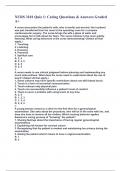
NURS 3000 Exam 4 Study Guide Questions With Correct Answers. Nursing interventions for pt receiving O2 via nasal cannula(nose prongs) -Assess for signs of O2 impairment -Ensure proper functioning and rate of O2 Nursing interventions to promote circulation and oxygenation in hospitalized patients -Teach effective coughing and Deep breathing -TCDB(Turn, Cough, Deep Breathe every 2 hrs. -Postural drainage with percussion(Chest Vest) -Hydration -Assuming Fowler's or High Fowler's position -Ambulation Priority nursing actions for a patient exhibiting s/s of impaired oxygenation -Ambulation -TCBD -NPPV(Noninvasive Positive Pressure Ventilation) -O2 therapy(treat as drug/med -Incentive spirometry -Updraft treatments -Postural drainage with percussion(Chest Vest) -Meds: Broncholdiators, Steriods, and expectorants -Elevate HOB -Positioning: Fowler's, High Fowlers, Orthopneic Priority short-term goals for a patient exhibiting s/s of impaired oxygenation -Exhibit signs of increased oxygenation -Maintain patient airway -Maintain and improve pulmonary ventilation and oxygenation -Prevent risk associated with skin and tissue breakdown Independent nursing interventions to maintain a patent airway in a patient with Ineffective Airway Clearance -TCBD -Elevate HOB -Increase fluids Fowler's position Therapeutic communication with a patient who uses CPAP Explain to the patient that is a type of Noninvasive ventialtion treatment to maintain adequate breathing( used in acute and chronic respiratory failure, pulmonary edema, COPD, and obstructive sleep apnea) -Nurse's primary role in caring for patients using CPAP or BiPAP devises is to ensusre optimal functioning and use of the device since it may need to be used nightly for the remainder of their lives Actions for a patient experiencing sudden onset chest pain while ambulating -Have pt. to sit or rest and takes things slow -Reduce anxiety -Stop ambulating What is Atelectasis? How would it affect the lung sounds? A collapse of a portion of the lung; results in decreased or absent gas exchange/ the lungs cannot fill with enough air, and the oxygen level in your blood may go down O2 administration in patients with COPD; What's important to remember? -(MCD)mucus clearance device-client inhales slowly(keeps cheeks firm) , exhales fast through the device, causing the steel ball to move up and down -Nasal cannula: 2L/min, above 6 L/min the pt, swallows air and the FiO2 is not increased -CPAP: ensure functioning and use of the device, need to be used nightly for the remainder of their lives - COPD pt have chronic hypercapnia and there incentive to breath comes from hypoxemia -Sustained maximal inspiration devices (SMIs), measure the flow of air inhaled through the mouthpiece -Designed to mimic natural sighing or yawning by encouraging the pt to take long, slow deep breaths Incentive Spiometer Pt teaching in using incentive spirometer: -Hold or place the SMI in an upright position -Exhale normally -Seal your lips tightly around the mouthpiece -Take in a slow, deep breath -If you have difficulty breathing only through the mouth, a nose clip can be used -Remove the mouthpiece and exhale normally -Relax and take several normal breaths before using it again -Repeat procedure several times and 4 or 5 times hourly -Clean the mouthpiece with water and shake it dry Hyperkalemia-priority nursing assessments -Assess for cardiac arrhythmias and flaccid muscle paralysis(weakness) *Administer diuretics/other meds such as glucose and insulin as ordered -Hold potassium supplements and K+ conserving diuretics -Monitor serum K+ levels carefully S/S of Deficient Fluid Volume -Decreased urine volume (<30 mL/hr) -Postural hypotension -Decreased turgor -Dry mucous membranes, sunken eyeballs, decreased tearing -Weak pulse(bradycardia) or rapid(tachycardia -Weight loss -Decreased cap. refill, central venous pressure, blood pressure, tissue turgor -Increased specific gravity of urine, hematocrit, and BUN Nursing interventions for Deficient Fluid Volume -Assess for clinical manifestations of VFD -Monitor weight, V/S, and temp. -Assess tissue turgor -Monitor I & O and lab findings -Administer oral and IV fluids as indicated -Provide frequent mouth/skincare -Provide for safety S/S of Excess Fluid Volume -5% wt. gain -Fluid intake >than output -NVD -Peripheral edema(hands, legs, and feet) -Rales(crackles) -Dyspnea(Shortness of breath) -Polyuria -Full, Bounding pulse, tachycardia -Hypertension -Mental confusion What is the normal range for sodium? 135-145 mEq/L What is the normal range for potassium? 3.5-5.5 mEq/L What is the normal range for calcium? 8.5-10.5 mg/dl -%>ECF; nervous & muscular tissue -Generates & transmits nerve impulses -Acid-base balance -Cellular chemical reactions -Influences water distribution -Regulated by dietary intake & aldosterone secretion 135-145 mEq/L-Normal! Sodium %>ICF; vital for ALL muscle activity -Transmits electrical impulses -In bananas, peaches, figs, etc. -Excreted by kidneys -aldosterone K+ excretion 3.5-5.5 mEq/L-Normal!! -Body does not store K+ well so any condition of UOP serum K+ (Med ex: ???) -Putting put more urine potassium levels will lower Potassium -Most abundant in bone; c phosphate -Nerve impulses, blood clotting, muscle contr, cell chemical activities (enzyme activator) -Helps cells adhere to one another & maintain shape -Aging= less calcium absorbed in intestines shifts out of bones (Osteoporosis) 8.5-10.5 mg/dl-normal range Calcium Excess Fluid Volume priority nursing interventions -Assess for clinical manifestation of FVE -Bedrest -Assess breath sounds and edema -Elevate HOB(Fowler's position) -Monitor weight and V/S -Restrict fluid and sodium intake -Implement measures to prevent skin breakdown -Watch for seizures List risk factors for Hyponatremia. GI fluid loss, sweating, diuretics, hypotension , tube feeding, excessive drinking of water, and IV D5W, head injury, AIDS, and malignant tumors S/S of Hyponatremia(Low sodium) -Muscle cramps/twitching, -Seizures, coma(severe) -Lethargy, confusion, apprehension -Abdominal cramps -Anorexia, nausea, vomiting Lab findings: Serum sodium <135 mEq/L and Serum osmolaity: < 280 mOsm/kg Nursing Interventions for Hyponatremia -Careful administration of NA -Monitor I & O and lab data (serum sodium) -Assess pt if administering hypertonic IVs -Encourage food and fluid high in sodium -Limit water intake List risk factors for Hypernatremia. Water loss, diarrhea, water deprivation, parenteral admin. of saline products, hypertonic tube feedings without adequate water, excessive use of table salt, diabetes insipidus, and heat stroke S/S of Hypernatremia(High Sodium) -Thirst -Increased temp. -Dry, swollen red tongue -Sticky mucus membrane; severe disorientation -Weakness -Severe symptoms: fatigue/restlessness, decreased LOC, disorientation, and convulsions -Lab results: Serum sodium >145 mEq/L and Serum osmolaity > 300 mOsm/kg Nursing interventions for Hypernatremia(High Sodium)
Escuela, estudio y materia
- Institución
- NURS 3000
- Grado
- NURS 3000
Información del documento
- Subido en
- 16 de abril de 2024
- Número de páginas
- 13
- Escrito en
- 2023/2024
- Tipo
- Examen
- Contiene
- Preguntas y respuestas
Temas
-
nurs 3000 exam 4 study guide questions with correc

Documento también disponible en un lote