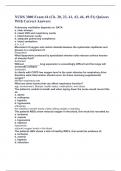
NURS 3000 Exam #4 (Ch. 20, 23, 41, 43, 46, 49-51) Quizzes With Correct Answers
NURS 3000 Exam #4 (Ch. 20, 23, 41, 43, 46, 49-51) Quizzes With Correct Answers Pulmonary ventilation depends on: SATA a. clear airways b. intact CNS and respiratory center c. intact thoracic cavity d. adequate pulmonary compliance e. intact cerebellum a, b, c, d Movement of oxygen and carbon dioxide between the systematic capillaries and tissues is a component of: Respiration What lipoprotein produced by specialized alveolar cells reduces surface tension of alveolar fluid? Surfactant Without ___________ lung expansion is exceedingly difficult and the lungs will eventually collapse. Surfactant In clients with COPD low oxygen level is the main stimulus for respiratory drive therefore what intervention should occur for those receiving supplemental oxygen? Monitor respiratory rate What are some factors that can affect respiratory function? age, environment, lifestyle, health status, medications, and stress The patient is unable to breath well when laying down the nurse would record this as: a. apnea b. orthopnea c. hypoxia d. hypoxemia orthopnea the inability to breath easily unless sitting upright or standing The patients ABGs show reduced oxygen in the blood, this would be recorded as: a. ischemia b. anemia c. hypoxemia d. hypoxia hypoxemia reduced oxygen levels in the blood The patients H&H shows a lack of healthy RBCs, this would be evidence of: a. ischemia b. anemia c. hypoxia d. infarction anemia Which of the following would be helpful diagnostic studies to assess respiratory function? SATA a. CXR b. Bronchoscopy c. Angiogram d. ABGs e. Stress test CXR, Bronchoscopy, ABGs, Stress test Adventitious breath sounds: crackles (rales), rhonchi, friction rub, wheeze Which medication promote oxygenation? SATA a. bronchodilators b. anti-inflammatories c. diuretics d. expectorants e. beta blockers bronchodilators - reduce bronchospasms and open tight airways anti-inflammatories - decrease edema and inflammation in airways expectorants - break up mucus by making it more liquid and easier to expectorate Hypoventilation can lead to: SATA a. hypercarbia b. hypercapnia c. hypoxia d. hypoxemia e. seizures hypercarbia - increased CO2 in bloodstream hypercapnia - same as hypercarbia hypoxia - insufficient O2 hypoxemia - reduced O2 in the blood Interventions by the nurse to maintain the normal respirations of clients: -Positioning the client to allow for maximum chest expansion -Encourage or provide frequent changes in position -Encourage deep breathing and coughing -Encourage ambulation Clients with severe pneumonia or other pulmonary disease in one lung, if positioned laterally, should be generally positioned how? with the "good lung" down A client with COPD experiencing dyspnea may benefit from: SATA a. tripod sitting position b. laying flat in bed c. ambulating d. pursed lip breathing tripod sitting position - forces the diaphragm down and forward and stabilizes the chest, which reduces the work of breathing pursed lip breathing - tightens abd muscles to assist with exhalation What is the max flow rate for nasal cannula? a. 5-10 L/min b. 6-12 L/min c. 2-6 L/min d. no maximum 2-6 L/min What are some things that can affect homeostasis? illness, excessive temperatures, vigorous activity, diuretics, NG suction ICF is found within the cells and accounts for about ______ of the total body fluids in adults. 2/3 ECF is 1/3 and broken down into intravascular (plasma) 20% and interstitial 75% Osmosis is: diffusion of water from low to high concentration of solutes What are the main sources of fluid output in adults? SATA a. urine b. lungs c. bleeding d. sweat e. feces a, b, d, e What is the role of ADH in fluid balance? regulates water excretion from the kidneys causing the collecting ducts to become more permeable to water. water is reabsorbed. What is the normal pH of blood? 7.35-7.45 Fluid volume deficit generally occurs as a result of: SATA a. abnormal losses through the skin, gastrointestinal tract, or kidney b. decreased intake of fluid c. bleeding d. movement of fluid into a third space a, b, c, d Clinical manifestations of fluid volume deficit (hypovolemia) include: SATA a. weakness and thirst b. weight loss c. dry mucous membranes d. distended neck veins e. mental confusion a, b, c (d & e are manifestations of hypervolemia) Hyponatremia <135 mEq/L lethargy, confusion, weakness, anorexia, N/V, muscle cramps, seizures Hypernatremia >145 mEq/L thirst, dry sticky mucous membranes, tongue, red dry & swollen, weakness decreased LOC & convulsions (severe) Hypokalemia <3.5 mEq/L
Escuela, estudio y materia
- Institución
- NURS 3000
- Grado
- NURS 3000
Información del documento
- Subido en
- 16 de abril de 2024
- Número de páginas
- 8
- Escrito en
- 2023/2024
- Tipo
- Examen
- Contiene
- Preguntas y respuestas
Temas
-
nurs 3000 exam 4 ch 49 51

Documento también disponible en un lote