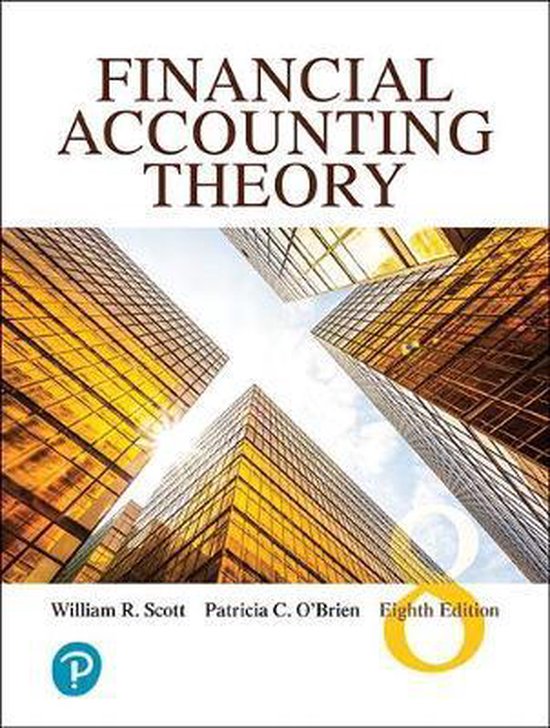
Solution Manual Financial
Accounting Theory 8th
Edition by William Scott
More than 60,000 Solution Manual and Test
Bank are available in our archive.
If you want full complete of this solution Manual, don’t hesitate to contact me:
Email:
WhatsApp: https://wa.me/message/2H3BV2L5TTSUF1
Telegram: https://t.me/solutionmanual
We can access any Solution Manual, Test Bank and E-Books.
Important: Our service is not available for these countries: Libya, Syria,
Yemen, Iran, North Korea, Venezuela, Myanmar, Cuba, Somalia,
, Scott, Financial Accounting Theory, 8th Edition Instructor’s Solutions Manual Chapter 1
CHAPTER 1
INTRODUCTION
1.1 The Objective of This Book
1.2 Some Historical Perspective
1.3 The 2007-2008 Market Meltdowns
1.4 Efficient Contracting
1.5 A Note on Ethical Behaviour
1.6 Rules-Based versus Principles-Based Accounting Standards
1.7 The Complexity of Information in Financial Accounting and Reporting
1.8 The Role of Accounting Research
1.9 The Importance of Information Asymmetry
1.10 The Fundamental Problem of Financial Accounting Theory
1.11 Regulation as a Reaction to the Fundamental Problem
1.12 The Organization of This Book
1.12.1 Ideal Conditions
1.12.2 Adverse Selection
1.12.3 Moral Hazard
1.12.4 Standard Setting
1.12.5 The Process of Standard Setting
1.13 Relevance of Financial Accounting Theory to Accounting Practice
1
, https://unihelp.xyz/solution-manual-for-financial-accounting-theory-william-scott/
Contact me on email () to access complete document, if you can't open/access/reach our si
Scott, Financial Accounting Theory, 8th Edition Instructor’s Solutions Manual Chapter 1
LEARNING OBJECTIVES AND SUGGESTED TEACHING APPROACHES
1. The Broad Outline of the Book
I use Figure 1.1 as a template to describe the broad outline of the book. Since the students
typically have not had a chance to read Chapter 1 in the first course session, I stick fairly
closely to the chapter material.
The major points I discuss are:
• Accounting in an ideal setting. Here, present-value-based accounting is
natural. I go over the ideal conditions needed for such a basis of accounting
to be feasible, but do not go into much detail because this topic is covered
in greater depth in Chapter 2.
• An introduction to the concept of information asymmetry and resulting
problems of adverse selection and moral hazard. These problems are basic
to the book and I feel it is desirable for the students to have a “first go” at
them at this point. I concentrate on the intuition underlying the two
problems. For example, adverse selection can be illustrated by asking who
would be first in line to purchase life insurance if there was no medical
examination, or what quality of used cars are likely to be brought to market.
For moral hazard I try to pin them down on how hard they would work in
this course if there were no exams.
• The environment in which financial accounting and reporting operates. My
main goal at this point is that the students do not take this environment for
granted. I discuss the procedures of standard setting briefly and point out
that this is really a process of regulation. In the past, there have been well-
known cases of deregulation, such as airlines, trucking, financial
institutions, power generation. However, regulation of financial institutions
increased following the 2007-2008 market meltdowns (Section 1.3).
Currently, at least in the United States, some of these regulations are being
rolled back. Instructors may wish to anticipate briefly the pros and cons of
2
Accounting Theory 8th
Edition by William Scott
More than 60,000 Solution Manual and Test
Bank are available in our archive.
If you want full complete of this solution Manual, don’t hesitate to contact me:
Email:
WhatsApp: https://wa.me/message/2H3BV2L5TTSUF1
Telegram: https://t.me/solutionmanual
We can access any Solution Manual, Test Bank and E-Books.
Important: Our service is not available for these countries: Libya, Syria,
Yemen, Iran, North Korea, Venezuela, Myanmar, Cuba, Somalia,
, Scott, Financial Accounting Theory, 8th Edition Instructor’s Solutions Manual Chapter 1
CHAPTER 1
INTRODUCTION
1.1 The Objective of This Book
1.2 Some Historical Perspective
1.3 The 2007-2008 Market Meltdowns
1.4 Efficient Contracting
1.5 A Note on Ethical Behaviour
1.6 Rules-Based versus Principles-Based Accounting Standards
1.7 The Complexity of Information in Financial Accounting and Reporting
1.8 The Role of Accounting Research
1.9 The Importance of Information Asymmetry
1.10 The Fundamental Problem of Financial Accounting Theory
1.11 Regulation as a Reaction to the Fundamental Problem
1.12 The Organization of This Book
1.12.1 Ideal Conditions
1.12.2 Adverse Selection
1.12.3 Moral Hazard
1.12.4 Standard Setting
1.12.5 The Process of Standard Setting
1.13 Relevance of Financial Accounting Theory to Accounting Practice
1
, https://unihelp.xyz/solution-manual-for-financial-accounting-theory-william-scott/
Contact me on email () to access complete document, if you can't open/access/reach our si
Scott, Financial Accounting Theory, 8th Edition Instructor’s Solutions Manual Chapter 1
LEARNING OBJECTIVES AND SUGGESTED TEACHING APPROACHES
1. The Broad Outline of the Book
I use Figure 1.1 as a template to describe the broad outline of the book. Since the students
typically have not had a chance to read Chapter 1 in the first course session, I stick fairly
closely to the chapter material.
The major points I discuss are:
• Accounting in an ideal setting. Here, present-value-based accounting is
natural. I go over the ideal conditions needed for such a basis of accounting
to be feasible, but do not go into much detail because this topic is covered
in greater depth in Chapter 2.
• An introduction to the concept of information asymmetry and resulting
problems of adverse selection and moral hazard. These problems are basic
to the book and I feel it is desirable for the students to have a “first go” at
them at this point. I concentrate on the intuition underlying the two
problems. For example, adverse selection can be illustrated by asking who
would be first in line to purchase life insurance if there was no medical
examination, or what quality of used cars are likely to be brought to market.
For moral hazard I try to pin them down on how hard they would work in
this course if there were no exams.
• The environment in which financial accounting and reporting operates. My
main goal at this point is that the students do not take this environment for
granted. I discuss the procedures of standard setting briefly and point out
that this is really a process of regulation. In the past, there have been well-
known cases of deregulation, such as airlines, trucking, financial
institutions, power generation. However, regulation of financial institutions
increased following the 2007-2008 market meltdowns (Section 1.3).
Currently, at least in the United States, some of these regulations are being
rolled back. Instructors may wish to anticipate briefly the pros and cons of
2