Outline and evaluate explanations for obedience
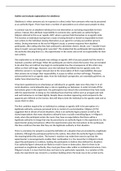
Obedience is when someone acts in response to a direct order from someone who may be perceived
as an authority figure. There have been a number of speculations as to what causes people to obey.
A common way for an obedient individual is to see themselves as not being responsible for their
actions. Instead, they attribute responsibility to someone else, particularly an authority figure.
Milgram referred to this as an ‘agentic shift’, where a person finds themselves in an agentic state.
This involves an individual moving from a state of seeing himself or herself as responsible for their
own actions to the individual viewing themselves as an agent for carrying out another person’s
wishes. During interviews at the end of Milgram’s study, a common response from obedient
participants, after asking why they had continued to administer electric shocks, was “I wouldn’t have
done it myself. I was just doing what I was told.” This implies that the participants felt responsible to
the authority directing them (i.e. the experimenter in the room) and so felt no responsibility for their
own actions.
One explanation as to why people may undergo an agentic shift is because people feel the need to
maintain a positive self-image. When the participants are told to shock the learner, they are tempted
to do what they are told but may begin to contemplate how the consequences of this action may
reflect on their self-image. However, once the individual has shifted into the agentic state, this
reflective concern is no longer relevant due to the renunciation of their responsibilities. Because
their actions are no longer their responsibility, it ceases to reflect on their self-image. Therefore,
actions performed in an agentic state, from the individual’s perspective, are essentially guilt-free, no
matter how inhumane they are.
It has been questioned as to what keeps an individual in an agentic state once they enter it. In all
social situations, social etiquette plays a role in regulating our behaviour. In order to break off the
instructions given in the experiment, the participants must breach the commitment they have made
with the experimenter. In doing so, the individual fears that they will be seen as arrogant and rude
and such behaviour is not taken lightly. Despite these emotions appearing small compared to the
apparent pain inflicted on the learner, they still help to bind the individual to the agentic state and so
causes them to obey.
The first condition required for an individual to undergo an agentic shift is the perception of a
legitimate authority, someone perceived to be in control of a social situation. Milgram (1974)
suggested that in almost all social situations, there is an authority figure present as well as the
shared expectations that many situations ordinarily have a socially controlling figure. In Milgram’s
study, when the participant enters the room, they have an expectations that there will be a
legitimate authority in charge that may be perceived as an authority figure in the experiment (i.e. the
experimenter giving instructions). When the experimenter gives the instructions to the participant,
this then reinforces the idea that they are the legitimate authority in that situation.
There is a tendency for people to accept the definition of a situation that are provided by a legitimate
authority. Although the participant performs the actions, they allow the authority figure to define
the meaning behind the actions. The learner’s reaction may make them want to quit but the
experimenter’s encouragements enables their continuation (i.e. the researcher in Milgram’s study
urged the participants to continue, leading the participants to believe they defined the situation).
If an authority figure’s demands are likely to result in harm or destruction, then for them to be
perceived as a legitimate authority, they must give these order within an institutional structure. From
Milgram’s study, it is clear that this does not have to be particularly reputable. In a variation of this
study, the experiment was moved to a rundown building where the study was to be carried out by
Obedience is when someone acts in response to a direct order from someone who may be perceived
as an authority figure. There have been a number of speculations as to what causes people to obey.
A common way for an obedient individual is to see themselves as not being responsible for their
actions. Instead, they attribute responsibility to someone else, particularly an authority figure.
Milgram referred to this as an ‘agentic shift’, where a person finds themselves in an agentic state.
This involves an individual moving from a state of seeing himself or herself as responsible for their
own actions to the individual viewing themselves as an agent for carrying out another person’s
wishes. During interviews at the end of Milgram’s study, a common response from obedient
participants, after asking why they had continued to administer electric shocks, was “I wouldn’t have
done it myself. I was just doing what I was told.” This implies that the participants felt responsible to
the authority directing them (i.e. the experimenter in the room) and so felt no responsibility for their
own actions.
One explanation as to why people may undergo an agentic shift is because people feel the need to
maintain a positive self-image. When the participants are told to shock the learner, they are tempted
to do what they are told but may begin to contemplate how the consequences of this action may
reflect on their self-image. However, once the individual has shifted into the agentic state, this
reflective concern is no longer relevant due to the renunciation of their responsibilities. Because
their actions are no longer their responsibility, it ceases to reflect on their self-image. Therefore,
actions performed in an agentic state, from the individual’s perspective, are essentially guilt-free, no
matter how inhumane they are.
It has been questioned as to what keeps an individual in an agentic state once they enter it. In all
social situations, social etiquette plays a role in regulating our behaviour. In order to break off the
instructions given in the experiment, the participants must breach the commitment they have made
with the experimenter. In doing so, the individual fears that they will be seen as arrogant and rude
and such behaviour is not taken lightly. Despite these emotions appearing small compared to the
apparent pain inflicted on the learner, they still help to bind the individual to the agentic state and so
causes them to obey.
The first condition required for an individual to undergo an agentic shift is the perception of a
legitimate authority, someone perceived to be in control of a social situation. Milgram (1974)
suggested that in almost all social situations, there is an authority figure present as well as the
shared expectations that many situations ordinarily have a socially controlling figure. In Milgram’s
study, when the participant enters the room, they have an expectations that there will be a
legitimate authority in charge that may be perceived as an authority figure in the experiment (i.e. the
experimenter giving instructions). When the experimenter gives the instructions to the participant,
this then reinforces the idea that they are the legitimate authority in that situation.
There is a tendency for people to accept the definition of a situation that are provided by a legitimate
authority. Although the participant performs the actions, they allow the authority figure to define
the meaning behind the actions. The learner’s reaction may make them want to quit but the
experimenter’s encouragements enables their continuation (i.e. the researcher in Milgram’s study
urged the participants to continue, leading the participants to believe they defined the situation).
If an authority figure’s demands are likely to result in harm or destruction, then for them to be
perceived as a legitimate authority, they must give these order within an institutional structure. From
Milgram’s study, it is clear that this does not have to be particularly reputable. In a variation of this
study, the experiment was moved to a rundown building where the study was to be carried out by