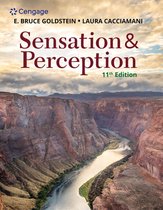
TEST BANK FOR SENSATION AND PERCEPTION 11TH EDITION BY E.
BRUCE GOLDSTEIN REVISED 100% CORRECT ANSWERS
(INCLUDES ESSAY QUESTIONS)
Test Bank—Chapter 1: Introduction to Perception
MULTIPLE CHOICE
1. “Perceiving machines” that can negotiate the environment with
humanlike ease
a. were developed by computer scientists in the 1960s.
b. were developed by computer scientists in the 1970s.
c. were developed by computer scientists in the 1990s.
d. have yet to be developed.
ANS: D
2. Which of the following is an application of perception research?
a. Developing speech recognition c. Devising robots that can “see.”
systems.
b. Treating hearing problems. d. All of these.
ANS: D
3. Which of the following is a reason for studying perception?
a. To become more aware of your own perceptual experiences.
b. To provide information that may help with a future career.
c. To apply perception to everyday problems, such as highway sign visibility.
d. All of these.
ANS: D
4. The study of perception can overlap with
a. medicine. c. philosophy.
b. computer science. d. all of these.
ANS: D
5. Which of the following is NOT a category of the stages in the perceptual process?
a. Stimuli c. Serendipity
b. Neural Processing d. Behavioral Responses
1
, ANS: C
6. The process of transforming energy in the environment into electrical energy in the neurons is
called
a. refraction. c. reduction.
b. transduction. d. construction.
ANS: B
7. is the step in the perceptual process that is analogous to an ATM withdrawal
(pressure from button press becomes electrical energy then becomes a mechanical response
resulting in the dispensing of money).
a. Knowledge c. Action
b. Transference d. Transduction
ANS: C
8. The specific term for the “stimulus on the receptors” in visual processing is the
a. transduced image. c. visual image.
b. environmental stimulus. d. perception.
ANS: C
9. The image projected on the retina is best described as a of the actual stimulus.
a. representation. c. replication.
b. environmental stimulus. d. scale model.
ANS: A
10. Which brain structure is responsible for creating perceptions and producing other “high” level
functions such as language, memory, and thinking?
a. Brain stem c. Hypothalamus
b. Cerebral cortex d. Occipital lobe
ANS: B
11. Visual form agnosia is a problem of the step of the perceptual process.
a. action c. transduction
b. attention d. Recognition
ANS: D
12. Which of the following best describes the steps of the perceptual process?
a. The steps are unidirectional, starting at the environmental stimulus and ending at
perception.
2
, b. The steps are unidirectional, starting at the environmental stimulus and ending at
knowledge.
c. The steps are unidirectional, starting at transduction and ending at recognition.
d. The sequence of steps is dynamic and constantly changing.
ANS: D
13. If a person sees the unambiguous “rat” stimulus, and then views the ambiguous “rat-man”
figure, the person will most likely report seeing
a. a rat, because of the effect of knowledge.
b. a man, because we tend to see things that match our species.
c. a rat, because of the effect of action.
d. a rat or a man equally.
ANS: A
14. Justin forgot to wear his glasses to class so the writing he sees on the chalk board is blurry.
Even so, he is sure it says “Pop Quiz!” because he knows that there are pop quizzes in the
class and he can see read the “P” and the “Q”. What allows him to read the board?
a. Bottom-up processing c. Top-down processing
b. Oblique processing d. Compression
ANS: C
15. processing is based on the stimuli reaching the receptors.
a. Bottom-up c. Top-down
b. Oblique d. Receptor
ANS: A
16. Trying to read a note written by someone with poor handwriting involves
a. only top-down processing.
b. only bottom-up processing.
c. both top-down and bottom-up processing.
d. only data-based processing.
ANS: C
17. The physiological level of analysis involves the relationship between
a. stimulus-and-physiology.
b. physiology-and-perception.
c. stimulus-and-perception.
d. both stimulus-and-physiology and physiology-and-perception.
ANS: D
18. Kimmy is casting shadows on the wall and watching whether her cat Tiger jumps at the
3
, shadows or not. She uses different hand motions to see if there is a difference in whether
Tiger jumps or not. Kimmy is informally studying which relationship?
a. the stimulus-physiology relationship c. the stimulus-perception relationship
b. the physiology-perception relationship d. all of these
ANS: C
19. Cognitive influences affect the level of analysis.
a. physiological c. both physiological and psychophysical
b. psychophysical d. neither physiological and
psychophysical
ANS: C
20. The psychophysical method in which stimuli of varying intensities are presented in ascending
and descending orders in discrete steps is called the method of
a. limits. c. searching.
b. constant stimuli. d. scaling.
ANS: A
21. When using the method of limits, the absolute threshold is determined by calculating
a. the stimulus intensity detected 50% of the time.
b. the stimulus intensity detected 75% of the time.
c. the stimulus intensity detected 100% of the time.
d. the average of the “cross-over” points.
ANS: D
22. The difference between the method of limits and the method of adjustment is that, in the
method of adjustment, stimulus intensity is changed in a manner.
a. stepwise c. continuous
b. bivariate d. Discrete
ANS: C
23. Of the three classical psychophysical methods, the method of constant stimuli
a. is most accurate, but takes the most amount of time.
b. is least accurate, but is the fastest.
c. is the fastest and most accurate method.
d. is the least accurate and takes the most amount of time.
ANS: A
24. As used in the textbook, the “DL” is the abbreviation for
a. detection level. c. descending limit.
b. differenze limen. d. determinant logarithm.
4
, ANS: B
25. Using Weber’s Law, if the DL for a 100 gram weight standard is 2 grams, then the DL when
using a 200 gram standard would be grams.
a. 0.02 c. 4
b. 2 d. 50
ANS: C
26. The Weber’s fraction for electric shock is , and for light intensity.
a. 0.01; 0.08 c. 0.02; 0.02
b. 0.08; 0.01 d. 0.08; 0.08
ANS: A
27. The “S” in the Weber fraction stands for:
a. sensation c. standard stimulus
b. synapse d. Somatic
ANS: A
28. Demetri is a participant in an auditory detection study using the method of constant stimuli.
He never detects the 10 unit tone. He detects the 20 unit tone 25% of the trials. He detects the
30 unit tone 50% of the trials. He detects the 40 unit tone 80% of the trials. He detects the 50
unit tone 95% of the trials. His threshold for hearing tones would be taken as the
a. 15 unit tone. c. 30 unit tone.
b. 20 unit tone. d. 55 unit tone.
ANS: C
29. A soup company wants to develop a “reduced-salt” version of their traditional minestrone.
Which of the following would be the best first step to take?
a. find taste-testers who have agnosia
b. measure the amount of “cross-talk” using the method of adjustment
c. determine the absolute threshold for salty taste using the method of limits
d. determine the Weber’s fraction for salty taste
ANS: D
30. Which of the following methods are used to measure the quantitative relationship between the
stimulus and perception?
a. description c. reflection
b. the phenomenological method d. classical psychophysical methods
5
, ANS: D
31. Fechner’s psychophysical methods
a. are important from a historical perspective, but are no longer used in
contemporary research.
b. were developed in the early 1960s.
c. showed that mental activity cannot be measured quantitatively.
d. are currently used to test a person’s hearing and vision.
ANS: A
32. The first step in the procedure for is to present the participant a “standard
stimulus” and assign a numerical value to that stimulus.
a. the method of limits c. the method of adjustment
b. the method of constant stimuli d. magnitude estimation
ANS: D
33. Response in a magnitude estimation experiment when doubling the stimulus
intensity LESS than doubles the subjective magnitude of the stimulus.
a. accretion c. regression
b. compression d. Expansion
ANS: B
34. To double the perceived brightness of a light, you need to multiply the physical intensity of
the light by about 9. This is an example of response
a. compression. c. linearity.
b. expansion. d. inversion.
ANS: A
35. Stevens’s Power Law is so named because
a. it is the best psychophysical law that has ever been theorized.
b. the law explains why electrical power in the brain is responsible for perception.
c. it explains how electrical signals in the retina are involved in transduction.
d. the stimulus intensity is raised to a specific exponent to predict perceived
magnitude. ** (page 16-17; conceptual)
ANS: D
36. Stevens’s Power Law
a. accurately describes vision, but not any other modality.
b. accurately describes audition and vision, but not the skin senses.
6
BRUCE GOLDSTEIN REVISED 100% CORRECT ANSWERS
(INCLUDES ESSAY QUESTIONS)
Test Bank—Chapter 1: Introduction to Perception
MULTIPLE CHOICE
1. “Perceiving machines” that can negotiate the environment with
humanlike ease
a. were developed by computer scientists in the 1960s.
b. were developed by computer scientists in the 1970s.
c. were developed by computer scientists in the 1990s.
d. have yet to be developed.
ANS: D
2. Which of the following is an application of perception research?
a. Developing speech recognition c. Devising robots that can “see.”
systems.
b. Treating hearing problems. d. All of these.
ANS: D
3. Which of the following is a reason for studying perception?
a. To become more aware of your own perceptual experiences.
b. To provide information that may help with a future career.
c. To apply perception to everyday problems, such as highway sign visibility.
d. All of these.
ANS: D
4. The study of perception can overlap with
a. medicine. c. philosophy.
b. computer science. d. all of these.
ANS: D
5. Which of the following is NOT a category of the stages in the perceptual process?
a. Stimuli c. Serendipity
b. Neural Processing d. Behavioral Responses
1
, ANS: C
6. The process of transforming energy in the environment into electrical energy in the neurons is
called
a. refraction. c. reduction.
b. transduction. d. construction.
ANS: B
7. is the step in the perceptual process that is analogous to an ATM withdrawal
(pressure from button press becomes electrical energy then becomes a mechanical response
resulting in the dispensing of money).
a. Knowledge c. Action
b. Transference d. Transduction
ANS: C
8. The specific term for the “stimulus on the receptors” in visual processing is the
a. transduced image. c. visual image.
b. environmental stimulus. d. perception.
ANS: C
9. The image projected on the retina is best described as a of the actual stimulus.
a. representation. c. replication.
b. environmental stimulus. d. scale model.
ANS: A
10. Which brain structure is responsible for creating perceptions and producing other “high” level
functions such as language, memory, and thinking?
a. Brain stem c. Hypothalamus
b. Cerebral cortex d. Occipital lobe
ANS: B
11. Visual form agnosia is a problem of the step of the perceptual process.
a. action c. transduction
b. attention d. Recognition
ANS: D
12. Which of the following best describes the steps of the perceptual process?
a. The steps are unidirectional, starting at the environmental stimulus and ending at
perception.
2
, b. The steps are unidirectional, starting at the environmental stimulus and ending at
knowledge.
c. The steps are unidirectional, starting at transduction and ending at recognition.
d. The sequence of steps is dynamic and constantly changing.
ANS: D
13. If a person sees the unambiguous “rat” stimulus, and then views the ambiguous “rat-man”
figure, the person will most likely report seeing
a. a rat, because of the effect of knowledge.
b. a man, because we tend to see things that match our species.
c. a rat, because of the effect of action.
d. a rat or a man equally.
ANS: A
14. Justin forgot to wear his glasses to class so the writing he sees on the chalk board is blurry.
Even so, he is sure it says “Pop Quiz!” because he knows that there are pop quizzes in the
class and he can see read the “P” and the “Q”. What allows him to read the board?
a. Bottom-up processing c. Top-down processing
b. Oblique processing d. Compression
ANS: C
15. processing is based on the stimuli reaching the receptors.
a. Bottom-up c. Top-down
b. Oblique d. Receptor
ANS: A
16. Trying to read a note written by someone with poor handwriting involves
a. only top-down processing.
b. only bottom-up processing.
c. both top-down and bottom-up processing.
d. only data-based processing.
ANS: C
17. The physiological level of analysis involves the relationship between
a. stimulus-and-physiology.
b. physiology-and-perception.
c. stimulus-and-perception.
d. both stimulus-and-physiology and physiology-and-perception.
ANS: D
18. Kimmy is casting shadows on the wall and watching whether her cat Tiger jumps at the
3
, shadows or not. She uses different hand motions to see if there is a difference in whether
Tiger jumps or not. Kimmy is informally studying which relationship?
a. the stimulus-physiology relationship c. the stimulus-perception relationship
b. the physiology-perception relationship d. all of these
ANS: C
19. Cognitive influences affect the level of analysis.
a. physiological c. both physiological and psychophysical
b. psychophysical d. neither physiological and
psychophysical
ANS: C
20. The psychophysical method in which stimuli of varying intensities are presented in ascending
and descending orders in discrete steps is called the method of
a. limits. c. searching.
b. constant stimuli. d. scaling.
ANS: A
21. When using the method of limits, the absolute threshold is determined by calculating
a. the stimulus intensity detected 50% of the time.
b. the stimulus intensity detected 75% of the time.
c. the stimulus intensity detected 100% of the time.
d. the average of the “cross-over” points.
ANS: D
22. The difference between the method of limits and the method of adjustment is that, in the
method of adjustment, stimulus intensity is changed in a manner.
a. stepwise c. continuous
b. bivariate d. Discrete
ANS: C
23. Of the three classical psychophysical methods, the method of constant stimuli
a. is most accurate, but takes the most amount of time.
b. is least accurate, but is the fastest.
c. is the fastest and most accurate method.
d. is the least accurate and takes the most amount of time.
ANS: A
24. As used in the textbook, the “DL” is the abbreviation for
a. detection level. c. descending limit.
b. differenze limen. d. determinant logarithm.
4
, ANS: B
25. Using Weber’s Law, if the DL for a 100 gram weight standard is 2 grams, then the DL when
using a 200 gram standard would be grams.
a. 0.02 c. 4
b. 2 d. 50
ANS: C
26. The Weber’s fraction for electric shock is , and for light intensity.
a. 0.01; 0.08 c. 0.02; 0.02
b. 0.08; 0.01 d. 0.08; 0.08
ANS: A
27. The “S” in the Weber fraction stands for:
a. sensation c. standard stimulus
b. synapse d. Somatic
ANS: A
28. Demetri is a participant in an auditory detection study using the method of constant stimuli.
He never detects the 10 unit tone. He detects the 20 unit tone 25% of the trials. He detects the
30 unit tone 50% of the trials. He detects the 40 unit tone 80% of the trials. He detects the 50
unit tone 95% of the trials. His threshold for hearing tones would be taken as the
a. 15 unit tone. c. 30 unit tone.
b. 20 unit tone. d. 55 unit tone.
ANS: C
29. A soup company wants to develop a “reduced-salt” version of their traditional minestrone.
Which of the following would be the best first step to take?
a. find taste-testers who have agnosia
b. measure the amount of “cross-talk” using the method of adjustment
c. determine the absolute threshold for salty taste using the method of limits
d. determine the Weber’s fraction for salty taste
ANS: D
30. Which of the following methods are used to measure the quantitative relationship between the
stimulus and perception?
a. description c. reflection
b. the phenomenological method d. classical psychophysical methods
5
, ANS: D
31. Fechner’s psychophysical methods
a. are important from a historical perspective, but are no longer used in
contemporary research.
b. were developed in the early 1960s.
c. showed that mental activity cannot be measured quantitatively.
d. are currently used to test a person’s hearing and vision.
ANS: A
32. The first step in the procedure for is to present the participant a “standard
stimulus” and assign a numerical value to that stimulus.
a. the method of limits c. the method of adjustment
b. the method of constant stimuli d. magnitude estimation
ANS: D
33. Response in a magnitude estimation experiment when doubling the stimulus
intensity LESS than doubles the subjective magnitude of the stimulus.
a. accretion c. regression
b. compression d. Expansion
ANS: B
34. To double the perceived brightness of a light, you need to multiply the physical intensity of
the light by about 9. This is an example of response
a. compression. c. linearity.
b. expansion. d. inversion.
ANS: A
35. Stevens’s Power Law is so named because
a. it is the best psychophysical law that has ever been theorized.
b. the law explains why electrical power in the brain is responsible for perception.
c. it explains how electrical signals in the retina are involved in transduction.
d. the stimulus intensity is raised to a specific exponent to predict perceived
magnitude. ** (page 16-17; conceptual)
ANS: D
36. Stevens’s Power Law
a. accurately describes vision, but not any other modality.
b. accurately describes audition and vision, but not the skin senses.
6