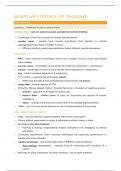
ADAPTIVE CONTROL OF THOUGHT
MIND (THAGARD)
CHAPTER 1 – REPRESENTATION & COMPUTATION
Cognitive science – main aim: explain how people accomplish various kinds of thinking
Knowledge in the mind consists of mental representations
Cognitive science – people have mental procedures that operate on mental
representations to produce thought & action
Different kinds of mental representations foster different mental procedures
BEGINNINGS
Plato – most important knowledge comes from concepts such as virtue that people
know innately
Descartes, Leibniz – knowledge can be gained by thinking & reasoning (= rationalism)
Aristotle – knowledge in terms of rules learned from experience (= empiricism)
Kant – tried to combine rationalism & empiricism
19th century – experimental psychology (Wundt)
Within few decades it was dominated by behaviourism (J.B. Watson)
George Miller – limited capacity of STM
McCarthy, Minsky, Newell, Simon – founded field of AI + founders of cognitive science
McCarthy – approach to AI based on formal logic
Newell & Simon – showed power of rules for accounting for aspects of human
intelligence
Minsky – concept like frames are central form of knowledge representations
1980s – rise of connectionist theories of mental representation & processing
METHODS IN COGNITIVE SCIENCE
Today – primary method: experimentation with human participants
Theory without experiment is empty & experiment without theory is blind
Developing theoretical framework
Forming & testing computational models intended to be analogous to mental
operations
Controlled experiments (brain scanning techniques OR observing performance of
people with brain damage)
Cognitive anthropology – how do thoughts work in different cultural settings
Main method: ethnography – requires living & interacting with members of a
culture
Best way to grasp complexity of human thinking – use multiple methods
, THE COMPUTATIONAL-REPRESENTATIONAL UNDERSTANDING OF MIND (CRUM)
Central hypothesis – thinking can best be understood in terms of representational
structures in the mind & computational procedures that operate on those structures
CRUM – most theoretically & experimentally successful approach to mind
Compares minds with computers – better than previous metaphors
Program Mind
Data structures + algorithms = Mental rep. + computational procedures =
running programs thinking
Connectionists – neurons & their connections as inspirations for data structures
CRUM works with complex 3-way analogy among mind, brain & computers
No single computational model of the mind
Computers Brain
Serial processors – perform one instruction at Parallel processors – doing many operations
a time at once
THEORIES, MODELS & PROGRAMS
Important to distinguish between 4 crucial elements
Cognitive theory – set of representational structures & set of processes that operate
on these structures
Computational model – makes these structures & processes more precise by
interpreting them by analogy with computer programs that consist of data
structures & algorithms
To test model it must be implemented in a software program in a programming
language
This program may run on a variety of hardware platforms
Theory-, model- & program development and evaluation often go hand in hand
Running program – contributes to evaluation of model & theory in 3 ways
Helps to show that postulated representations & processes are computationally
realisable
Shows psychological plausibility by being applied qualitatively to various
examples of thinking
More detailed fit between theory & human thinking by being used quantitatively
to generate detailed predictions about human thinking that can be compared with
results of psychological experiments
EVALUATING APPROACHES TO MENTAL REPRESENTATIONS
MIND (THAGARD)
CHAPTER 1 – REPRESENTATION & COMPUTATION
Cognitive science – main aim: explain how people accomplish various kinds of thinking
Knowledge in the mind consists of mental representations
Cognitive science – people have mental procedures that operate on mental
representations to produce thought & action
Different kinds of mental representations foster different mental procedures
BEGINNINGS
Plato – most important knowledge comes from concepts such as virtue that people
know innately
Descartes, Leibniz – knowledge can be gained by thinking & reasoning (= rationalism)
Aristotle – knowledge in terms of rules learned from experience (= empiricism)
Kant – tried to combine rationalism & empiricism
19th century – experimental psychology (Wundt)
Within few decades it was dominated by behaviourism (J.B. Watson)
George Miller – limited capacity of STM
McCarthy, Minsky, Newell, Simon – founded field of AI + founders of cognitive science
McCarthy – approach to AI based on formal logic
Newell & Simon – showed power of rules for accounting for aspects of human
intelligence
Minsky – concept like frames are central form of knowledge representations
1980s – rise of connectionist theories of mental representation & processing
METHODS IN COGNITIVE SCIENCE
Today – primary method: experimentation with human participants
Theory without experiment is empty & experiment without theory is blind
Developing theoretical framework
Forming & testing computational models intended to be analogous to mental
operations
Controlled experiments (brain scanning techniques OR observing performance of
people with brain damage)
Cognitive anthropology – how do thoughts work in different cultural settings
Main method: ethnography – requires living & interacting with members of a
culture
Best way to grasp complexity of human thinking – use multiple methods
, THE COMPUTATIONAL-REPRESENTATIONAL UNDERSTANDING OF MIND (CRUM)
Central hypothesis – thinking can best be understood in terms of representational
structures in the mind & computational procedures that operate on those structures
CRUM – most theoretically & experimentally successful approach to mind
Compares minds with computers – better than previous metaphors
Program Mind
Data structures + algorithms = Mental rep. + computational procedures =
running programs thinking
Connectionists – neurons & their connections as inspirations for data structures
CRUM works with complex 3-way analogy among mind, brain & computers
No single computational model of the mind
Computers Brain
Serial processors – perform one instruction at Parallel processors – doing many operations
a time at once
THEORIES, MODELS & PROGRAMS
Important to distinguish between 4 crucial elements
Cognitive theory – set of representational structures & set of processes that operate
on these structures
Computational model – makes these structures & processes more precise by
interpreting them by analogy with computer programs that consist of data
structures & algorithms
To test model it must be implemented in a software program in a programming
language
This program may run on a variety of hardware platforms
Theory-, model- & program development and evaluation often go hand in hand
Running program – contributes to evaluation of model & theory in 3 ways
Helps to show that postulated representations & processes are computationally
realisable
Shows psychological plausibility by being applied qualitatively to various
examples of thinking
More detailed fit between theory & human thinking by being used quantitatively
to generate detailed predictions about human thinking that can be compared with
results of psychological experiments
EVALUATING APPROACHES TO MENTAL REPRESENTATIONS