C464 WGU EXAM STUDY GUIDE WITH COMPLETE SOLUTIONS
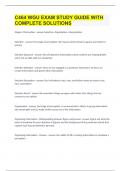
Stages of Perception Selection, Organization, Interpretation Selection First stage of perception. We choose which stimuli to ignore and which to process Selective Exposure We will attend to information which confirms our existing beliefs and is not at odds with our viewpoints Selective Attention Once we are engaged in a particular interaction, we focus on certain information and ignore other information Selective Perception Our inclination to see, hear, and believe what we want to see, hear, and believe Selective Recall We remember things we agree with rather than things that are contrary to our beliefs Organization 2nd stage of perception. A communicator's efforts to group information into meaningful units to make further sense out of the information Organizing Information - Distinguishing between figure and ground Figure out what the point of emphasis for your attention is (figure) and the background of the particular stimuli that capture your focused attention (ground) Organizing Information - Closure Our ability to fill in missing information to complete a perception Organizing Information - Proximity Organizing information based on its proximity in relation to other information Organizing Information - Similarity Organizing information based on its similarity, or the degree to which something shares attributes with other stimuli Interpretation The 3rd stage of perception. We assign meaning to stimuli Perception Modifiers BIOLOGICAL (height, sense of smell, eyesight) PAST EXPERIENCES (family, education, relationships) IDENTITY (Cultural and group affiliations) CURRENT INTERNAL STATES (hungry, tired, confident, well-rested, etc) Self-concept The way you define yourself. Groups we're a part of, roles we play, relationships and experiences we have Self-esteem The degree to which you approve of, value, and like the concept that you have of yourself Attribution errors Common mistakes people make in perceiving events, messages, and people. The two primary types are the fundamental attribution error and the self-serving bias Fundamental Attribution errors The mistake of attributing other people's positive characteristics to external, situation favors, and their negative characteristics and failures to aspects of who they are Locus of Causation Refers to whether a communicator's behavior was motivated by an internal state such as intelligence, compassion, or honesty, or instead motivated by an external factor such as resources, luck, favoritism, or the situation, Self-serving Bias We attribute our failures to external factors and our successes to internal positive qualities. Self-presentation The strategic development and use of verbal and nonverbal messages that result in others making conclusions about the kind of individual you are. We can influence how others perceive us by selecting the impressions we want to make and communication in ways that will help us accomplish that. Impression Management The deliberate use of verbal and nonverbal messages to create a particular impression among others. Four Steps for Effective Self-Presentation Set a goal, create a strategy, execute the strategy and evaluate the results, modify negative perceptions Culture a seat of learned or shared behaviors, values, or practices associated with a community of people Co-cultures A smaller culture which fits inside an umbrella culture like Democrats, southerners, stay-at-home moms, Christians Individualism vs. Collectivism Whether a society values strong individuals or values their membership in their particular in-group High context vs low-context communication Whether communication relies heavily on environmental cues (high-context) vs explicit or clear verbal messages (low-context) High power distance vs low power distance Whether a culture values power and rank (high power distance) or depends more on equality (low power distance) Monochronic vs. Polychronic Time Monochronic people tend to like doing one thing at a time, being punctual, and concentrating fully to meet their commitments. Polychronic people tend to like working on multiple things at one time. They change plans and priorities easily, and the border between work and personal time is fluid for them. Rich media Media which comes close to simulating face-to-face communication Lean media Media which relies mostly on text and permits little or no exchange of affect, instant feedback, or important nonverbal clues Role-taking the skill that allows communicators to figuratively stand in one another's shoes and assume one another's social roles and perspective. Denotative meanings The universal or dictionary definitions of words that groups agree on Connotative meanings Contextual meanings that we associate with words, meanings that often express some kind of value beyond the commonly agreed upon definition Concrete words Refer to tangible objects - car, rock, boat Abstract words Refer to intangibles - honor, love, moral God terms Words that trigger positive and desirable feelings Devil terms Words that trigger negativity and may incite angry action Bias-free language language which is sensitive to others' sex, race, age, physical condition, and other characteristics Verbal immediacy Verbally immediate people are viewed by others as warm, friendly, accepting, approachable, and understanding Kinesics The study of body movements, including posture, gestures, and facial expressions Emblems Nonverbal movements that substitute for words and verbalization. Hold a hand up for "stop", giving the "thumbs up" symbol to suggest that all is well Illustrators Movements that accompany or reinforce the meaning of a verbal code, like shaking our head to tell someone "no" or nodding our head to say "yes" Affect displays Nonverbal movements that reveal emotion. Slumped shoulders, minimal eye contact may indicate sadness.
Escuela, estudio y materia
- Institución
- Columbia International University
- Grado
- WGU C464 - Introduction to Communication
Información del documento
- Subido en
- 15 de septiembre de 2023
- Número de páginas
- 10
- Escrito en
- 2023/2024
- Tipo
- Examen
- Contiene
- Preguntas y respuestas
Temas
-
c464 wgu

Documento también disponible en un lote