Gerontology Primary Care Exam Review| Guide with Verified Answers (2023/ 202 4 Newly Updated) Q: Non ulcer dyspepsia Answer: called functional dyspepsia characterized by indgiestion with no obvious cause Q: Chornic Gastritis Answer: inflammation of inner lining of stomach secondary to mucos - al injury usually asymptomatic but may manifest as epigastric pain, heartburn, N/V and anorexia and weight loss Q: Esophageal cancer Answer: malignant cells with in esophagus. s/s can inclu de heart - burn dysphagia. Q: Esophegal spasm/stricture Answer: abnormal narrowing of the esophageal lumen, dysphagia is common s/s Q: Cholecycstitis Answer: inflammation of gall bladder characterized by abd pain n/v and fever Q: Hiatal hernia Answer: prolapse d portion of stomach through diaphragmatic esophageal hiatus, heart burn common s/s Q: IBS Answer: chronic disorder results from disordered sensation or abnormal function of small intestine and large intestine. Although not associated with serious medica l consequences it does significancy impact individual quality of life. Q: Risk factors for IBS Answer: female 35 -50yrs, family hx, trauma, stress, emotional, small intestine bacterial overgrowth. Q: Characteristics of IBS Answer: alteration in bowel habits, abd pain with diarrhea with or without constipation. or painless diarrhea Q: Dx criteria for IBS Answer: Recurrent abd pain (on average > 1 day per week in 3 months). with the onset of >6 months before dx. Pain in abd must be associated with two of the foll owing: - Change stool frequency - change in appearance - pain related to pooping

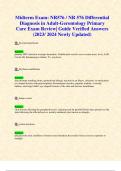
Final Exam: Midterm Exam: NR576 / NR 576 Differential Diagnosis in Adult-Gerontology Primary Care Exam Review| Guide with Verified Answers (2023/ 2024 Newly Updated) -Chamberlain
Final Exam: Midterm Exam: NR576 / NR 576 Differential Diagnosis in Adult-Gerontology Primary Care Exam Review| Guide with Verified Answers (2023/ 2024 Newly Updated) Q: Non ulcer dyspepsia Answer: called functional dyspepsia characterized by indgiestion with no obvious cause Q: Chornic Gastritis Answer: inflammation of inner lining of stomach secondary to mucos- al injury usually asymptomatic but may manifest as epigastric pain, heartburn, N/V and anorexia and weight loss Q: Esophageal cancer Answer: malignant cells with in esophagus. s/s can include heart- burn dysphagia. Q: Esophegal spasm/stricture Answer: abnormal narrowing of the esophageal lumen, dysphagia is common s/s Q: Cholecycstitis Answer: inflammation of gall bladder characterized by abd pain n/v and fever Q: Hiatal hernia Answer: prolapsed portion of stomach through diaphragmatic esophageal hiatus, heart burn common s/s Q: IBS Answer: chronic disorder results from disordered sensation or abnormal function of small intestine and large intestine. Although not associated with serious medical consequences it does significancy impact individual quality of life. Q: Risk factors for IBS Answer: female 35-50yrs, family hx, trauma, stress, emotional, small intestine bacterial overgrowth. Q: Characteristics of IBS Answer: alteration in bowel habits, abd pain with diarrhea with or without constipation. or painless diarrhea Q: Dx criteria for IBS Answer: Recurrent abd pain (on average > 1 day per week in 3 months). with the onset of >6 months before dx. Pain in abd must be associated with two of the following: - Change stool frequency - change in appearance - pain related to pooping Q: Patient cannot have any of the following to be dx with IBS Answer: unintentional weight loss > 50yrs w/o colon cancer screening recent change bowel habits hematochezia or melena: GI bleeding nocturnal pain in abd or stool passage Hx IBD or colorectal cancer in family Palpable abd mass or presence of lymphaednopathy + fecal occult blood blood test show anemia Q: Tx for IBS Answer: there is no "prove" treatment therapy is aimed at symptom manage- ment. -Antidiarrheal -Stimulant laxatives - Linaclotide (linzess) - Plecanatide (trulance) -Bentyl -Hycosamine Q: Rx for IBS-C medicaiton Answer: work by acting locally on apical membrane of GI tract to increase intestinal fluid secretion and improve fecal transport. These medications are: Linaclotide (Linzeess) and Plecanatide (trulance) Q: Antispasmodics for tx of IBS Answer: abd caused by intestinal spasm can be con- trolled with favorable results. These medications are used for postprandial pain and can be treated with dicyclomine (Bentyl) 10-20mg TID or QID PRN or you can use Hycocyamine 0.125mg - 0.75mg BID antidepressants: tricyclic antidepressants and SSRI
Escuela, estudio y materia
- Institución
- Chamberlain College Of Nursing
- Grado
- NR 576/ NR 576 (NR576)
Información del documento
- Subido en
- 5 de agosto de 2023
- Número de páginas
- 9
- Escrito en
- 2023/2024
- Tipo
- Examen
- Contiene
- Preguntas y respuestas
Temas
-
nr 576 nr576 latest
-
nr 576 nr576 week 1
-
nr 576 nr576 latest
-
nr 576 nr576 week
-
nr 576 nr576 latest
-
nr 576 nr576 week 1
-
nr 576 nr576 latest
-
nr 576 nr576 week 2
-
nr 576 nr576 latest
-
nr 576 nr576
Vista previa del contenido
Gerontology Primary Care Exam Review| Guide with Verified Answers (2023/ 202 4 Newly Updated) Q: Non ulcer dyspepsia Answer: called functional dyspepsia characterized by indgiestion with no obvious cause Q: Chornic Gastritis Answer: inflammation of inner lining of stomach secondary to mucos - al injury usually asymptomatic but may manifest as epigastric pain, heartburn, N/V and anorexia and weight loss Q: Esophageal cancer Answer: malignant cells with in esophagus. s/s can inclu de heart - burn dysphagia. Q: Esophegal spasm/stricture Answer: abnormal narrowing of the esophageal lumen, dysphagia is common s/s Q: Cholecycstitis Answer: inflammation of gall bladder characterized by abd pain n/v and fever Q: Hiatal hernia Answer: prolapse d portion of stomach through diaphragmatic esophageal hiatus, heart burn common s/s Q: IBS Answer: chronic disorder results from disordered sensation or abnormal function of small intestine and large intestine. Although not associated with serious medica l consequences it does significancy impact individual quality of life. Q: Risk factors for IBS Answer: female 35 -50yrs, family hx, trauma, stress, emotional, small intestine bacterial overgrowth. Q: Characteristics of IBS Answer: alteration in bowel habits, abd pain with diarrhea with or without constipation. or painless diarrhea Q: Dx criteria for IBS Answer: Recurrent abd pain (on average > 1 day per week in 3 months). with the onset of >6 months before dx. Pain in abd must be associated with two of the foll owing: - Change stool frequency - change in appearance - pain related to pooping
Documento también disponible en un lote