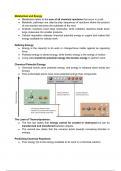
Metabolism and Energy
● Metabolism refers to the sum of all chemical reactions that occur in a cell.
● Metabolic pathways are step-by-step sequences of reactions where the product
of one reaction becomes the substrate of the next.
● Anabolic reactions build large molecules, while catabolic reactions break down
large molecules into smaller products.
● Cellular respiration releases chemical potential energy in sugars and makes that
energy available for cellular work.
Defining Energy:
● Energy is the capacity to do work or change/move matter against an opposing
force.
● Potential energy is stored energy, while kinetic energy is the energy of motion.
● Living cells transform potential energy into kinetic energy to perform work.
Chemical Potential Energy:
● Chemical bonds store potential energy, and energy is released when bonds are
formed.
● Free (unbonded) atoms have more potential energy than compounds.
The Laws of Thermodynamics:
● The first law states that energy cannot be created or destroyed but can be
transformed and transferred between objects.
● The second law states that the universe tends towards increasing disorder or
entropy.
Predicting Chemical Reactions:
● Free energy (G) is the energy available to do work in a chemical reaction.
● Metabolism refers to the sum of all chemical reactions that occur in a cell.
● Metabolic pathways are step-by-step sequences of reactions where the product
of one reaction becomes the substrate of the next.
● Anabolic reactions build large molecules, while catabolic reactions break down
large molecules into smaller products.
● Cellular respiration releases chemical potential energy in sugars and makes that
energy available for cellular work.
Defining Energy:
● Energy is the capacity to do work or change/move matter against an opposing
force.
● Potential energy is stored energy, while kinetic energy is the energy of motion.
● Living cells transform potential energy into kinetic energy to perform work.
Chemical Potential Energy:
● Chemical bonds store potential energy, and energy is released when bonds are
formed.
● Free (unbonded) atoms have more potential energy than compounds.
The Laws of Thermodynamics:
● The first law states that energy cannot be created or destroyed but can be
transformed and transferred between objects.
● The second law states that the universe tends towards increasing disorder or
entropy.
Predicting Chemical Reactions:
● Free energy (G) is the energy available to do work in a chemical reaction.