Other Functions and Disorders of the Excretory System
Apart from filtering wastes from the blood, the kidneys perform additional homeostatic
functions and can be affected by various disorders. Here's an overview:
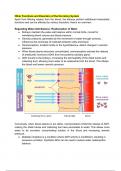
Regulating Water-Salt Balance: Reabsorption of Water
● Kidneys maintain the water-salt balance within normal limits, crucial for
maintaining blood volume and blood pressure.
● Osmotic pressure, generated by the movement of water through osmosis,
influences the exchange of materials between cells and blood.
● Osmoreceptors, located mostly in the hypothalamus, detect changes in osmotic
pressure.
● When blood plasma becomes concentrated, osmoreceptors activate the release
of antidiuretic hormone (ADH) from the posterior pituitary gland.
● ADH travels to the kidneys, increasing the permeability of the distal tubule and
collecting duct, allowing more water to be reabsorbed into the blood. This dilutes
the blood and lowers osmotic pressure.
Conversely, when blood plasma is too dilute, osmoreceptors inhibit the release of ADH,
making the distal tubule and collecting duct less permeable to water. This allows more
water to be excreted, concentrating solutes in the blood and increasing osmotic
pressure.
● Diabetes insipidus is a condition where ADH activity is insufficient, resulting in
excessive urination. Synthetic ADH can be used to restore water reabsorption
balance.
Apart from filtering wastes from the blood, the kidneys perform additional homeostatic
functions and can be affected by various disorders. Here's an overview:
Regulating Water-Salt Balance: Reabsorption of Water
● Kidneys maintain the water-salt balance within normal limits, crucial for
maintaining blood volume and blood pressure.
● Osmotic pressure, generated by the movement of water through osmosis,
influences the exchange of materials between cells and blood.
● Osmoreceptors, located mostly in the hypothalamus, detect changes in osmotic
pressure.
● When blood plasma becomes concentrated, osmoreceptors activate the release
of antidiuretic hormone (ADH) from the posterior pituitary gland.
● ADH travels to the kidneys, increasing the permeability of the distal tubule and
collecting duct, allowing more water to be reabsorbed into the blood. This dilutes
the blood and lowers osmotic pressure.
Conversely, when blood plasma is too dilute, osmoreceptors inhibit the release of ADH,
making the distal tubule and collecting duct less permeable to water. This allows more
water to be excreted, concentrating solutes in the blood and increasing osmotic
pressure.
● Diabetes insipidus is a condition where ADH activity is insufficient, resulting in
excessive urination. Synthetic ADH can be used to restore water reabsorption
balance.