DNA Replication - Explanation & Study Guide
DNA replication is the process of copying one DNA molecule into two identical
molecules. It occurs during the cell cycle, which is the life cycle of a cell. Through
an experiment conducted by Matthew Meselson and Franklin Stahl, it was
determined that DNA replicates in a semi-conservative manner.
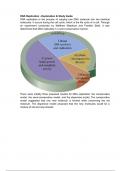
There were initially three proposed models for DNA replication: the conservative
model, the semi-conservative model, and the dispersive model. The conservative
model suggested that one new molecule is formed while conserving the old
molecule. The dispersive model proposed that the new molecules would be a
mixture of old and new strands.
,
DNA replication is the process of copying one DNA molecule into two identical
molecules. It occurs during the cell cycle, which is the life cycle of a cell. Through
an experiment conducted by Matthew Meselson and Franklin Stahl, it was
determined that DNA replicates in a semi-conservative manner.
There were initially three proposed models for DNA replication: the conservative
model, the semi-conservative model, and the dispersive model. The conservative
model suggested that one new molecule is formed while conserving the old
molecule. The dispersive model proposed that the new molecules would be a
mixture of old and new strands.
,