Samenvatting Analyse + Finance + OPM
Analyse
Les 1
Simulation is: an imitation of a system
- Experimentation with a simplified imitation (on a computer) of a ... system as it
progresses through time, for the purpose of better understanding and/or improving
that system.
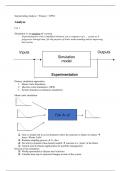
Inputs Outputs
Simulation
model
Experimentation
Primary simulation approaches
1. Monte Carlo Simulation
2. Discrete-event simulation (=DES)
3. System dynamics (continuous simulation)
Monte carlo simulation
f (a, b, c)
q Aim: to model risk in an environment where the outcome is subject to chance
hence ‘Monte Carlo’
q Random sampling process f.i. dice
q Not always dynamic (time-based) models outcome is a ‘point’ in the future
q Typical used in finance applications for portfolio management
Discrete event simulation
q World represented as Queues and Activities
q Variable time step to represent changes in state of the system
, q Used for modelling queuing systems e.g. airports, banks, manufacturing plant, call
centres, ports, computer systems...
q Main focus of this course!
Contentious simulation
q World represented by Stocks (f.i. population) and Flows (f.i. birth rate)
q Need to model time continuously
q Constant (small) time step (Δt) to approximate continuous time
q Typical used in business strategy/policy and more general continuous simulation in
science and engineering
Nine step approach:
1. Define the problem -> is there a problem, top down, tackle problem
2. Set the goals -> goal needs to be clear, focus during every step, opinion
3. Describe the system -> maximaze profit
4. Collect data and information
5. Built a model
6. Verify and validate
7. Experiment
8. Analyze the results
9. Documentation and presentation
Advantages simulation
- Cost, time and control
- Transparent, models variability
- Visualization, knowledge
Disadvantages
- Expensive
- Data hungry
- Overconfidence
Vereenvoudiging van de werkelijkheid -> nooit 100%
Discrete-Event Simulation (DES)?
q Time is modelled in discrete steps of variable length.
q The simulation updates whenever there is a change of state in the system.
q The system is modelled as series of events
q DES is used for modelling queuing systems
Simulatie planning om output te verhogen
- Variability -> predective and unpredictve
- Interconnectedness -> connected to other sources of variability
- Complexity -> number of combinations
Input: arrivals -> outputs: throughput
Random numbers
- Uniform = zelfde kans elk nummer
Frequency
- Independent = als nummer gekozen is, kans dat nog een (%)
x gekozen wordt even groot
- Computer = random door de computer 30
20
, Frequentietabel maken of
PDF maken met x en percentage grafiek
Voorbeeld met nummer = 0,3
Table standard normal distribution: 0,3 gives z = -0.52
x−μ
z= → x=μ+ z × σ
σ
x=5−0,52× 1=4,48
Simple linear congruential random number generator
Xi+1 = aXi + c (mod m)
where:
Xi: stream of random numbers (integer) on interval (0, m-1)
a: multiplier constant
c: additive constant
m:modulus; mod m means take the remainder having divided by m
les 2
simulation modeling -> content of simulation model
- Level of abstraction
- Conceptual modelling
Analyse
Les 1
Simulation is: an imitation of a system
- Experimentation with a simplified imitation (on a computer) of a ... system as it
progresses through time, for the purpose of better understanding and/or improving
that system.
Inputs Outputs
Simulation
model
Experimentation
Primary simulation approaches
1. Monte Carlo Simulation
2. Discrete-event simulation (=DES)
3. System dynamics (continuous simulation)
Monte carlo simulation
f (a, b, c)
q Aim: to model risk in an environment where the outcome is subject to chance
hence ‘Monte Carlo’
q Random sampling process f.i. dice
q Not always dynamic (time-based) models outcome is a ‘point’ in the future
q Typical used in finance applications for portfolio management
Discrete event simulation
q World represented as Queues and Activities
q Variable time step to represent changes in state of the system
, q Used for modelling queuing systems e.g. airports, banks, manufacturing plant, call
centres, ports, computer systems...
q Main focus of this course!
Contentious simulation
q World represented by Stocks (f.i. population) and Flows (f.i. birth rate)
q Need to model time continuously
q Constant (small) time step (Δt) to approximate continuous time
q Typical used in business strategy/policy and more general continuous simulation in
science and engineering
Nine step approach:
1. Define the problem -> is there a problem, top down, tackle problem
2. Set the goals -> goal needs to be clear, focus during every step, opinion
3. Describe the system -> maximaze profit
4. Collect data and information
5. Built a model
6. Verify and validate
7. Experiment
8. Analyze the results
9. Documentation and presentation
Advantages simulation
- Cost, time and control
- Transparent, models variability
- Visualization, knowledge
Disadvantages
- Expensive
- Data hungry
- Overconfidence
Vereenvoudiging van de werkelijkheid -> nooit 100%
Discrete-Event Simulation (DES)?
q Time is modelled in discrete steps of variable length.
q The simulation updates whenever there is a change of state in the system.
q The system is modelled as series of events
q DES is used for modelling queuing systems
Simulatie planning om output te verhogen
- Variability -> predective and unpredictve
- Interconnectedness -> connected to other sources of variability
- Complexity -> number of combinations
Input: arrivals -> outputs: throughput
Random numbers
- Uniform = zelfde kans elk nummer
Frequency
- Independent = als nummer gekozen is, kans dat nog een (%)
x gekozen wordt even groot
- Computer = random door de computer 30
20
, Frequentietabel maken of
PDF maken met x en percentage grafiek
Voorbeeld met nummer = 0,3
Table standard normal distribution: 0,3 gives z = -0.52
x−μ
z= → x=μ+ z × σ
σ
x=5−0,52× 1=4,48
Simple linear congruential random number generator
Xi+1 = aXi + c (mod m)
where:
Xi: stream of random numbers (integer) on interval (0, m-1)
a: multiplier constant
c: additive constant
m:modulus; mod m means take the remainder having divided by m
les 2
simulation modeling -> content of simulation model
- Level of abstraction
- Conceptual modelling