Week 1
Qualitative Research: using words as data that is collected and analyzed.
Paradigm: refers to the beliefs, assumptions, values, and practices shared by the research
community that provides an overarching framework for research.
Methodology: refers to the framework within which our research is conducted
Methods: the way in which data is collected. Realism: assumes a knowable world that is
comprehensible through research.
Relativism: assumes multiple constructed realities, rather than a single mind- independent truth.
Critical Realism: knowledge is viewed as socially influenced and reflects a separate reality that can
only be partially accessed.
Positivism: assumesa singular truth; a straightforward relationship between the world and our
perception.
Constructivism: argues that knowledge is objective and that what we know of the world doesn't
reflect its true nature.
Contextualism: sees knowledge as emerging from contexts instead of a singular reality.
Reflexivity: the process of critically reflecting on the knowledge we produce, and our role in
producing that knowledge.
Functional reflexivity: involves giving critical attention to the way our research tools and process
may have influenced the research.
Personal reflexivity: makes the researcher a part of the research process whereby they can impact
the production of knowledge.
Saturation: the point when additional data fails to generate new information.
Chapter 1
What do you need to become qualitative research?
- Eyes and ears
o Listening to people they give you the data you use
o How they behave and react
- Interest in process and meaning
o Curiosity
o How do people behave? What does a commercial mean to people?
- Critical approach to life and knowledge
o Why? How?
- Reflexivity
o Reflect on your own role
- Good interaction skills
What is qualitative research
- Words are used as data
- Meanings
o What people feel
o Understanding and interpretation of how people feel
- Rich data
o Dive deep into what people are thinking
o verstehen
- Theory generating
o Developing a new theory/insides
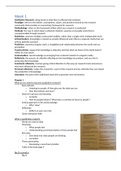
- Table in the book page 4
Big Q vs small q
- Big Q
, o Paradigm
Quantitate doesn’t exists
o Perspective
o Full research circle is qualitative
- Small q
o Techniques
o Mixed methods
o Parts of research circle are qualitative
Chapter 2
10 fundamentals of qualitative research
1. QR is about meaning, not about numbers
2. QR doesn’t provide a single answer or single truth
3. QR treats context as important
4. QR can be experiential or critical, there is not a single
approach or method, and different forms have
different purposes
5. QR is underpinned by ontological assumptions
a. Continuum
b. Relativism – realism image
6. QR is underpinned by epistemological assumptions
a. Constructionism – positivism image
7. QR involves a qualitative methodology
8. QR uses all sorts of data
a. Should be rich data
b. Linked to the purpose of research
9. QR involves thinking qualitatively
10. QR values subjectivity and reflexivity SUPER IMPORTANT DEFFO AN EXAM QUESTION
a. Subjectivity important for the exam
i. 2 levels
1. Data (what the interview tells me), individual perspective
2. interpretation the data from the researcher
b. Reflexivity important for the exam
i. Reflect on the subjectivity
ii. You are part of the research, reflect the part you play on the
interview/analysis
Chapter 3
Step 1: Create RQ
- Scope and rational
- Formulate RQ
- Fit within qualitative RQs aims and objectives
- Match to methods and theory
- Implication of research topics and questions
Step 2: Sampling
- Sample size: how many people we need
o We do not know how many samples we need before hand
- Saturation important for the exam
- Sampling strategy
o Purposive sampling
o Snowball sampling
Step 3: Recruiting participants
Qualitative Research: using words as data that is collected and analyzed.
Paradigm: refers to the beliefs, assumptions, values, and practices shared by the research
community that provides an overarching framework for research.
Methodology: refers to the framework within which our research is conducted
Methods: the way in which data is collected. Realism: assumes a knowable world that is
comprehensible through research.
Relativism: assumes multiple constructed realities, rather than a single mind- independent truth.
Critical Realism: knowledge is viewed as socially influenced and reflects a separate reality that can
only be partially accessed.
Positivism: assumesa singular truth; a straightforward relationship between the world and our
perception.
Constructivism: argues that knowledge is objective and that what we know of the world doesn't
reflect its true nature.
Contextualism: sees knowledge as emerging from contexts instead of a singular reality.
Reflexivity: the process of critically reflecting on the knowledge we produce, and our role in
producing that knowledge.
Functional reflexivity: involves giving critical attention to the way our research tools and process
may have influenced the research.
Personal reflexivity: makes the researcher a part of the research process whereby they can impact
the production of knowledge.
Saturation: the point when additional data fails to generate new information.
Chapter 1
What do you need to become qualitative research?
- Eyes and ears
o Listening to people they give you the data you use
o How they behave and react
- Interest in process and meaning
o Curiosity
o How do people behave? What does a commercial mean to people?
- Critical approach to life and knowledge
o Why? How?
- Reflexivity
o Reflect on your own role
- Good interaction skills
What is qualitative research
- Words are used as data
- Meanings
o What people feel
o Understanding and interpretation of how people feel
- Rich data
o Dive deep into what people are thinking
o verstehen
- Theory generating
o Developing a new theory/insides
- Table in the book page 4
Big Q vs small q
- Big Q
, o Paradigm
Quantitate doesn’t exists
o Perspective
o Full research circle is qualitative
- Small q
o Techniques
o Mixed methods
o Parts of research circle are qualitative
Chapter 2
10 fundamentals of qualitative research
1. QR is about meaning, not about numbers
2. QR doesn’t provide a single answer or single truth
3. QR treats context as important
4. QR can be experiential or critical, there is not a single
approach or method, and different forms have
different purposes
5. QR is underpinned by ontological assumptions
a. Continuum
b. Relativism – realism image
6. QR is underpinned by epistemological assumptions
a. Constructionism – positivism image
7. QR involves a qualitative methodology
8. QR uses all sorts of data
a. Should be rich data
b. Linked to the purpose of research
9. QR involves thinking qualitatively
10. QR values subjectivity and reflexivity SUPER IMPORTANT DEFFO AN EXAM QUESTION
a. Subjectivity important for the exam
i. 2 levels
1. Data (what the interview tells me), individual perspective
2. interpretation the data from the researcher
b. Reflexivity important for the exam
i. Reflect on the subjectivity
ii. You are part of the research, reflect the part you play on the
interview/analysis
Chapter 3
Step 1: Create RQ
- Scope and rational
- Formulate RQ
- Fit within qualitative RQs aims and objectives
- Match to methods and theory
- Implication of research topics and questions
Step 2: Sampling
- Sample size: how many people we need
o We do not know how many samples we need before hand
- Saturation important for the exam
- Sampling strategy
o Purposive sampling
o Snowball sampling
Step 3: Recruiting participants