PART I
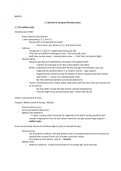
1. The search for a new framework (1450-1650)
Those two centuries in which major shifts in global power and economic relations started and gave
way to revolutions (French revolution, American revolution, Haitian revolution) to political
modernity.
- Crumbling of the impact of Christian cosmology and emergence of science
- Transition from feudal principalities to absolutism
- Slow and gradual emergence of capitalism (new economic relationships)
- End of the catholic hegemony (emergence of science).
→ period of European history known as Renaissance (started in Italy and spread across Europe)
Renaissance:
- The revival of European thought / a period defined by the flourishing of the arts and literature
based on Antiquity.
- After “dark” Middle Ages, a period of rebirth.
- The demise of the feudal system
- Emergence of new economic relationships form 1650 on = birth of capitalism
- Discovery of new countries and continents with the growth of shipping + new
scientific insights
→ Thus, one should look at the concept of Renaissance globally (Europe was becoming modern
mostly through trade and contact with non European countries.)
1.1. The end of Catholic Hegemony
The ecclesiastical ideology (Catholic hegemony) does not survive the period 1450-1650.
Why?
- Science began to free itself from religious supervision → replacing faith with rational inquiry
- The secularization of the scientific enterprise slowly gave rise to various sub-sciences.
But,
- Catholicism was not only challenged by science, it had to face up to a major religious
movement, Protestantism (major impact on European history and on shaping modern political
ideas), that thoroughly changed Christianity.
,→ The emancipation of science for religion and church was a long process wrought with tensions and
conflicts.
Protestantism
A. Luther (1483-1546)
- University, already a conflict - scholastics vs. humanists
- Humansists: Intellectual movement that expresses a new self-awareness of the human
mind in which love for man and nature are central.
- Scholastics: Based on dogmatic arguments and reasoning.
- BUT, Luther rejects both principles and focuses on the direct search for God.
- Took the whole theology of the Church under fire → NO need for Church
→ Religious radicalism: Religious liberation of man, the creation of a direct bond between the individual
and God, w/o the intervention of an ecclesiastical institution.
→ Obrigkeit: No concrete state system or organization but all believers must submit to a strong
authority.
- German princes, knights, traders and farmers supported Luther for political and economic
reasons - ideal ally → his ideas were embedded with German social and national aspirations.
“An earthly kingdom cannot exist without inequality. Some must be free, others must be serves, some
must be rulers, and others must be subjects”.
→ attempt of a peasant’s revolution BUT Luther rejects the idea of any social revolution
- Advises the princes to crack down on the peasants
- The princes destroyed the peasant’s uprising resulting in 100,000 deaths.
Conclusion:
- Pioneer of a larger German community
- Economic utility is subordinate to the moral ruel
- Production for the sake of production and profit was prohibited
- Christinaity has nothing to do with politics
→ A unifier of the German community but did not hardly make any contribution to the birth of
capitalism and mercantilism.
B. Calvin (1509-1564)
- Radicalized Luther’s vision → man was destined to hell or heaven (God guides everything from
the start)
- Moral and political power (in Geneva) through his Ordonnances ecclésiastiques and Ordonnances
, sur le régime du peuple
- Profit/Early capitalist
- Live in the fear of God and banish pleasure SO money could only be spent in a useful
way → as capital
- Calvin rejected the Catholic ban on interest but regulated the use of interests by strict
ethical rule
- Government consisted of Ministry and Consistory
- Ministry: Disciplined group of protestants thinkers who spread Calvin’s doctrine
- Consistories: Ficntioned as a sort of court in order to investigate complaitns about
morality and to pronounce punishments
→ questions about morality were turned into legal matter subject to the power of the
administration
- Theocracy
- Worship of God - an institution that wanted to perfect mankind to be able to worship
God
Effects of his influence/ideas/rule:
“Calvin's dictatorial theocratic regime that did not tolerate contradiction or deviation was paradoxically
also the breeding ground for a gradual development of individual freedom and political individualism.
The medieval hierarchical order gradually gave way to an equal obligation to the Law. The worship of
God and piety no longer depended on the social origin of an individual, but on the degree to which he
realizes himself labor. The place a person occupies in society no longer derives from birth.” !!!
C. Munzer (1525)
- Anabaptists
Halfway through the 17th century, the Christian Roman Empire in Europe was shattered.
- The Catholic Church saw its authority declining in large parts of the continent but especially in
England and Germany.
- This was painfully illustrated in 1527 when the “Landsknechte” (mercenary soldiers) of Charles
V went to Rome because their wages had not been paid on time = the Holy City was looted and
set on fire.
1. The search for a new framework (1450-1650)
Those two centuries in which major shifts in global power and economic relations started and gave
way to revolutions (French revolution, American revolution, Haitian revolution) to political
modernity.
- Crumbling of the impact of Christian cosmology and emergence of science
- Transition from feudal principalities to absolutism
- Slow and gradual emergence of capitalism (new economic relationships)
- End of the catholic hegemony (emergence of science).
→ period of European history known as Renaissance (started in Italy and spread across Europe)
Renaissance:
- The revival of European thought / a period defined by the flourishing of the arts and literature
based on Antiquity.
- After “dark” Middle Ages, a period of rebirth.
- The demise of the feudal system
- Emergence of new economic relationships form 1650 on = birth of capitalism
- Discovery of new countries and continents with the growth of shipping + new
scientific insights
→ Thus, one should look at the concept of Renaissance globally (Europe was becoming modern
mostly through trade and contact with non European countries.)
1.1. The end of Catholic Hegemony
The ecclesiastical ideology (Catholic hegemony) does not survive the period 1450-1650.
Why?
- Science began to free itself from religious supervision → replacing faith with rational inquiry
- The secularization of the scientific enterprise slowly gave rise to various sub-sciences.
But,
- Catholicism was not only challenged by science, it had to face up to a major religious
movement, Protestantism (major impact on European history and on shaping modern political
ideas), that thoroughly changed Christianity.
,→ The emancipation of science for religion and church was a long process wrought with tensions and
conflicts.
Protestantism
A. Luther (1483-1546)
- University, already a conflict - scholastics vs. humanists
- Humansists: Intellectual movement that expresses a new self-awareness of the human
mind in which love for man and nature are central.
- Scholastics: Based on dogmatic arguments and reasoning.
- BUT, Luther rejects both principles and focuses on the direct search for God.
- Took the whole theology of the Church under fire → NO need for Church
→ Religious radicalism: Religious liberation of man, the creation of a direct bond between the individual
and God, w/o the intervention of an ecclesiastical institution.
→ Obrigkeit: No concrete state system or organization but all believers must submit to a strong
authority.
- German princes, knights, traders and farmers supported Luther for political and economic
reasons - ideal ally → his ideas were embedded with German social and national aspirations.
“An earthly kingdom cannot exist without inequality. Some must be free, others must be serves, some
must be rulers, and others must be subjects”.
→ attempt of a peasant’s revolution BUT Luther rejects the idea of any social revolution
- Advises the princes to crack down on the peasants
- The princes destroyed the peasant’s uprising resulting in 100,000 deaths.
Conclusion:
- Pioneer of a larger German community
- Economic utility is subordinate to the moral ruel
- Production for the sake of production and profit was prohibited
- Christinaity has nothing to do with politics
→ A unifier of the German community but did not hardly make any contribution to the birth of
capitalism and mercantilism.
B. Calvin (1509-1564)
- Radicalized Luther’s vision → man was destined to hell or heaven (God guides everything from
the start)
- Moral and political power (in Geneva) through his Ordonnances ecclésiastiques and Ordonnances
, sur le régime du peuple
- Profit/Early capitalist
- Live in the fear of God and banish pleasure SO money could only be spent in a useful
way → as capital
- Calvin rejected the Catholic ban on interest but regulated the use of interests by strict
ethical rule
- Government consisted of Ministry and Consistory
- Ministry: Disciplined group of protestants thinkers who spread Calvin’s doctrine
- Consistories: Ficntioned as a sort of court in order to investigate complaitns about
morality and to pronounce punishments
→ questions about morality were turned into legal matter subject to the power of the
administration
- Theocracy
- Worship of God - an institution that wanted to perfect mankind to be able to worship
God
Effects of his influence/ideas/rule:
“Calvin's dictatorial theocratic regime that did not tolerate contradiction or deviation was paradoxically
also the breeding ground for a gradual development of individual freedom and political individualism.
The medieval hierarchical order gradually gave way to an equal obligation to the Law. The worship of
God and piety no longer depended on the social origin of an individual, but on the degree to which he
realizes himself labor. The place a person occupies in society no longer derives from birth.” !!!
C. Munzer (1525)
- Anabaptists
Halfway through the 17th century, the Christian Roman Empire in Europe was shattered.
- The Catholic Church saw its authority declining in large parts of the continent but especially in
England and Germany.
- This was painfully illustrated in 1527 when the “Landsknechte” (mercenary soldiers) of Charles
V went to Rome because their wages had not been paid on time = the Holy City was looted and
set on fire.