Principles of finance summary
Chapter 1, 2 and 3
CHAPTER ONE (accounting, information for decision making)
The primary objective of accounting
To provide information that is useful for decision-making purpose. The final product of accounting
information is the decision that is enhanced by the use of that information, whether owners,
management, creditors, governmental regulatory bodies, labor unions or the many other groups that
have an interest in the financial performance of an enterprise make the decision.
The language of business
Because accounting is widely used to describe all types of business activity. Cost, prices, sales
volume, profits and return on investment are all accounting measurements.
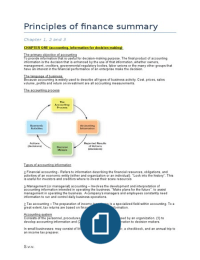
The accounting process
Types of accounting information
> Financial accounting - Refers to information describing the financial resources, obligations, and
activities of an economic entity (either and organization or an individual). ‘’Look into the history’’. This
is useful for investors and creditors where to invest their scare resources
> Management (or managerial) accounting – Involves the development and interpretation of
accounting information intended in operating the business. ‘’Make plans for the future’’. to assist
management in operating the business. A company’s managers and employees constantly need
information to run and control daily business operations.
> Tax accounting – The preparation of income tax returns is a specialized field within accounting. To a
great extent, tax returns are based on financial accounting information.
Accounting system
Consists of the personnel, procedures, technology, and records used by an organization. (1) to
develop accounting information and (2) to communicate this information to decision makers.
In small businesses: may consist of little more than a cash register, a checkbook, and an annual trip to
an income tax preparer.
S.v.v.
,In large businesses: it includes computers, highly trained personnel, and accounting reports that affect
the daily operations of every department.
The basic purpose of the account system: is to meet the organization’s needs for information as
efficiently as possible.
Information system
The system produces the information presented in the middle of the diagram. Financial position,
profitability and cash flows, this information meets the needs of users of the information: investors,
managers, creditors et cetera. It supports many kinds of financial decisions. Performance evaltuations
and resource allocation among others.
Information System
Information Financial Decisions
Users Information Supported
Ÿ Investors Provided Ÿ Performance
Ÿ Creditors Ÿ Proftability evaluations
Ÿ Managers Ÿ Financial Ÿ Stock
Ÿ Owners position investments
Ÿ Customers Ÿ Cash fows Ÿ Tax strategies
Ÿ Employees Ÿ Labor
Ÿ Regulators relations
- SEC Ÿ Resource
- IRS allocations
- FTC Ÿ Lending
decisions
Ÿ Borrowing
1-6
Accounting systems must be cost effective
That is, the value of the information produced should exceed the cost of producing it. Management
has no choice but to produce the types of accounting reports required by law or contract. But in other
cases management may use ‘cost effectiveness’ as a criterion for deciding whether or not to produce
certain information.
Basic functions of an accounting system
In developing information about the activities of a business, every accounting system performs the
following basic functions.
1. interpret an record business transactions.
2. Classify the effects of similar transactions in a manner that permits determination of the
various totals and subtotals useful to management and used in accounting reports.
3. Summarize and communicate the information contained in the system to decision makers.
Internal control
Is a process designed to provide reasonable assurance that the organization produces reliable
financial reports, complies with applicable (voldoen aan) law and regulations, and conducts (leiden) its
operations in an efficient and effective manner
S.v.v.
,The five components of internal control
Control environment – is the foundation for all the other elements of internal control, setting
the overall tone for the organization. Factors that effect the company’s control environment:
1. The organization’s commitment to integrity and ethical values
2. The independence of the board of directors from management, and the board’s
oversight of internal control.
3. Management assignment with board oversight, of appropriate levels of authority
and responsibility.
4. Organizational commitments to attract, develop, and retain competent individuals.
5. Individuals being held accountable for the performance of their control
responsibilities.
Risk assessment – involves identifying, analyzing and managing those risks that pose a threat
to the achievement of the organization’s objectives.
Control activities – are the policies and procedures that management puts in place to address
the risks identified during the risk assessment process.
Information and communication – involves developing information systems to capture and
communicate operational, financial, and compliance-related information necessary to run the
business.
Monitoring activities – all internal control systems have to be monitored (checked). They
enable the company to evaluate the effectiveness of its system of internal control over time.
External users of accounting information (financial accounting information)
Are individuals and other enterprises that have a current or potential financial interest in the reporting
enterprise, but that are not involved in the day-to-day operations of that enterprise.
External Users of Accounting
Information
• Owners
• Creditors
• Potential investors
• Labor unions
• Governmental agencies
• Suppliers
• Customers
• Trade associations
• General public
1-10
Two groups primarily use external financial reporting:
1. Investors – individuals and other enterprises that own the reporting enterprise.
2. Creditors – Individuals and other enterprises to whom the reporting entity owes money.
Objectives of external financial reporting
If I invest in a company is would be interested in:
S.v.v.
, The return of my investment – I would be interested in the return to me at some future dat of
the amount I had invested or loaned.
The return on my investment – I would expect the company to pay me something for the use
of my funds, either as an owner or a creditor.
Read it from the bottom up (general to specific)
Objectives of External Financial
Reporting
Provide specifc information about
economic resources, claims to resources,
and changes in resources and claims.
Provide information useful in assessing
amount, timing and uncertainty of future
cash fows.
Provide general information useful in
making investment and credit decisions.
1-11
Financial statement
Is simply a monetary declaration of what is believed to be true about an enterprise.
The primary financial statements are:
Balance sheet (statement of financial position) – is a position statement that shows where the
company stands in financial terms at a specific date. (A=L+O.E.)
Income statement (Profit & Loss statement) – is an activity statement that shows details and
results of the company’s profit-related activities for a period of time (month, quarter or year).
Revenues – expenses = net income (retained earnings)
Statement of cash flows – is an activity statement that shows the details of the company’s
activities involving cash during a period of time (month, quarter or year).
S.v.v.
Chapter 1, 2 and 3
CHAPTER ONE (accounting, information for decision making)
The primary objective of accounting
To provide information that is useful for decision-making purpose. The final product of accounting
information is the decision that is enhanced by the use of that information, whether owners,
management, creditors, governmental regulatory bodies, labor unions or the many other groups that
have an interest in the financial performance of an enterprise make the decision.
The language of business
Because accounting is widely used to describe all types of business activity. Cost, prices, sales
volume, profits and return on investment are all accounting measurements.
The accounting process
Types of accounting information
> Financial accounting - Refers to information describing the financial resources, obligations, and
activities of an economic entity (either and organization or an individual). ‘’Look into the history’’. This
is useful for investors and creditors where to invest their scare resources
> Management (or managerial) accounting – Involves the development and interpretation of
accounting information intended in operating the business. ‘’Make plans for the future’’. to assist
management in operating the business. A company’s managers and employees constantly need
information to run and control daily business operations.
> Tax accounting – The preparation of income tax returns is a specialized field within accounting. To a
great extent, tax returns are based on financial accounting information.
Accounting system
Consists of the personnel, procedures, technology, and records used by an organization. (1) to
develop accounting information and (2) to communicate this information to decision makers.
In small businesses: may consist of little more than a cash register, a checkbook, and an annual trip to
an income tax preparer.
S.v.v.
,In large businesses: it includes computers, highly trained personnel, and accounting reports that affect
the daily operations of every department.
The basic purpose of the account system: is to meet the organization’s needs for information as
efficiently as possible.
Information system
The system produces the information presented in the middle of the diagram. Financial position,
profitability and cash flows, this information meets the needs of users of the information: investors,
managers, creditors et cetera. It supports many kinds of financial decisions. Performance evaltuations
and resource allocation among others.
Information System
Information Financial Decisions
Users Information Supported
Ÿ Investors Provided Ÿ Performance
Ÿ Creditors Ÿ Proftability evaluations
Ÿ Managers Ÿ Financial Ÿ Stock
Ÿ Owners position investments
Ÿ Customers Ÿ Cash fows Ÿ Tax strategies
Ÿ Employees Ÿ Labor
Ÿ Regulators relations
- SEC Ÿ Resource
- IRS allocations
- FTC Ÿ Lending
decisions
Ÿ Borrowing
1-6
Accounting systems must be cost effective
That is, the value of the information produced should exceed the cost of producing it. Management
has no choice but to produce the types of accounting reports required by law or contract. But in other
cases management may use ‘cost effectiveness’ as a criterion for deciding whether or not to produce
certain information.
Basic functions of an accounting system
In developing information about the activities of a business, every accounting system performs the
following basic functions.
1. interpret an record business transactions.
2. Classify the effects of similar transactions in a manner that permits determination of the
various totals and subtotals useful to management and used in accounting reports.
3. Summarize and communicate the information contained in the system to decision makers.
Internal control
Is a process designed to provide reasonable assurance that the organization produces reliable
financial reports, complies with applicable (voldoen aan) law and regulations, and conducts (leiden) its
operations in an efficient and effective manner
S.v.v.
,The five components of internal control
Control environment – is the foundation for all the other elements of internal control, setting
the overall tone for the organization. Factors that effect the company’s control environment:
1. The organization’s commitment to integrity and ethical values
2. The independence of the board of directors from management, and the board’s
oversight of internal control.
3. Management assignment with board oversight, of appropriate levels of authority
and responsibility.
4. Organizational commitments to attract, develop, and retain competent individuals.
5. Individuals being held accountable for the performance of their control
responsibilities.
Risk assessment – involves identifying, analyzing and managing those risks that pose a threat
to the achievement of the organization’s objectives.
Control activities – are the policies and procedures that management puts in place to address
the risks identified during the risk assessment process.
Information and communication – involves developing information systems to capture and
communicate operational, financial, and compliance-related information necessary to run the
business.
Monitoring activities – all internal control systems have to be monitored (checked). They
enable the company to evaluate the effectiveness of its system of internal control over time.
External users of accounting information (financial accounting information)
Are individuals and other enterprises that have a current or potential financial interest in the reporting
enterprise, but that are not involved in the day-to-day operations of that enterprise.
External Users of Accounting
Information
• Owners
• Creditors
• Potential investors
• Labor unions
• Governmental agencies
• Suppliers
• Customers
• Trade associations
• General public
1-10
Two groups primarily use external financial reporting:
1. Investors – individuals and other enterprises that own the reporting enterprise.
2. Creditors – Individuals and other enterprises to whom the reporting entity owes money.
Objectives of external financial reporting
If I invest in a company is would be interested in:
S.v.v.
, The return of my investment – I would be interested in the return to me at some future dat of
the amount I had invested or loaned.
The return on my investment – I would expect the company to pay me something for the use
of my funds, either as an owner or a creditor.
Read it from the bottom up (general to specific)
Objectives of External Financial
Reporting
Provide specifc information about
economic resources, claims to resources,
and changes in resources and claims.
Provide information useful in assessing
amount, timing and uncertainty of future
cash fows.
Provide general information useful in
making investment and credit decisions.
1-11
Financial statement
Is simply a monetary declaration of what is believed to be true about an enterprise.
The primary financial statements are:
Balance sheet (statement of financial position) – is a position statement that shows where the
company stands in financial terms at a specific date. (A=L+O.E.)
Income statement (Profit & Loss statement) – is an activity statement that shows details and
results of the company’s profit-related activities for a period of time (month, quarter or year).
Revenues – expenses = net income (retained earnings)
Statement of cash flows – is an activity statement that shows the details of the company’s
activities involving cash during a period of time (month, quarter or year).
S.v.v.