Marketing
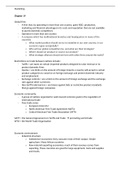
Chapter 19
Global firm:
- A firm that, by operating in more than one country, gains R&D, production,
marketing and financial advantages in its costs and reputation that are not available
to purely domestic competitors
- Operates in more than one country
- A company which has multinational branches and headquarters in many of the
countries
o What market position should we try to establish in our own country, in our
econonic region and globally?
o Who will our global competitors be, and what are their strategies?
o Where should we produce or source our product?
o What strategic alliances should we form with other firms around the world?
Restrictions on trade between nations include:
- Tariffs = are taxes on certain imported products designed to raise revenue or to
protect domestic firms
- Quotas = are limits on the amount of foreign imports a country will accept in certain
product categories to conserve on foreign exchange and protect domestic industry
and employment
- Exchange controls = are a limit on the amount of foreign exchange and the exchange
rate against other currencies
- Non-tariff trade barriers = are biases against bids or restrictive product standards
that go against foreign companies
Economic community:
- A group of nations organized to work toward common goals in the regulation of
international trade
- Free-trade zones
o European Union EU
o North American Free Trade Agreement NAFTA
o Central American Free Trade Association CAFTA
GATT = the General Agreement on Tariffs and Trade promoting world trade
WTO = the World Trade Organisation
Economic environment:
- Industrial structure
o Subsistence economies: they consume most of their output. Simple
agriculture. Many African countries
o Raw material exporting economies: much of their revenue comes from
exporting. These countries are good for large equipment, tools and supplies
and trucks.
Chapter 19
Global firm:
- A firm that, by operating in more than one country, gains R&D, production,
marketing and financial advantages in its costs and reputation that are not available
to purely domestic competitors
- Operates in more than one country
- A company which has multinational branches and headquarters in many of the
countries
o What market position should we try to establish in our own country, in our
econonic region and globally?
o Who will our global competitors be, and what are their strategies?
o Where should we produce or source our product?
o What strategic alliances should we form with other firms around the world?
Restrictions on trade between nations include:
- Tariffs = are taxes on certain imported products designed to raise revenue or to
protect domestic firms
- Quotas = are limits on the amount of foreign imports a country will accept in certain
product categories to conserve on foreign exchange and protect domestic industry
and employment
- Exchange controls = are a limit on the amount of foreign exchange and the exchange
rate against other currencies
- Non-tariff trade barriers = are biases against bids or restrictive product standards
that go against foreign companies
Economic community:
- A group of nations organized to work toward common goals in the regulation of
international trade
- Free-trade zones
o European Union EU
o North American Free Trade Agreement NAFTA
o Central American Free Trade Association CAFTA
GATT = the General Agreement on Tariffs and Trade promoting world trade
WTO = the World Trade Organisation
Economic environment:
- Industrial structure
o Subsistence economies: they consume most of their output. Simple
agriculture. Many African countries
o Raw material exporting economies: much of their revenue comes from
exporting. These countries are good for large equipment, tools and supplies
and trucks.