100% de satisfacción garantizada Inmediatamente disponible después del pago Tanto en línea como en PDF No estas atado a nada 4.2 TrustPilot
logo-home
Examen

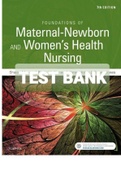
Exam (elaborations) TEST BANK Foundations of Maternal-Newborn & Women’s Health Nursing 7th Edition

Puntuación
4.2
(9)
Vendido
37
Páginas
417
Grado
A+
Subido en
27-10-2021
Escrito en
2021/2022

TEST BANK with Complete Questions and Solutions. To clarify, this is the TEST BANK, not the textbook. You get immediate access to download your test bank. You will receive a complete test bank; in other words, all chapters will be there. Test banks come in PDF format; therefore, you do not need specialized software to open them. Exam (elaborations) TEST BANK Foundations of Maternal-Newborn & Women’s Health Nursing 7th Edition Chapter 01: Maternity and Women’s Health Care Today Foundations of Maternal-Newborn & Women’s Health Nursing, 7th Edition MULTIPLE CHOICE 1. A nurse educator is teaching a group of nursing students about the history of family-centered maternity care. Which statement should the nurse include in the teaching session? a. The Sheppard-Towner Act of 1921 promoted family-centered care. b. Changes in pharmacologic management of labor prompted family-centered care. c. Demands by physicians for family involvement in childbirth increased the practice of family-centered care. d. Parental requests that infants be allowed to remain with them rather than in a nursery initiated the practice of family-centered care. ANS: D 2. Expectant parents ask a prenatal nurse educator, “Which setting for childbirth limits the amount of parent–infant interaction?” Which answer should the nurse provide for these parents in order to assist them in choosing an appropriate birth setting? a. Birth center b. Home birth c. Traditional hospital birth d. Labor, birth, and recovery room ANS: C In the traditional hospital setting, the mother may see the infant for only short feeding periods, and the infant is cared for in a separate nursery. Birth centers are set up to allow an increase in parent–infant contact. Home births allow the greatest amount of parent–infant contact. The labor, birth, recovery, and postpartum room setting allows for increased parent–infant contact. DIF: Cognitive Level: Understanding OBJ: Nursing Process Step: Planning MSC: Patient Needs: Health Promotion and Maintenance 3. Which statement best describes the advantage of a labor, birth, recovery, and postpartum (LDRP) room? a. The family is in a familiar environment. b. They are less expensive than traditional hospital rooms. c. The infant is removed to the nursery to allow the mother to rest. d. The woman’s support system is encouraged to stay until discharge. ANS: D Sleeping equipment is provided in a private room. A hospital setting is never a familiar environment to new parents. An LDRP room is not less expensive than a traditional hospital room. The baby remains with the mother at all times and is not removed to the nursery for routine care or testing. The father or other designated members of the mother’s support system are encouraged to stay at all times. DIF: Cognitive Level: Understanding OBJ: Nursing Process Step: Assessment MSC: Patient Needs: Health Promotion and Maintenance 4. Which nursing intervention is an independent function of the professional nurse? a. Administering oral analgesics b. Requesting diagnostic studies c. Teaching the patient perineal care d. Providing wound care to a surgical incision ANS: C Nurses are now responsible for various independent functions, including teaching, counseling, and intervening in nonmedical problems. Interventions initiated by the physician and carried out by the nurse are called dependent functions. Administrating oral analgesics is a dependent function; it is initiated by a physician and carried out by a nurse. Requesting diagnostic studies is a dependent function. Providing wound care is a dependent function; however, the physician prescribes the type of wound care through direct orders or protocol. DIF: Cognitive Level: Understanding OBJ: Nursing Process Step: Assessment MSC: Patient Needs: Safe and Effective Care Environment 5. Which response by the nurse is the most therapeutic when the patient states, “I’m so afraid to have a cesarean birth”? a. “Everything will be OK.” b. “Don’t worry about it. It will be over soon.” c. “What concerns you most about a cesarean birth?” d. “The physician will be in later and you can talk to him.” ANS: C The response, “What concerns you most about a cesarean birth” focuses on what the patient is saying and asks for clarification, which is the most therapeutic response. The response, “Everything will be ok” is belittling the patient’s feelings. The response, “Don’t worry about it. It will be over soon” will indicate that the patient’s feelings are not important. The response, “The physician will be in later and you can talk to him” does not allow the patient to verbalize her feelings when she wishes to do that. DIF: Cognitive Level: Application OBJ: Nursing Process Step: Implementation MSC: Patient Needs: Psychosocial Integrity 6. In which step of the nursing process does the nurse determine the appropriate interventions for the identified nursing diagnosis? a. Planning b. Evaluation c. Assessment d. Intervention ANS: A The third step in the nursing process involves planning care for problems that were identified during assessment. The evaluation phase is determining whether the goals have been met. During the assessment phase, data are collected. The intervention phase is when the plan of care is carried out. DIF: Cognitive Level: Understanding OBJ: Nursing Process Step: Planning MSC: Patient Needs: Safe and Effective Care Environment 7. Which goal is most appropriate for the collaborative problem of wound infection? a. The patient will not exhibit further signs of infection. b. Maintain the patient’s fluid intake at 1000 mL/8 hour. c. The patient will have a temperature of 98.6F within 2 days. d. Monitor the patient to detect therapeutic response to antibiotic therapy. ANS: D In a collaborative problem, the goal should be nurse-oriented and reflect the nursing interventions of monitoring or observing. Monitoring for complications such as further signs of infection is an independent nursing role. Intake and output is an independent nursing role. Monitoring a patient’s temperature is an independent nursing role. DIF: Cognitive Level: Application OBJ: Nursing Process Step: Planning MSC: Patient Needs: Safe and Effective Care Environment 8. Which nursing intervention is written correctly? a. Force fluids as necessary. b. Observe interaction with the infant. c. Encourage turning, coughing, and deep breathing. d. Assist to ambulate for 10 minutes at 8 AM, 2 PM, and 6 PM. ANS: D Interventions might not be carried out if they are not detailed and specific. “Force fluids” is not specific; it does not state how much or how often. Encouraging the patient to turn, cough, and breathe deeply is not detailed or specific. Observing interaction with the infant does not state how often this procedure should be done. Assisting the patient to ambulate for 10 minutes within a certain timeframe is specific. DIF: Cognitive Level: Application OBJ: Nursing Process Step: Planning MSC: Patient Needs: Safe and Effective Care Environment 9. The patient makes the statement: “I’m afraid to take the baby home tomorrow.” Which response by the nurse would be the most therapeutic? a. “You’re afraid to take the baby home?” b. “Don’t you have a mother who can come and help?” c. “You should read the literature I gave you before you leave.” d. “I was scared when I took my first baby home, but everything worked out.” ANS: A This response uses reflection to show concern and open communication. The other choices are blocks to communication. Asking if the patient has a mother who can come and assist blocks further communication with the patient. Telling the patient to read the literature before leaving does not allow the patient to express her feelings further. Sharing your own birth experience is inappropriate. DIF: Cognitive Level: Application OBJ: Nursing Process Step: Implementation MSC: Patient Needs: Psychosocial Integrity 10. The nurse is writing an expected outcome for the nursing diagnosis—acute pain related to tissue trauma, secondary to vaginal birth, as evidenced by patient stating pain of 8 on a scale of 10. Which expected outcome is correctly stated for this problem? a. Patient will state that pain is a 2 on a scale of 10. b. Patient will have a reduction in pain after administration of the prescribed analgesic. c. Patient will state an absence of pain 1 hour after administration of the prescribed analgesic. d. Patient will state that pain is a 2 on a scale of 10, 1 hour after the administration of the prescribed analgesic. ANS: D The outcome should be patient-centered, measurable, realistic, and attainable and within a specified timeframe. Patient stating that her pain is now 2 on a scale of 10 lacks a timeframe. Patient having a reduction in pain after administration of the prescribed analgesic lacks a measurement. Patient stating an absence of pain 1 hour after the administration of prescribed analgesic is unrealistic. DIF: Cognitive Level: Application OBJ: Nursing Process Step: Planning MSC: Patient Needs: Physiologic Integrity 11. Which nursing diagnosis should the nurse identify as a priority for a patient in active labor? a. Risk for anxiety related to upcoming birth b. Risk for imbalanced nutrition related to NPO status c. Risk for altered family processes related to new addition to the family d. Risk for injury (maternal) related to altered sensations and positional or physical changes ANS: D The nurse should determine which problem needs immediate attention. Risk for injury is the problem that has the priority at this time because it is a safety problem. Risk for anxiety, imbalanced nutrition, and altered family processes are not the priorities at this time. DIF: Cognitive Level: Application OBJ: Nursing Process Step: Implementation MSC: Patient Needs: Safe and Effective Care Environment 12. Regarding advanced roles of nursing, which statement related to clinical practice is the most accurate? a. Family nurse practitioners (FNPs) can assist with childbirth care in the hospital setting. b. Clinical nurse specialists (CNSs) provide primary care to obstetric patients. c. Neonatal nurse practitioners provide emergency care in the postbirth setting to high-risk infants. d. A certified nurse midwife (CNM) is not considered to be an advanced practice nurse. ANS: C Neonatal NPs provide care for the high-risk neonate in the birth room and in the neonatal intensive care unit, as needed. FNPs do not participate in childbirth care; however, they can take care of uncomplicated pregnancies and postbirth care outside of the hospital setting. CNSs work in hospital settings but do not provide primary care services to patients. A CNM is an advanced practice nurse who receives additional certification in the specific area of midwifery. DIF: Cognitive Level: Application OBJ: Nursing Process Step: Evaluation MSC: Patient Needs: Management of Care: Legal Rights and Responsibilities 13. Which statement is true regarding the shortage of nurses in the United States? a. There are a larger proportion of younger nurses in the workforce as compared with older nurses. b. As a result of decreased RN-to-patient ratios, there is a decrease in patient mortality in the clinical setting. c. Nursing programs are turning away qualified applicants. d. There are adequate classroom and clinical facilities for training RNs. ANS: C According to an Institute of Medicine (IOM) report, by the year 2020, 80% of new RNs should hold baccalaureate degrees. Despite this need, baccalaureate and master’s programs are turning away qualified applicants due to an insufficient number of faculty. There are a larger proportion of older nurses in the workforce based on current research by the IOM. Increased nurse-to-patient ratios have resulted in decreased patient mortality in the clinical setting. There are currently numerous limitations of both classroom and clinical facilities necessary to train new nurses adequately. DIF: Cognitive Level: Application OBJ: Nursing Process Step: Implementation MSC: Patient Needs: Health Promotion: Teaching/Learning 14. A hospital has achieved Magnet status. Which indicators would be consistent with this type of certification? a. There is stratification of communication in a directed manner between nursing staff and administration. b. There is increased job satisfaction of nurses, with a lower staff turnover rate. c. Physicians are certified in their respective specialty areas. d. All nurses have baccalaureate degrees and certification in their clinical specialty area. ANS: B Magnet status is a certification offered by the ANCC (American Nurses Credentialing Center) in which hospitals apply based on designated criteria that consider nurse job satisfaction, staff patterns, strength, quality of nursing staff, and open communication. It is not based on physician status. Also, certification is not required for all nurses at this point. The expectation with Magnet status is that nurses will continue to expand their knowledge by earning additional degrees and certification. DIF: Cognitive Level: Application OBJ: Nursing Process Step: Assessment MSC: Patient Needs: Health Promotion: Teaching/Learning 15. Which of the following statements highlights the nurse’s role as a researcher? a. Reading peer-reviewed journal articles b. Working as a member of the interdisciplinary team to provide patient care c. Helping patient to obtain home care postdischarge from the hospital d. Delegating tasks to unlicensed personnel to allow for more teaching time with patients ANS: A A nurse in a researcher role should look to improve her or his knowledge base by reading and reviewing evidence-based practice information as found in peer-reviewed journals. Working as a member of the interdisciplinary team to provide patient care indicates that the nurse is working as a collaborator. Helping the patient to obtain home care postdischarge from the hospital indicates that the nurse is working as a patient advocate. Delegating tasks to unlicensed personnel in order to allow for more teaching time with patients indicates that the nurse is working as a manager. DIF: Cognitive Level: Application OBJ: Nursing Process Step: Assessment MSC: Patient Needs: Health Promotion: Teaching/Learning 16. Which patient could safely be cared for by a certified nurse-midwife? a. Gravida 3, para 2, with no complications b. Gravida 1, para 0, with mild hypertension c. Gravida 2, para 1, with insulin-dependent diabetes d. Gravida 1, para 0, with borderline pelvic measurements ANS: A A certified nurse-midwife (CNM) cares for women who are at low risk for complications. The CNM would not care for a woman with hypertension. The CNM would not care for a woman with insulin-dependent diabetes. The CNM would not care for a woman with borderline pelvic measurements. DIF: Cognitive Level: Analysis OBJ: Nursing Process Step: Evaluation MSC: Patient Needs: Health Promotion and Maintenance 17. A primipara patient asks about possible support options for her during the labor process. She is apprehensive that her family members will not be prepared to assist her during this time. Which option would be most effective for this patient? a. Reassure the patient that the labor and birth staff consists of highly trained nurses who are well educated to take care of laboring patients so that should be sufficient. b. Encourage the patient to take prepared childbirth classes with her husband because that should provide the best support by a family member. c. Provide information to the patient about obtaining a doula during the labor process. d. Tell the patient that this is a normal feeling based on fear of the unknown and that it will subside once she starts the labor process. ANS: C Providing information about a doula addresses the patient’s concern because the doula’s designated role is to provide support during labor. Although it is true that labor and birth nurses are trained in their specialty, the patient is voicing concern for support so her feelings should not be minimized. Encouraging the patient to take prepared childbirth classes is also important; however, it does not address the patient’s concern for support. Because this patient is a primipara, it is normal to have some anxiety over the unknown process of the labor experience but again this response minimizes the patient’s concern. DIF: Cognitive Level: Analysis OBJ: Nursing Process Step: Planning MSC: Patient Needs: Psychologic Integrity 18. The nurse states to the newly pregnant patient, “Tell me how you feel about being pregnant.” Which communication technique is the nurse using with this patient? a. Clarifying b. Paraphrasing c. Reflection d. Structuring ANS: A The nurse is attempting to follow up and check the accuracy of the patient’s message. Paraphrasing is restating words other than those used by the patient. Reflection is verbalizing comprehension of what the patient has said. Structuring takes place when the nurse has set guidelines or set priorities. DIF: Cognitive Level: Understanding OBJ: Nursing Process Step: Analysis MSC: Patient Needs: Health Promotion and Maintenance 19. When reviewing a new patient’s birth plan, the nurse notices that the patient will be bringing a doula to the hospital during labor. What does the nurse think that this means? a. The patient will have her grandmother as a support person. b. The patient will bring a paid, trained labor support person with her during labor. c. The patient will have a special video she will play during labor to assist with relaxation. d. The patient will have a bag that contains all the approved equipment that may help with the labor process. ANS: B A doula is a trained labor support person who is employed by the mother to provide labor support. She gives physical support such as massage, helps with relaxation, and provides emotional support and advocacy throughout labor. A doula is usually not a relative of the woman. A doula is a trained labor support person. DIF: Cognitive Level: Understanding OBJ: Nursing Process Step: Assessment MSC: Patient Needs: Health Promotion and Maintenance MULTIPLE RESPONSE 1. In consideration of the historic evolution of maternity care, which treatment options were used over the past century? (Select all that apply.) a. During the nineteenth century, women of privilege were delivered by midwives in a hospital setting. b. Granny midwives received their training through a period of apprenticeship. c. The recognition of improved obstetric outcomes was related to increased usage of hygienic practices. d. A shift to hospital-based births occurred as a result of medical equipment designed to facilitate birth. e. The use of chloroform by midwives led to decreased pain during birth. ANS: B, C, D Training of granny midwives was done by apprenticeship as opposed to formal medical school training. With the advent of usage of hygienic practices, improved health outcomes were seen with regard to a decrease in sepsis. New equipment such as forceps enabled easier birth. Women of privilege in the nineteenth century delivered at home, attended by a midwife. Chloroform was used by physicians and was not available to midwives. DIF: Cognitive Level: Analysis OBJ: Nursing Process Step: Implementation MSC: Patient Needs: Health Promotion and Maintenance 2. Many communities now offer the availability of free-standing birth centers to provide care for low-risk women during pregnancy, birth, and postpartum. When counseling the newly pregnant patient regarding this option, the nurse should be aware that this type of care setting includes which advantages? (Select all that apply.) a. Staffing by lay midwives b. Equipped for obstetric emergencies c. Less expensive than acute care hospitals d. Safe, homelike births in a familiar setting e. Access to follow-up care for 6 weeks postpartum ANS: C, D, E Patients who are at low risk and desire a safe, homelike birth are very satisfied with this type of care setting. The new mother may return to the birth center for postpartum follow-up care, breastfeeding assistance, and family planning information for 6 weeks postpartum. Because birth centers do not incorporate advanced technologies into their services, costs are significantly less than in a hospital setting. The major disadvantage of this care setting is that these facilities are not equipped to handle obstetric emergencies. Should unforeseen difficulties occur, the patient must be transported by ambulance to the nearest hospital. Birth centers are usually staffed by certified nurse-midwives (CNMs). DIF: Cognitive Level: Understanding OBJ: Nursing Process Step: Planning MSC: Patient Needs: Safe and Effective Care Environment 3. The nurse is assessing a patient’s use of complementary and alternative therapies. Which should the nurse document as an alternative or complementary therapy practice? (Select all that apply.) a. Practicing yoga daily b. Drinking green tea in the morning c. Taking omeprazole (Prilosec) once a day d. Using aromatherapy during a relaxing bath e. Wearing a lower back brace when lifting heavy objects ANS: A, B, D Complementary and alternative (CAM) therapies can be defined as those systems, practices, interventions, modalities, professions, therapies, applications, theories, and claims that are currently not an integral part of the conventional medical system in North America. Yoga is considered to be a mind–body alternative therapy. Green tea and aromatherapy are biologically based complementary therapies. Prilosec and the use of a lower back brace would be therapies consistent with those used by conventional medicine. DIF: Cognitive Level: Analysis OBJ: Nursing Process Step: Assessment MSC: Patient Needs: Health Promotion and Maintenance 4. The nurse is formulating a nursing care plan for a postpartum patient. Which actions by the nurse indicate use of critical thinking skills when formulating the care plan? (Select all that apply.) a. Using a standardized postpartum care plan b. Determining priorities for each diagnosis written c. Writing interventions from a nursing diagnosis book d. Reflecting and suspending judgment when writing the care plan e. Clustering data during the assessment process according to normal versus abnormal ANS: B, D, E Critical thinking focuses on appraisal of the way the individual thinks, and it emphasizes reflective skepticism. Determining priorities, reflecting and suspending judgment, and clustering data are actions that indicate the use of critical thinking. Using a standardized care plan and writing interventions from a nursing diagnosis book do not show that reflection about the patient’s individual care is being done. DIF: Cognitive Level: Application OBJ: Nursing Process Step: Planning MSC: Patient Needs: Physiologic Integrity 5. The RN is delegating tasks to the unlicensed assistive personnel (UAP). Which tasks can the nurse delegate? (Select all that apply.) a. Teaching the patient about breast care b. Assessment of a patient’s lochia and perineal area c. Assisting a patient to the bathroom for the first time after birth d. Vital signs on a postpartum patient who delivered the night before e. Assisting a postpartum patient to take a shower on the second postpartum day ANS: D, E Nurses must be aware that they remain legally responsible for patient assessments and must make the critical judgments necessary to ensure patient safety when delegating tasks to unlicensed personnel. The nurse cannot delegate assessment, teaching, or evaluation. The two tasks that the nurse can delegate are vital signs on a stable postpartum patient and assisting a stable postpartum patient on the second postpartum day to take a shower. DIF: Cognitive Level: Application OBJ: Nursing Process Step: Implementation MSC: Patient Needs: Safe and Effective Care Environment ------------------------------------------------------------------------------------------------------------------------------- Chapter 02: Social, Ethical, and Legal Issues Foundations of Maternal-Newborn & Women’s Health Nursing, 7th Edition MULTIPLE CHOICE 1. During which phase of the cycle of violence does the batterer become contrite and remorseful? a. Battering b. Honeymoon c. Tension-building d. Increased drug taking ANS: B During the honeymoon phase, the battered person wants to believe that the battering will never happen again, and the batterer will promise anything to get back into the home. During the battering phase, violence actually occurs, and the victim feels powerless. During the tension-building phase, the batterer becomes increasingly hostile, swears, threatens, throws things, and pushes the battered person. Often, the batterer increases the use of drugs during the tension-building phase. DIF: Cognitive Level: Understanding OBJ: Nursing Process Step: Assessment MSC: Patient Needs: Psychosocial Integrity 2. The United States ranks poorly in terms of worldwide infant mortality rates. Which factor has the greatest impact on decreasing the mortality rate of infants? a. Providing more women’s shelters b. Ensuring early and adequate prenatal care c. Resolving all language and cultural differences d. Enrolling pregnant women in the Medicaid program by their eighth month of pregnancy ANS: B Because preterm infants form the largest category of those needing expensive intensive care, early pregnancy intervention is essential for decreasing infant mortality. The women in shelters have the same difficulties in obtaining health care as other poor people, particularly lack of transportation and inconvenient clinic hours. Language and cultural differences are not infant mortality issues but must be addressed to improve overall health care. Medicaid provides health care for poor pregnant women, but the process may take weeks to take effect. The eighth month is too late to apply and receive benefits for this pregnancy. DIF: Cognitive Level: Understanding OBJ: Nursing Process Step: Assessment MSC: Patient Needs: Health Promotion and Maintenance 3. The nurse is planning a teaching session for staff on ethical theories. Which situation best reflects the Deontologic theory? a. Approving a physician-assisted suicide b. Supporting the transplantation of fetal tissue and organs c. Using experimental medications for the treatment of AIDS d. Initiating resuscitative measures on a 90-year-old patient with terminal cancer ANS: D In the Deontologic theory, life must be maintained at all costs, regardless of quality of life. Approving a physician-assisted suicide, supporting the transplantation of fetal tissue and organs, and using experimental medications for the treatment of AIDS are examples of a utilitarian model. DIF: Cognitive Level: Application OBJ: Nursing Process Step: Planning MSC: Patient Needs: Psychosocial Integrity 4. Which step of the nursing process is being used when the nurse decides whether an ethical dilemma exists? a. Analysis b. Planning c. Evaluation d. Assessment ANS: A When a nurse uses the collected data to determine whether an ethical dilemma exists, the data are being analyzed. Planning is done after the data have been analyzed. Evaluation occurs once the outcome has been achieved. Assessment is the data collection phase. DIF: Cognitive Level: Understanding OBJ: Nursing Process Step: Evaluation MSC: Patient Needs: Safe and Effective Care Environment: Coordinated Care 5. The nurse is interviewing a patient who is 6-weeks pregnant. The patient asks the nurse, “Why is elective abortion considered such an ethical issue?” Which response by the nurse is most appropriate? a. Abortion requires third-party consent. b. The U.S. Supreme Court ruled that life begins at conception. c. Abortion law is unclear about a woman’s constitutional rights. d. There is a conflict between the rights of the woman and the rights of the fetus. ANS: D Elective abortion is an ethical dilemma because two opposing courses of action are available. Abortion does not require third-party consent. The Supreme Court has not ruled on when life begins. Abortion laws are clear concerning a woman’s constitutional rights. DIF: Cognitive Level: Application OBJ: Nursing Process Step: Implementation MSC: Patient Needs: Safe and Effective Care Environment 6. At the present time, which agency governs surrogate parenting? a. State law b. Federal law c. Individual court decision d. Protective child services ANS: C Each surrogacy case is decided individually in a court of law. Surrogate parenting is not governed by either state or federal law. Protective child services do not make decisions related to surrogacy. DIF: Cognitive Level: Understanding OBJ: Nursing Process Step: Assessment MSC: Patient Needs: Health Promotion and Maintenance 7. Which patient will most likely seek prenatal care? a. A 15-year-old patient who tells her friends, “I just don’t believe that I am pregnant” b. A 28-year-old who is in her second pregnancy and abuses drugs and alcohol c. A 20-year-old who is in her first pregnancy and has access to a free prenatal clinic d. A 30-year-old who is in her fifth pregnancy and delivered her last infant at home with the help of her mother and sister ANS: C The patient who acknowledges the pregnancy early, has access to health care, and has no reason to avoid health care is most likely to seek prenatal care. Being in denial regarding the pregnancy will prevent a patient from seeking health care. Patients who abuse substances are less likely to seek health care. Some women see pregnancy and birth as a natural occurrence and do not seek health care. DIF: Cognitive Level: Understanding OBJ: Nursing Process Step: Assessment MSC: Patient Needs: Health Promotion and Maintenance 8. A medical-surgical nurse is asked to float to a women’s health unit to care for patients who are scheduled for therapeutic abortions. The nurse refuses to accept this assignment and expresses her personal beliefs as being incongruent with this medical practice. The nursing supervisor states that the unit is short-staffed and the nurse is familiar with caring for postoperative patients. In consideration of legal and ethical practices, can the nursing supervisor enforce this assignment? a. The staff nurse has the responsibility of accepting any assignment that is made while working for a health care unit, so the nursing supervisor is within his or her rights to enforce this assignment. b. Because the unit is short-staffed, the staff nurse should accept the assignment to provide care by benefit of her or his experience to patients who need care. c. The staff nurse has expressed a legitimate concern based on his or her feelings; the nursing supervisor does not have the authority to enforce this assignment. d. The nursing supervisor should emphasize that this assignment requires care of a surgical patient for which the staff nurse is adequately trained and should therefore enforce the assignment. ANS: C The Nurse Practice Act allows nurses to refuse assignments that involve practices that they have expressed as being opposed to their religious, cultural, ethical, and/or moral values. Although the nursing supervisor has a right to arrange assignments, the supervisor, if made aware of a potential bias or limitation, must act accordingly and accept the nurse’s position. This should be upheld regardless of staffing limitations and independent of persuasive efforts to make the nurse feel guilty for her or his stated beliefs. DIF: Cognitive Level: Analysis OBJ: Nursing Process Step: Implementation MSC: Patient Needs: Safe Effective Care: Ethical Practice/Assignment, Delegation and Supervision 9. With regard to an obstetric litigation case, a nurse working in labor and birth is found to be negligent. Which intervention performed by the nurse indicates that a breach of duty has occurred? a. The nurse did not document fetal heart tones (FHR) during the second stage of labor. b. The patient was only provided ice chips during the labor period, which lasted 8 hours. c. The nurse allowed the patient to use the bathroom rather than a bedpan during the first stage of labor. d. The nurse asked family members to leave the room when she prepared to do a pelvic exam on the patient. ANS: A A breach of duty has occurred when a nurse or health care provider fails to provide treatment relative to the standard of care. In this case, documentation of FHR during the second stage of labor is a recognized standard of care. Providing ice chips to laboring patients is within the standard of care. The time period of 8 hours is not excessive. A patient without any risk factors can use the bathroom and be ambulatory during the first stage of labor. Asking family members to leave during a vaginal exam helps maintain patient privacy. DIF: Cognitive Level: Analysis OBJ: Nursing Process Step: Implementation MSC: Patient Needs: Safe Effective Care: Legal Rights and Responsibilities 10. A nurse is working with an active labor patient who is in preterm labor and has been designated as high risk. The patient is very apprehensive and asks the nurse, “Is everything going to be all right?” The nurse replies, “Yes, everything will be okay.” Following delivery via an emergency cesarean birth, the newborn undergoes resuscitation and does not survive. The patient is distraught over the outcome and blames the nurse for telling her that everything would be okay. Which ethical principle did the nurse violate? a. Autonomy b. Fidelity c. Beneficence d. Accountability ANS: B In this type of situation, the nurse (and/or health care provider) cannot make statements or promises that cannot be kept. Telling the patient that everything will be okay is not based on the accuracy of medical diagnosis and should not be conveyed to the patient. The other ethical principles of autonomy (self-determination), beneficence (greatest good), and accountability (accepting responsibility) do not apply in this situation. DIF: Cognitive Level: Analysis OBJ: Nursing Process Step: Implementation

Mostrar más Leer menos
Institución
Grado


Ups! No podemos cargar tu documento ahora. Inténtalo de nuevo o contacta con soporte.

Libro relacionado

Escuela, estudio y materia

Institución
Grado

Información del documento

Subido en
27 de octubre de 2021
Archivo actualizado en
3 de marzo de 2022
Número de páginas
417
Escrito en
2021/2022
Tipo
Examen
Contiene
Preguntas y respuestas

Temas

Vista previa del contenido

,Table of Contents
Chapter 01: Maternity and Women’s Health Care Today................................................................ 3
Chapter 02: Social, Ethical, and Legal Issues .............................................................................. 16
Chapter 03: Reproductive Anatomy and Physiology .................................................................... 35
Chapter 04: Hereditary and Environmental Influences on Childbearing ....................................... 45
Chapter 05: Conception and Prenatal Development .................................................................... 57
Chapter 06: Maternal Adaptations to Pregnancy .......................................................................... 68
Chapter 07: Antepartum Assessment, Care, and Education ........................................................ 85
Chapter 08: Nutrition for Childbearing .........................................................................................102
Chapter 09: Assessing the Fetus ................................................................................................120
Chapter 10: Complications of Pregnancy ....................................................................................135
Chapter 11: The Childbearing Family with Special Needs ...........................................................163
Chapter 12: Processes of Birth ...................................................................................................173
Chapter 13: Pain Management During Childbirth ........................................................................191
Chapter 15: Nursing Care During Labor and Birth.......................................................................212
Chapter 16: Intrapartum Complications .......................................................................................238
Chapter 17: Postpartum Adaptations and Nursing Care..............................................................258
Chapter 18: Postpartum Maternal Complications ........................................................................282
Chapter 19: Normal Newborn: Processes of Adaptation .............................................................300
Chapter 20: Assessment of the Normal Newborn .......................................................................313
Chapter 21: Care of the Normal Newborn ...................................................................................325
Chapter 22: Infant Feeding .........................................................................................................346
Chapter 23: High-Risk Newborn: Complications Associated with Gestational Age and Development
...................................................................................................................................................362
Chapter 24: High-Risk Newborn: Acquired and Congenital Conditions .......................................374
Chapter 25: Family Planning .......................................................................................................385
Chapter 26: Infertility...................................................................................................................398
Chapter 27: Women’s Health ......................................................................................................405

,Chapter 01: Maternity and Women’s Health Care Today
Foundations of Maternal-Newborn & Women’s Health Nursing, 7th Edition
MULTIPLE CHOICE
1. A nurse educator is teaching a group of nursing students about the history of family-
centered maternity care. Which statement should the nurse include in the teaching
session?
a.
The Sheppard-Towner Act of 1921 promoted family-centered care.
b.
Changes in pharmacologic management of labor prompted family-centered care.
c.
Demands by physicians for family involvement in childbirth increased the practice of family-
centered care.
d.
Parental requests that infants be allowed to remain with them rather than in a nursery initiated
the practice of family-centered care.
ANS: D


2. Expectant parents ask a prenatal nurse educator, “Which setting for childbirth limits
the amount of parent–infant interaction?” Which answer should the nurse provide for
these parents in order to assist them in choosing an appropriate birth setting?
a.
Birth center
b.
Home birth
c.
Traditional hospital birth
d.
Labor, birth, and recovery room
ANS: C
In the traditional hospital setting, the mother may see the infant for only short feeding periods,
and the infant is cared for in a separate nursery. Birth centers are set up to allow an increase in
parent–infant contact. Home births allow the greatest amount of parent–infant contact. The
labor, birth, recovery, and postpartum room setting allows for increased parent–infant contact.
DIF: Cognitive Level: Understanding OBJ: Nursing Process Step: Planning
MSC: Patient Needs: Health Promotion and Maintenance

, 3. Which statement best describes the advantage of a labor, birth, recovery, and
postpartum (LDRP) room?
a.
The family is in a familiar environment.
b.
They are less expensive than traditional hospital rooms.
c.
The infant is removed to the nursery to allow the mother to rest.
d.
The woman’s support system is encouraged to stay until discharge.
ANS: D
Sleeping equipment is provided in a private room. A hospital setting is never a familiar
environment to new parents. An LDRP room is not less expensive than a traditional hospital
room. The baby remains with the mother at all times and is not removed to the nursery for

routine care or testing. The father or other designated members of the mother’s support system
are encouraged to stay at all times.
DIF: Cognitive Level: Understanding OBJ: Nursing Process Step: Assessment
MSC: Patient Needs: Health Promotion and Maintenance
4. Which nursing intervention is an independent function of the professional
nurse?
a.
Administering oral analgesics
b.
Requesting diagnostic studies
c.
Teaching the patient perineal care
d.
Providing wound care to a surgical incision
ANS: C
Nurses are now responsible for various independent functions, including teaching, counseling,
and intervening in nonmedical problems. Interventions initiated by the physician and carried out
by the nurse are called dependent functions. Administrating oral analgesics is a dependent
function; it is initiated by a physician and carried out by a nurse. Requesting diagnostic studies
is a dependent function. Providing wound care is a dependent function; however, the physician
prescribes the type of wound care through direct orders or protocol.
DIF: Cognitive Level: Understanding OBJ: Nursing Process Step: Assessment
MSC: Patient Needs: Safe and Effective Care Environment

$13.99
Accede al documento completo:
Comprado por 37 estudiantes

100% de satisfacción garantizada
Inmediatamente disponible después del pago
Tanto en línea como en PDF
No estas atado a nada

Reseñas de compradores verificados

Se muestran 7 de 9 comentarios
2 año hace

2 año hace

2 año hace

2 año hace

Thank you for the review. It helps us gauge the quality of the document and make necessary edits for maximum student satisfaction. Any requests can be made via message.

2 año hace

2 año hace

Thank you for the review. It helps us gauge the quality of the document and make necessary edits for maximum student satisfaction. Any requests can be made via message.

2 año hace

2 año hace

Thank you for the review. It helps us gauge the quality of the document and make necessary edits for maximum student satisfaction. Any requests can be made via message.

2 año hace

2 año hace

Thank you for the review. It helps us gauge the quality of the document and make necessary edits for maximum student satisfaction. Any requests can be made via message.

3 año hace

3 año hace

Thanks tony9348

4.2

9 reseñas

5
5
4
2
3
1
2
1
1
0
Reseñas confiables sobre Stuvia

Todas las reseñas las realizan usuarios reales de Stuvia después de compras verificadas.

Conoce al vendedor

Seller avatar
Los indicadores de reputación están sujetos a la cantidad de artículos vendidos por una tarifa y las reseñas que ha recibido por esos documentos. Hay tres niveles: Bronce, Plata y Oro. Cuanto mayor reputación, más podrás confiar en la calidad del trabajo del vendedor.
Expert001 Chamberlain School Of Nursing
Seguir Necesitas iniciar sesión para seguir a otros usuarios o asignaturas
Vendido
797
Miembro desde
4 año
Número de seguidores
566
Documentos
1190
Última venta
18 horas hace
Expert001

High quality, well written Test Banks, Guides, Solution Manuals and Exams to enhance your learning potential and take your grades to new heights. Kindly leave a review and suggestions. We do take pride in our high-quality services and we are always ready to support all clients.

4.2

159 reseñas

5
104
4
18
3
14
2
7
1
16

Recientemente visto por ti

Por qué los estudiantes eligen Stuvia

Creado por compañeros estudiantes, verificado por reseñas

Calidad en la que puedes confiar: escrito por estudiantes que aprobaron y evaluado por otros que han usado estos resúmenes.

¿No estás satisfecho? Elige otro documento

¡No te preocupes! Puedes elegir directamente otro documento que se ajuste mejor a lo que buscas.

Paga como quieras, empieza a estudiar al instante

Sin suscripción, sin compromisos. Paga como estés acostumbrado con tarjeta de crédito y descarga tu documento PDF inmediatamente.

Student with book image

“Comprado, descargado y aprobado. Así de fácil puede ser.”

Alisha Student

Preguntas frecuentes