Lecture 1 - 4 feb
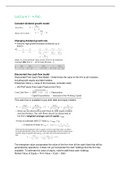
Constant dividend growth model
Changing dividend growth rate
Discounted free cash flow model
Discounted Free Cash Flow Model = Determines the value of the firm to all investors,
including both equity and debt holders.
Enterprise Value (= value of the business, excludes cash)
→ V0=PV(Future Free Cash Flows to the Firm)
This cash flow is available to pay both debt and equity holders.
The enterprise value incorporates the value of the firm from all the cash flows that will be
generated by operations. It does not yet incorporate the cash holdings that the firm has
available. To estimate the value of equity, need to add these cash holdings.
Market Value of Equity = Firm Value + Cash – Debt
,CAPM
For all securities, the expected return equals the required return. Assumptions:
1) Investors can buy and sell all securities at competitive market prices (no taxes or
transaction costs) and can borrow and lend at the risk-free interest rate.
2) Investors hold only efficient portfolios of traded securities - portfolios that yield the
maximum expected return for a given level of volatility.
3) Investors have homogeneous expectations regarding the volatilities, correlations, and
expected returns of securities. Homogeneous expectations= All investors have the
same estimates concerning future investments and returns.
The unlevered beta (=asset beta) is the beta of the firm. If there is leverage, then this beta is
amplified for the shareholder. Without tax advantage, from a risk perspective, equity-holders
do not like debt.
Problems with estimating the CAPM: betas are not observed, Expected returns are not
observed, market proxy is not correct.
The CAPM remains the predominant model used in practice to determine the equity cost of
capital.
Although the CAPM is not perfect, it is unlikely that a truly perfect model will be found in the
foreseeable future.
The imperfections of the CAPM may not be critical in the context of capital budgeting.
CAPM provides a method to identify the cost of capital for investments ⇒ The cost of capital
of any investment opportunity equals the expected return of (widely) available investments in
the financial markets with the same beta.
, Debt Yields
Yield to maturity = IRR an investor will earn from holding the bond to maturity and receiving
its promised payments.
- If there is little risk the firm will default, yield to maturity is a reasonable estimate of
investors’ expected rate of return.
- If there is significant risk of default, yield to maturity will overstate investors’ expected
return.
Expected return of the bond is: = Yield to Maturity – Prob(default) x Expected Loss Rate
The importance of the adjustment depends on the riskiness of the bond.
Debt beta
= measures the sensitivity of the return on debt to the returns of the market.
- If a company has zero probability of default, then the debt is risk free and the debt
beta is 0.
- The higher the probability of default, the more sensitive the debt return to the market,
the higher the debt beta.
- The more exposed an industry is to market risk, the higher the debt beta.
Debt betas are difficult to estimate because corporate bonds are traded infrequently.
Steps to determine the project cost of capital:
Assume the project is all equity financed.
1. Find an all-equity financed firm in a line of business that is comparable to the project
2. Use the comparable firm’s equity beta and cost of capital as estimates
Need to find the cost of capital as if the firm was all equity financed: the cost of capital
related to the assets
→ Unlevered cost of capital or Asset cost of capital or WACC:
Value of the firm is not value of equity (share price).
Constant dividend growth model
Changing dividend growth rate
Discounted free cash flow model
Discounted Free Cash Flow Model = Determines the value of the firm to all investors,
including both equity and debt holders.
Enterprise Value (= value of the business, excludes cash)
→ V0=PV(Future Free Cash Flows to the Firm)
This cash flow is available to pay both debt and equity holders.
The enterprise value incorporates the value of the firm from all the cash flows that will be
generated by operations. It does not yet incorporate the cash holdings that the firm has
available. To estimate the value of equity, need to add these cash holdings.
Market Value of Equity = Firm Value + Cash – Debt
,CAPM
For all securities, the expected return equals the required return. Assumptions:
1) Investors can buy and sell all securities at competitive market prices (no taxes or
transaction costs) and can borrow and lend at the risk-free interest rate.
2) Investors hold only efficient portfolios of traded securities - portfolios that yield the
maximum expected return for a given level of volatility.
3) Investors have homogeneous expectations regarding the volatilities, correlations, and
expected returns of securities. Homogeneous expectations= All investors have the
same estimates concerning future investments and returns.
The unlevered beta (=asset beta) is the beta of the firm. If there is leverage, then this beta is
amplified for the shareholder. Without tax advantage, from a risk perspective, equity-holders
do not like debt.
Problems with estimating the CAPM: betas are not observed, Expected returns are not
observed, market proxy is not correct.
The CAPM remains the predominant model used in practice to determine the equity cost of
capital.
Although the CAPM is not perfect, it is unlikely that a truly perfect model will be found in the
foreseeable future.
The imperfections of the CAPM may not be critical in the context of capital budgeting.
CAPM provides a method to identify the cost of capital for investments ⇒ The cost of capital
of any investment opportunity equals the expected return of (widely) available investments in
the financial markets with the same beta.
, Debt Yields
Yield to maturity = IRR an investor will earn from holding the bond to maturity and receiving
its promised payments.
- If there is little risk the firm will default, yield to maturity is a reasonable estimate of
investors’ expected rate of return.
- If there is significant risk of default, yield to maturity will overstate investors’ expected
return.
Expected return of the bond is: = Yield to Maturity – Prob(default) x Expected Loss Rate
The importance of the adjustment depends on the riskiness of the bond.
Debt beta
= measures the sensitivity of the return on debt to the returns of the market.
- If a company has zero probability of default, then the debt is risk free and the debt
beta is 0.
- The higher the probability of default, the more sensitive the debt return to the market,
the higher the debt beta.
- The more exposed an industry is to market risk, the higher the debt beta.
Debt betas are difficult to estimate because corporate bonds are traded infrequently.
Steps to determine the project cost of capital:
Assume the project is all equity financed.
1. Find an all-equity financed firm in a line of business that is comparable to the project
2. Use the comparable firm’s equity beta and cost of capital as estimates
Need to find the cost of capital as if the firm was all equity financed: the cost of capital
related to the assets
→ Unlevered cost of capital or Asset cost of capital or WACC:
Value of the firm is not value of equity (share price).