LECTURE 1
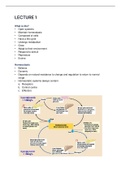
What is life?
• Open systems
• Maintain homeostasis
• Composed of cells
• Have a life cycle
• Undergo metabolism
• Grow
• Adapt to their environment
• Respond to stimuli
• Reproduce
• Evolve
Homeostasis
• Balance
• Dynamic
• Depends on natural resistance to change and regulation to return to normal
range
• Homeostatic systems always contain:
a. Receptors
b. Control centre
c. Effectors
,Universal principles of life and cell biology
• There are a limited number of general principles that can explain the most
complex processes
• They are based on common molecular mechanisms
1. Genetic information
• Genetic information stored as DNA sequence is duplicated and passed on to
daughter cells
,2. Transcription and translation
• Linear chemical sequences (DNA) give rise to the linear sequences and three-
dimensional structures of RNAs and proteins
3. Macromolecules
• Macromolecules are built by combining subunits
• Allows for diversity from identical building blocks
• Self-assemble
, 4. Membranes
• Living organisms are surrounded by a membrane
• Made up of a lipid bilayer
• Following the fluid mosaic model
• Membranes are not made de novo
5. Subcellular targeting
• Spatial targeting a form of regulation
• Dependent on protein motifs and signals
• Soluble proteins start at ribosomes
• Membrane proteins carried by vesicles to target membrane
What is life?
• Open systems
• Maintain homeostasis
• Composed of cells
• Have a life cycle
• Undergo metabolism
• Grow
• Adapt to their environment
• Respond to stimuli
• Reproduce
• Evolve
Homeostasis
• Balance
• Dynamic
• Depends on natural resistance to change and regulation to return to normal
range
• Homeostatic systems always contain:
a. Receptors
b. Control centre
c. Effectors
,Universal principles of life and cell biology
• There are a limited number of general principles that can explain the most
complex processes
• They are based on common molecular mechanisms
1. Genetic information
• Genetic information stored as DNA sequence is duplicated and passed on to
daughter cells
,2. Transcription and translation
• Linear chemical sequences (DNA) give rise to the linear sequences and three-
dimensional structures of RNAs and proteins
3. Macromolecules
• Macromolecules are built by combining subunits
• Allows for diversity from identical building blocks
• Self-assemble
, 4. Membranes
• Living organisms are surrounded by a membrane
• Made up of a lipid bilayer
• Following the fluid mosaic model
• Membranes are not made de novo
5. Subcellular targeting
• Spatial targeting a form of regulation
• Dependent on protein motifs and signals
• Soluble proteins start at ribosomes
• Membrane proteins carried by vesicles to target membrane