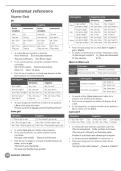
Grammar reference
Starter Unit interrogativa respuestas cortas
be afirmativa negativa
I got a dog? Yes, I have. No, I haven’t.
afirmativa negativa Have
you got a dog? Yes, you have. No, you haven’t.
forma contracción forma contracción
he got a dog? Yes, he has. No, he hasn’t.
completa completa
Has she got a dog? Yes, she has. No, she hasn’t.
I am I’m I am not I’m not it got a dog? Yes, it has. No, it hasn’t.
You are You’re You are not You aren’t we got a dog? Yes, we have. No, we haven’t.
He / She / He’s / She’s / He / She / He / She / Have you got a dog? Yes, you have. No, you haven’t.
It is It’s It is not It isn’t they got a dog? Yes, they have. No, they haven’t.
We / You / We’re / You’re / We / You / We / You /
They are They’re They are not They aren’t
• Para formular preguntas se utiliza have + sujeto +
got + objeto.
• Se utiliza be para nombrar o describir. • En inglés conversacional se utilizan respuestas cortas.
He is American. Él es estadounidense. A: Has she got a sister? A: ¿Tiene una hermana?
They are red flowers. Son flores rojas. B: Yes, she has. B: Sí.
• En las conversaciones, se tiende a emplear formas there is/there are
contraídas.
We’re from London. Somos de Londres. afirmativa negativa
She’s 14. Tiene 14 años. singular There’s a TV. There isn’t a cinema.
• Para formar el negativo, se añade not después de be. plural There are some CDS. There aren’t any books.
Normalmente se contrae not (n’t).
( ).
interrogativa respuestas cortas interrogativa respuestas cortas
afirmativa negativa Yes, there is.
singular Is there a cinema?
No, there isn’t.
Am I right? Yes, I am No, I’m not.
Yes, there are.
Are you right? Yes, you are. No, you aren’t. plural Are there any apples?
No, there aren’t.
Is he / she / it right? Yes, he / she / it is. No, he / she / it isn’t.
Are we / you / Yes, we / you / No, we / you / they • Se puede utilizar there is/are para hablar de la
they right? they are. aren’t. posición o la existencia de objetos.
• Para formar el negativo se añade n’t después de is
• Al hacer preguntas invertimos el orden de las palabras o are.
y be se sitúa antes del sujeto. • En las preguntas, se cambia el orden de las palabras y
Are you cousins? (x You are cousins?) ¿Sois primos? be se coloca ante de there.
have got can/can’t
afirmativa negativa afirmativa negativa
I / You’ve got a cap. I / You haven’t got a cap. I / You / He / She / can I / You / He / She / can’t speak
He / She / It’s got a cap. He / She / It hasn’t got a cap. It / We / You / They sing. It / We / You / They Chinese.
We / You / They’ve got a cap. We / You / They haven’t got a cap.
• Se utiliza can para expresar capacidad y permiso.
• Se utiliza have got para hablar sobre posesión. She can snowboard Sabe surfear en la nieve.
• En las conversaciones, se suelen emplear formas They can go to the party on Saturday night.
contraídas. Pueden ir a la fiesta del sábado por la noche.
He’s got a new mobile. Tiene un móvil nuevo. • La tercera persona (he/she/it) no termina en -s.
• Para formar el negativo, se añade n’t (not) después de • Para hacer preguntas se cambia el orden de las
have y antes de got. palabras.
She hasn’t got a big family. Can I go to the toilet, please? ¿Puedo ir al baño?
No tiene una familia muy grande.
100 Grammar reference
,Grammar practice S
be 5 Write questions and short answers with have
got about the people in the table.
1 Circle the correct words.
1 Jason is / am my cousin. a bike a cat
2 I am / is 12 years old. Anna ✗ ✓
3 We is / are from Glasgow. Lisa and Jack ✓ ✓
4 My teacher is / are Mr Wilson. David ✗ ✗
5 You is / are in my class.
6 It is / are windy today. 1 Has Anna got a bike ?
No , she hasn’t .
2 Complete the sentences with the negative 2 ?
form of be. Use contractions. , .
1 They aren’t from Italy.
3 ?
2 She my teacher.
, .
3 I 12 years old.
4 ?
4 We in your class.
, .
5 You late.
6 It cold today. 5 ?
, .
3 Write the questions. 6 ?
1 How / you / old / ? , .
How old are you?
2 What / your name / ? there is/there are
3 Where / he from / ? 6 Tick the correct column.
There is … There are …
4 she / a student / ?
✓ a table.
some books.
5 they / in your class / ?
some desks.
6 we / late / ? a bookshelf.
a computer.
some flowers.
have got
4 Circle the correct options.
can/can’t
1 ’ve got three cats.
a He b She c They 7 Complete the sentences with the correct form
2 hasn’t got brown hair. of can and a verb from the box.
a He b You c They
go make open play ride speak
3 ’ve got a blue T-shirt.
a I b She c It
1 I can’t play rugby. (✗)
4 ’ve got an exam tomorrow.
2 Isabel a bike. (✓)
a He b We c She
3 They Spanish. (✓)
5 ’s got a new computer.
4 My mum really good pizzas. (✓)
a Lisa b Max and Lisa c They
5 Tim and Sara to the party. (✗)
6 haven’t got a big house.
6 We this box. (✗)
a She b My friend c They
Grammar practice 1
, Grammar reference
Unit 1 • Los adverbios de frecuencia se utilizan para indicar la
frecuencia con la que hacemos algo. Van después del
Presente simple: afirmativa y negativa verbo be y antes de los otros verbos principales.
afirmativa I’m never late. Nunca llego tarde.
He always does his homework.
I like chat shows.
Siempre hace los deberes.
You like chat shows.
He / She / It likes chat shows. like, love, hate + ing
We / You / They like chat shows. • Después de love, like, don’t like, hate y don’t mind
se utiliza la forma -ing de los verbos.
• Se utiliza el presente simple para expresar hechos, I love watching comedy films.
hábitos y rutinas. Me encanta ver películas de humor.
We don’t live in the city centre. • Detrás de estos verbos también se pueden utilizar
No vivimos en el centro de la ciudad. nombres directamente.
She goes to school at 8.30 am. He doesn’t like soap operas.
Va al colegio a las 8.30 de la mañana. No le gustan los culebrones.
Ortografía: tercera persona Presente simple: preguntas con respuesta
• La tercera persona del singular (he/she/it) del presente del tipo sí/no
simple acaba en -s. interrogativa respuestas cortas
speak – he speaks hablar – él habla
afirmativa negativa
put – she puts poner – ella pone
I watch cartoons? Yes, I do. No, I don’t.
• Cuando un verbo termina en consonante + y, se Do
you watch cartoons? Yes, you do. No, you don’t.
sustituye la y por -ies para las formas he/she/it.
fly – it flies volar – vuela he watch cartoons? Yes, he does. No, he doesn’t.
Does she watch cartoons? Yes, she does. No, she doesn’t
carry – she carries llevar – ella lleva it watch cartoons? Yes, it does. No, it doesn’t.
• Cuando un verbo termina en -s, -ss, -sh, -ch, -x y -o se
we watch cartoons? Yes, we do, No, we don’t.
añade -es.
Do you watch cartoons? Yes, you do, No, you don’t.
misses pierde relaxes se relaja they watch cartoons? Yes, they do, No, they don’t.
washes lava does hace
watches mira • Para formular preguntas con respuesta del tipo sí/no
se utiliza do / does + sujeto + infinitivo.
negativa • Para responder se utilizan respuestas cortas con do/
I don’t (do not) like does, y no se repite el verbo principal.
A: Do you like westerns?
You don’t (do not) like
westerns. A: ¿Os gustan las películas del oeste?
He / She / It doesn’t (does not) like
B: Yes, we do. (x Yes, we like.) B: Sí.
We / You / They don’t (do not) like
Presente simple: preguntas con partículas
• La negativa del presente simple se forma con el sujeto interrogativas
+ don’t (do not) + infinitivo.
I don’t speak French. No hablo francés. partícula do/does sujeto verbo
interrogativa
• Para la tercera persona se utiliza doesn’t (does not).
He doesn’t like cartoons. What do you study?
No le gustan los dibujos animados. Who does she like?
Adverbios de frecuencia Where does he study?
When do they play?
always usually often sometimes never
• Para formular preguntas con partículas interrogativas
100% 0% se hace así: partícula interrogativa + do / does +
sujeto + verbo.
What time do you finish school?
102 Grammar reference ¿A qué hora sales del colegio?
Starter Unit interrogativa respuestas cortas
be afirmativa negativa
I got a dog? Yes, I have. No, I haven’t.
afirmativa negativa Have
you got a dog? Yes, you have. No, you haven’t.
forma contracción forma contracción
he got a dog? Yes, he has. No, he hasn’t.
completa completa
Has she got a dog? Yes, she has. No, she hasn’t.
I am I’m I am not I’m not it got a dog? Yes, it has. No, it hasn’t.
You are You’re You are not You aren’t we got a dog? Yes, we have. No, we haven’t.
He / She / He’s / She’s / He / She / He / She / Have you got a dog? Yes, you have. No, you haven’t.
It is It’s It is not It isn’t they got a dog? Yes, they have. No, they haven’t.
We / You / We’re / You’re / We / You / We / You /
They are They’re They are not They aren’t
• Para formular preguntas se utiliza have + sujeto +
got + objeto.
• Se utiliza be para nombrar o describir. • En inglés conversacional se utilizan respuestas cortas.
He is American. Él es estadounidense. A: Has she got a sister? A: ¿Tiene una hermana?
They are red flowers. Son flores rojas. B: Yes, she has. B: Sí.
• En las conversaciones, se tiende a emplear formas there is/there are
contraídas.
We’re from London. Somos de Londres. afirmativa negativa
She’s 14. Tiene 14 años. singular There’s a TV. There isn’t a cinema.
• Para formar el negativo, se añade not después de be. plural There are some CDS. There aren’t any books.
Normalmente se contrae not (n’t).
( ).
interrogativa respuestas cortas interrogativa respuestas cortas
afirmativa negativa Yes, there is.
singular Is there a cinema?
No, there isn’t.
Am I right? Yes, I am No, I’m not.
Yes, there are.
Are you right? Yes, you are. No, you aren’t. plural Are there any apples?
No, there aren’t.
Is he / she / it right? Yes, he / she / it is. No, he / she / it isn’t.
Are we / you / Yes, we / you / No, we / you / they • Se puede utilizar there is/are para hablar de la
they right? they are. aren’t. posición o la existencia de objetos.
• Para formar el negativo se añade n’t después de is
• Al hacer preguntas invertimos el orden de las palabras o are.
y be se sitúa antes del sujeto. • En las preguntas, se cambia el orden de las palabras y
Are you cousins? (x You are cousins?) ¿Sois primos? be se coloca ante de there.
have got can/can’t
afirmativa negativa afirmativa negativa
I / You’ve got a cap. I / You haven’t got a cap. I / You / He / She / can I / You / He / She / can’t speak
He / She / It’s got a cap. He / She / It hasn’t got a cap. It / We / You / They sing. It / We / You / They Chinese.
We / You / They’ve got a cap. We / You / They haven’t got a cap.
• Se utiliza can para expresar capacidad y permiso.
• Se utiliza have got para hablar sobre posesión. She can snowboard Sabe surfear en la nieve.
• En las conversaciones, se suelen emplear formas They can go to the party on Saturday night.
contraídas. Pueden ir a la fiesta del sábado por la noche.
He’s got a new mobile. Tiene un móvil nuevo. • La tercera persona (he/she/it) no termina en -s.
• Para formar el negativo, se añade n’t (not) después de • Para hacer preguntas se cambia el orden de las
have y antes de got. palabras.
She hasn’t got a big family. Can I go to the toilet, please? ¿Puedo ir al baño?
No tiene una familia muy grande.
100 Grammar reference
,Grammar practice S
be 5 Write questions and short answers with have
got about the people in the table.
1 Circle the correct words.
1 Jason is / am my cousin. a bike a cat
2 I am / is 12 years old. Anna ✗ ✓
3 We is / are from Glasgow. Lisa and Jack ✓ ✓
4 My teacher is / are Mr Wilson. David ✗ ✗
5 You is / are in my class.
6 It is / are windy today. 1 Has Anna got a bike ?
No , she hasn’t .
2 Complete the sentences with the negative 2 ?
form of be. Use contractions. , .
1 They aren’t from Italy.
3 ?
2 She my teacher.
, .
3 I 12 years old.
4 ?
4 We in your class.
, .
5 You late.
6 It cold today. 5 ?
, .
3 Write the questions. 6 ?
1 How / you / old / ? , .
How old are you?
2 What / your name / ? there is/there are
3 Where / he from / ? 6 Tick the correct column.
There is … There are …
4 she / a student / ?
✓ a table.
some books.
5 they / in your class / ?
some desks.
6 we / late / ? a bookshelf.
a computer.
some flowers.
have got
4 Circle the correct options.
can/can’t
1 ’ve got three cats.
a He b She c They 7 Complete the sentences with the correct form
2 hasn’t got brown hair. of can and a verb from the box.
a He b You c They
go make open play ride speak
3 ’ve got a blue T-shirt.
a I b She c It
1 I can’t play rugby. (✗)
4 ’ve got an exam tomorrow.
2 Isabel a bike. (✓)
a He b We c She
3 They Spanish. (✓)
5 ’s got a new computer.
4 My mum really good pizzas. (✓)
a Lisa b Max and Lisa c They
5 Tim and Sara to the party. (✗)
6 haven’t got a big house.
6 We this box. (✗)
a She b My friend c They
Grammar practice 1
, Grammar reference
Unit 1 • Los adverbios de frecuencia se utilizan para indicar la
frecuencia con la que hacemos algo. Van después del
Presente simple: afirmativa y negativa verbo be y antes de los otros verbos principales.
afirmativa I’m never late. Nunca llego tarde.
He always does his homework.
I like chat shows.
Siempre hace los deberes.
You like chat shows.
He / She / It likes chat shows. like, love, hate + ing
We / You / They like chat shows. • Después de love, like, don’t like, hate y don’t mind
se utiliza la forma -ing de los verbos.
• Se utiliza el presente simple para expresar hechos, I love watching comedy films.
hábitos y rutinas. Me encanta ver películas de humor.
We don’t live in the city centre. • Detrás de estos verbos también se pueden utilizar
No vivimos en el centro de la ciudad. nombres directamente.
She goes to school at 8.30 am. He doesn’t like soap operas.
Va al colegio a las 8.30 de la mañana. No le gustan los culebrones.
Ortografía: tercera persona Presente simple: preguntas con respuesta
• La tercera persona del singular (he/she/it) del presente del tipo sí/no
simple acaba en -s. interrogativa respuestas cortas
speak – he speaks hablar – él habla
afirmativa negativa
put – she puts poner – ella pone
I watch cartoons? Yes, I do. No, I don’t.
• Cuando un verbo termina en consonante + y, se Do
you watch cartoons? Yes, you do. No, you don’t.
sustituye la y por -ies para las formas he/she/it.
fly – it flies volar – vuela he watch cartoons? Yes, he does. No, he doesn’t.
Does she watch cartoons? Yes, she does. No, she doesn’t
carry – she carries llevar – ella lleva it watch cartoons? Yes, it does. No, it doesn’t.
• Cuando un verbo termina en -s, -ss, -sh, -ch, -x y -o se
we watch cartoons? Yes, we do, No, we don’t.
añade -es.
Do you watch cartoons? Yes, you do, No, you don’t.
misses pierde relaxes se relaja they watch cartoons? Yes, they do, No, they don’t.
washes lava does hace
watches mira • Para formular preguntas con respuesta del tipo sí/no
se utiliza do / does + sujeto + infinitivo.
negativa • Para responder se utilizan respuestas cortas con do/
I don’t (do not) like does, y no se repite el verbo principal.
A: Do you like westerns?
You don’t (do not) like
westerns. A: ¿Os gustan las películas del oeste?
He / She / It doesn’t (does not) like
B: Yes, we do. (x Yes, we like.) B: Sí.
We / You / They don’t (do not) like
Presente simple: preguntas con partículas
• La negativa del presente simple se forma con el sujeto interrogativas
+ don’t (do not) + infinitivo.
I don’t speak French. No hablo francés. partícula do/does sujeto verbo
interrogativa
• Para la tercera persona se utiliza doesn’t (does not).
He doesn’t like cartoons. What do you study?
No le gustan los dibujos animados. Who does she like?
Adverbios de frecuencia Where does he study?
When do they play?
always usually often sometimes never
• Para formular preguntas con partículas interrogativas
100% 0% se hace así: partícula interrogativa + do / does +
sujeto + verbo.
What time do you finish school?
102 Grammar reference ¿A qué hora sales del colegio?