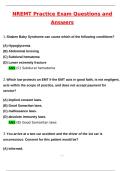
NREMT Practice Exam Questions and
Answers
1.Shaken Baby Syndrome can cause which of the following conditions?
(A) Hypoglycemia
(B) Abdominal bruising
(C) Subdural hematoma
(D) Lower extremity fracture
ANS (C) Subdural hematoma
2.Which law protects an EMT if the EMT acts in good faith, is not negligent,
acts within the scope of practice, and does not accept payment for
service?
(A) implied consent laws.
(B) Good Samaritan laws.
(C) malfeasance laws.
(D) absolute immunity laws.
ANS (B) Good Samaritan laws
3.You arrive at a two car accident and the driver of the 1st car is
unconscious. Consent for this patient would be?
(A) informed.
,(B) implied.
(C) expressed.
(D) involuntary.
ANS (B) implied
4.Organ responsible for insulin production.
(A) adrenal
(B) pancreas
(C) thyroid
(D) thymus
ANS (B) pancreas
5.Which federal agency regulates telecommunications in the United States?
(A) FBI.
(B) FDIC.
(C) FCC.
(D) FACEP.
ANS (C) FCC.
6.What is the rate of chest compressions for a two-year-old in cardiac arrest
(A) 80/minute.
(B) 100/minute.
(C) 110/minute.
, (D) 120/minute.
ANS (B) 100/minute.
7.A BVM with a reservoir and oxygen source (at least 15 LPM) delivers
an oxygen concentration of
(A) 21%.
(B) 40% to 60%.
(C) 80%.
(D) 100%.
ANS (D) 100%.
8.Beck's triad (associated with pericardial tamponade) includes
distant heart tones, JVD, and...
(A) pulse deviation.
(B) narrowing pulse pressure.
(C) wheezing.
(D) delayed capillary refill.
ANS (B) narrowing pulse pressure.
9.What happens during inspiration?
(A) the diaphragm contracts and the intercostal muscles relax.
(B) the diaphragm relaxes and the intercostal muscles contract.
(C) the diaphragm relaxes and the intercostal muscles relax.
Answers
1.Shaken Baby Syndrome can cause which of the following conditions?
(A) Hypoglycemia
(B) Abdominal bruising
(C) Subdural hematoma
(D) Lower extremity fracture
ANS (C) Subdural hematoma
2.Which law protects an EMT if the EMT acts in good faith, is not negligent,
acts within the scope of practice, and does not accept payment for
service?
(A) implied consent laws.
(B) Good Samaritan laws.
(C) malfeasance laws.
(D) absolute immunity laws.
ANS (B) Good Samaritan laws
3.You arrive at a two car accident and the driver of the 1st car is
unconscious. Consent for this patient would be?
(A) informed.
,(B) implied.
(C) expressed.
(D) involuntary.
ANS (B) implied
4.Organ responsible for insulin production.
(A) adrenal
(B) pancreas
(C) thyroid
(D) thymus
ANS (B) pancreas
5.Which federal agency regulates telecommunications in the United States?
(A) FBI.
(B) FDIC.
(C) FCC.
(D) FACEP.
ANS (C) FCC.
6.What is the rate of chest compressions for a two-year-old in cardiac arrest
(A) 80/minute.
(B) 100/minute.
(C) 110/minute.
, (D) 120/minute.
ANS (B) 100/minute.
7.A BVM with a reservoir and oxygen source (at least 15 LPM) delivers
an oxygen concentration of
(A) 21%.
(B) 40% to 60%.
(C) 80%.
(D) 100%.
ANS (D) 100%.
8.Beck's triad (associated with pericardial tamponade) includes
distant heart tones, JVD, and...
(A) pulse deviation.
(B) narrowing pulse pressure.
(C) wheezing.
(D) delayed capillary refill.
ANS (B) narrowing pulse pressure.
9.What happens during inspiration?
(A) the diaphragm contracts and the intercostal muscles relax.
(B) the diaphragm relaxes and the intercostal muscles contract.
(C) the diaphragm relaxes and the intercostal muscles relax.