KRM 320 B Study unit 1
Erin Polyblank
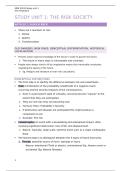
STUDY UNIT 1: THE RISK SOCIETY
ARTICLE 1 ULRICH BECK
There are 3 reactions to risk:
1. Denial
2. Apathy
3. Transformation
OLD DANGERS, NEW RISKS: DENCEPTUAL DIFFERNTIATION, HISTORICAL
LOCALISATION
Present action requires knowledge of the future in order to govern the future.
o The future in many ways is unknowable and uncertain.
People have always tried to fill by imaginative means this irrevocable uncertainty
regarding the spaces of the future.
o Eg. Religion and literature or even risk calculations.
CONCEPTUAL DISTINCTIONS
The First step is to identify the difference between risk and catastrophe
Risk: Combination of the probability (Likelihood) of a negative event
occurring and the severity (Impact) of the consequences.
o Exist in a permanent state of virtuality, and only become “topical” to the
extent that they are anticipated.
o They are not real; they are becoming real.
o Formula- Risk= Probability x Severity
o If destruction and disaster are anticipated this might produce a
compulsion to act.
o Example- The risk
Catastrophe: An event with a devastating and widespread impact, often
involving significant destruction, loss of life, and displacement.
o Nature- Typically, large scale, extreme event such as a major earthquake,
flood
The Second step is to distinguish between the 3 types of future insecurity:
1. Threat: potential source of harm, damage or injury.
- Nature- Intentional (Theft or attack), unintentional (Eg. Human error) or
accidental (Eg. Natural Disaster)
1
,KRM 320 B Study unit 1
Erin Polyblank
o Example- A bank robber for a bank, a computer virus for an organization
or an extreme earthquake.
2. Risks: presupposes human decisions, humanly made futures (probability,
technology, modernization).
3. Manufactured uncertainties: Dependent on human decisions, created
by society itself, immanent to society and thus externalizable, collectively
imposed and thus individually unavoidable.
- Their perceptions break with the past, break with experienced risks and
institutionalized routines; they are incalculable, uncontrollable and in
the final analysis no longer (privately) insurable (climate change, for
example).
Modern societies and their foundations are shaken by the global anticipation
of global catastrophes (climate change, financial crisis, terrorism).
Perceptions of globalised manufactured risks and uncertainties are
characterised by 3 features:
1. De-localisation: Their causes and consequences are not limited to one
geographical location or space, but are in principle omnipresent.
- Eg. COVID-19 affected all countries in the world not just a specific
country
2. Incalculableness: Their consequences are in principle incalculable; at
bottom it is a matter of “hypothetical” or “virtual” risks which, not least,
are based on scientifically induced not-knowing and normative dissent.
- Eg. You can’t calculate the amount of damage that COVID-19 caused
altogether (Not just monetary)
3. Non-compensability: The Monetary damage/catastrophe cannot be
calculated.
- Eg. The excessive corruption occurring in South Africa cannot be
calculated and the amount of damage or the murder of a person may
not be able to be calculated monetarily.
The nation-state frame of reference, prevents the social sciences and
humanities from understanding and analysing the dynamics, conflicts,
ambiguities and new perspectives of world risk.
o This is true in both the anthropological tradition and cultural theory of
Mary Douglas and the historical tradition and social and political theory of
Michel Foucault.
2
, KRM 320 B Study unit 1
Erin Polyblank
HISTORICAL CONTEXTUALISATION
THREAT
Societies have responded to the challenge of an unknown future by
developing a diversity of knowledge practices that attempt to reduce or
contain this uncertainty in order to render it more manageable.
o In the Middle-ages it was believed that there was a master plan and that
there is a reason for different catastrophe.
Pre-modern societies seek to tame the future by deducing its shape from
eternally unchanging laws as inscribed,
Advances in the mathematical calculation of the heavenly bodies are
employed for prognosticating future events; astrology provides scientific
support for politics.
RISK
When we speak of “risk” we refer to a future that is made knowable by
measurement, even if this “knowledge” remains speculative.
o This knowledge forms a basis for rational decisions and calculations that
are no longer determined by faith or the affective perception of danger.
While danger is something we find ourselves (passively) exposed to, risk is
something we (actively) take on.
Risks and chances are to be shared by insurer and insured by determining the
probability of certain events happening in the future so precisely that for the
insurer on average and over a long period no economic risk and no financial
damage are incurred, while the insured is still safe-guarded against the
unplanned and unforeseeable single event.
2 faces of risk
1. Chance.
2. Danger
MANUFACTURED UNCERTAINTY
3
Erin Polyblank
STUDY UNIT 1: THE RISK SOCIETY
ARTICLE 1 ULRICH BECK
There are 3 reactions to risk:
1. Denial
2. Apathy
3. Transformation
OLD DANGERS, NEW RISKS: DENCEPTUAL DIFFERNTIATION, HISTORICAL
LOCALISATION
Present action requires knowledge of the future in order to govern the future.
o The future in many ways is unknowable and uncertain.
People have always tried to fill by imaginative means this irrevocable uncertainty
regarding the spaces of the future.
o Eg. Religion and literature or even risk calculations.
CONCEPTUAL DISTINCTIONS
The First step is to identify the difference between risk and catastrophe
Risk: Combination of the probability (Likelihood) of a negative event
occurring and the severity (Impact) of the consequences.
o Exist in a permanent state of virtuality, and only become “topical” to the
extent that they are anticipated.
o They are not real; they are becoming real.
o Formula- Risk= Probability x Severity
o If destruction and disaster are anticipated this might produce a
compulsion to act.
o Example- The risk
Catastrophe: An event with a devastating and widespread impact, often
involving significant destruction, loss of life, and displacement.
o Nature- Typically, large scale, extreme event such as a major earthquake,
flood
The Second step is to distinguish between the 3 types of future insecurity:
1. Threat: potential source of harm, damage or injury.
- Nature- Intentional (Theft or attack), unintentional (Eg. Human error) or
accidental (Eg. Natural Disaster)
1
,KRM 320 B Study unit 1
Erin Polyblank
o Example- A bank robber for a bank, a computer virus for an organization
or an extreme earthquake.
2. Risks: presupposes human decisions, humanly made futures (probability,
technology, modernization).
3. Manufactured uncertainties: Dependent on human decisions, created
by society itself, immanent to society and thus externalizable, collectively
imposed and thus individually unavoidable.
- Their perceptions break with the past, break with experienced risks and
institutionalized routines; they are incalculable, uncontrollable and in
the final analysis no longer (privately) insurable (climate change, for
example).
Modern societies and their foundations are shaken by the global anticipation
of global catastrophes (climate change, financial crisis, terrorism).
Perceptions of globalised manufactured risks and uncertainties are
characterised by 3 features:
1. De-localisation: Their causes and consequences are not limited to one
geographical location or space, but are in principle omnipresent.
- Eg. COVID-19 affected all countries in the world not just a specific
country
2. Incalculableness: Their consequences are in principle incalculable; at
bottom it is a matter of “hypothetical” or “virtual” risks which, not least,
are based on scientifically induced not-knowing and normative dissent.
- Eg. You can’t calculate the amount of damage that COVID-19 caused
altogether (Not just monetary)
3. Non-compensability: The Monetary damage/catastrophe cannot be
calculated.
- Eg. The excessive corruption occurring in South Africa cannot be
calculated and the amount of damage or the murder of a person may
not be able to be calculated monetarily.
The nation-state frame of reference, prevents the social sciences and
humanities from understanding and analysing the dynamics, conflicts,
ambiguities and new perspectives of world risk.
o This is true in both the anthropological tradition and cultural theory of
Mary Douglas and the historical tradition and social and political theory of
Michel Foucault.
2
, KRM 320 B Study unit 1
Erin Polyblank
HISTORICAL CONTEXTUALISATION
THREAT
Societies have responded to the challenge of an unknown future by
developing a diversity of knowledge practices that attempt to reduce or
contain this uncertainty in order to render it more manageable.
o In the Middle-ages it was believed that there was a master plan and that
there is a reason for different catastrophe.
Pre-modern societies seek to tame the future by deducing its shape from
eternally unchanging laws as inscribed,
Advances in the mathematical calculation of the heavenly bodies are
employed for prognosticating future events; astrology provides scientific
support for politics.
RISK
When we speak of “risk” we refer to a future that is made knowable by
measurement, even if this “knowledge” remains speculative.
o This knowledge forms a basis for rational decisions and calculations that
are no longer determined by faith or the affective perception of danger.
While danger is something we find ourselves (passively) exposed to, risk is
something we (actively) take on.
Risks and chances are to be shared by insurer and insured by determining the
probability of certain events happening in the future so precisely that for the
insurer on average and over a long period no economic risk and no financial
damage are incurred, while the insured is still safe-guarded against the
unplanned and unforeseeable single event.
2 faces of risk
1. Chance.
2. Danger
MANUFACTURED UNCERTAINTY
3