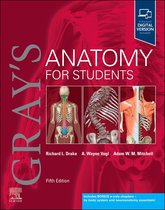
GRAY'S ANATOMY FOR STUDENTS
5TH EDITION
• AUTHOR(S)RICHARD L. DRAKE
TEST BANK
MCQ 1
Reference
Ch. 1 — The Body — What is anatomy
Stem
A first-year medical student is asked to choose the best
approach to learn the relationship between the femoral
triangle’s borders and femoral neurovascular structures for both
surgical access and surface palpation. Considering study
strategies, which approach most directly links form to clinical
function and safe procedural access?
Options
A. Memorizing names and origins of all muscles crossing the hip
joint.
B. Taking a strictly systemic approach (study all muscles of the
lower limb together).
,C. Adopting a regional approach focused on the femoral triangle
and its relationships.
D. Relying primarily on textbook images without cadaveric or
surface palpation practice.
Correct answer
C
Rationales
Correct (C) — Gray emphasizes the regional approach to
directly relate local anatomy (borders of the femoral triangle) to
clinical function (vascular access, nerve blocks) and surface
anatomy; this supports safe interventions.
A — Memorizing muscle origins alone neglects spatial relations
and surface landmarks critical for access.
B — A systemic approach can be useful, but it disperses local
relationships needed for procedural planning.
D — Images are helpful but insufficient without hands-on
correlation to surface anatomy and three-dimensional
relationships.
Teaching point
Regional anatomy best links surface landmarks to clinical
procedures.
Citation (Simplified APA)
Drake, R. L. (2024). Gray’s Anatomy for Students (5th Ed.). Ch. 1.
MCQ 2
,Reference
Ch. 1 — The Body — What is anatomy
Stem
A clinician interprets the term “anatomical variation” when
encountering an atypical course of a superficial artery during
surgery. From an A&P perspective, why does recognizing
anatomical variation matter for patient safety and diagnosis?
Options
A. Variations are rare curiosities and rarely change clinical
decisions.
B. Variations alter predictable relationships and may change
surgical landmarks or risk of iatrogenic injury.
C. Variations only affect embryology and are irrelevant in adult
anatomy practice.
D. Variations are synonymous with pathological disease.
Correct answer
B
Rationales
Correct (B) — Gray highlights that common anatomical
variations modify expected relationships; clinicians must
anticipate altered landmarks to avoid harm (e.g., aberrant
artery crossing).
A — Many variations are common enough to affect routine
procedures.
C — While rooted in development, variations have crucial adult
clinical implications.
, D — Variations are not necessarily pathologic; they are normal
differences.
Teaching point
Anatomical variation changes landmarks — anticipate to reduce
iatrogenic injury.
Citation (Simplified APA)
Drake, R. L. (2024). Gray’s Anatomy for Students (5th Ed.). Ch. 1.
MCQ 3
Reference
Ch. 1 — The Body — Imaging
Stem
A patient presents with acute abdominal pain. The attending
asks which imaging modality best differentiates soft-tissue
planes and inflammatory edema without ionizing radiation.
Which modality is most appropriate and why?
Options
A. Plain radiograph — because it quickly shows soft-tissue
edema.
B. CT scan — because it avoids radiation and shows excellent
soft-tissue contrast.
C. MRI — because it provides superior soft-tissue contrast and
avoids ionizing radiation.
D. Ultrasound — because it is the only modality that
differentiates soft-tissue planes in adults.
5TH EDITION
• AUTHOR(S)RICHARD L. DRAKE
TEST BANK
MCQ 1
Reference
Ch. 1 — The Body — What is anatomy
Stem
A first-year medical student is asked to choose the best
approach to learn the relationship between the femoral
triangle’s borders and femoral neurovascular structures for both
surgical access and surface palpation. Considering study
strategies, which approach most directly links form to clinical
function and safe procedural access?
Options
A. Memorizing names and origins of all muscles crossing the hip
joint.
B. Taking a strictly systemic approach (study all muscles of the
lower limb together).
,C. Adopting a regional approach focused on the femoral triangle
and its relationships.
D. Relying primarily on textbook images without cadaveric or
surface palpation practice.
Correct answer
C
Rationales
Correct (C) — Gray emphasizes the regional approach to
directly relate local anatomy (borders of the femoral triangle) to
clinical function (vascular access, nerve blocks) and surface
anatomy; this supports safe interventions.
A — Memorizing muscle origins alone neglects spatial relations
and surface landmarks critical for access.
B — A systemic approach can be useful, but it disperses local
relationships needed for procedural planning.
D — Images are helpful but insufficient without hands-on
correlation to surface anatomy and three-dimensional
relationships.
Teaching point
Regional anatomy best links surface landmarks to clinical
procedures.
Citation (Simplified APA)
Drake, R. L. (2024). Gray’s Anatomy for Students (5th Ed.). Ch. 1.
MCQ 2
,Reference
Ch. 1 — The Body — What is anatomy
Stem
A clinician interprets the term “anatomical variation” when
encountering an atypical course of a superficial artery during
surgery. From an A&P perspective, why does recognizing
anatomical variation matter for patient safety and diagnosis?
Options
A. Variations are rare curiosities and rarely change clinical
decisions.
B. Variations alter predictable relationships and may change
surgical landmarks or risk of iatrogenic injury.
C. Variations only affect embryology and are irrelevant in adult
anatomy practice.
D. Variations are synonymous with pathological disease.
Correct answer
B
Rationales
Correct (B) — Gray highlights that common anatomical
variations modify expected relationships; clinicians must
anticipate altered landmarks to avoid harm (e.g., aberrant
artery crossing).
A — Many variations are common enough to affect routine
procedures.
C — While rooted in development, variations have crucial adult
clinical implications.
, D — Variations are not necessarily pathologic; they are normal
differences.
Teaching point
Anatomical variation changes landmarks — anticipate to reduce
iatrogenic injury.
Citation (Simplified APA)
Drake, R. L. (2024). Gray’s Anatomy for Students (5th Ed.). Ch. 1.
MCQ 3
Reference
Ch. 1 — The Body — Imaging
Stem
A patient presents with acute abdominal pain. The attending
asks which imaging modality best differentiates soft-tissue
planes and inflammatory edema without ionizing radiation.
Which modality is most appropriate and why?
Options
A. Plain radiograph — because it quickly shows soft-tissue
edema.
B. CT scan — because it avoids radiation and shows excellent
soft-tissue contrast.
C. MRI — because it provides superior soft-tissue contrast and
avoids ionizing radiation.
D. Ultrasound — because it is the only modality that
differentiates soft-tissue planes in adults.