📙
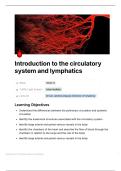
Introduction to anatomy, a brief
summary of its history and the
language used
Week Week 1
Traffic Light System Intermediate
Lecturer Dr Ian Jenkins Deputy Director of Anatomy
Learning Objectives Structure of anatomy teaching
1. Lectures
Be able to describe the anatomical position and 2. Lab-based classes (Anatomy Lab)
terms of position
a. Prosections (cadavers)
Be able to use terms of movement
i. Lab 1: Skeleton and
Be able to identify different planes of section Nervous System
Introduction to anatomy, a brief summary of its history and the language used 1
, Be able to distinguish the axial skeleton from ii. Viscera (organs)
the appendicular skeleton
b. Skeletons/bones (real and
Be able to discuss some of the major events in model)
the history of anatomy and how that has shaped the
c. Plastic Models
human tissue act of today
d. Poster (Diagrams)
e. X-rays/CTs/MRI (plain chest
Recommended Textbooks:
x-ray, full body MRI, CT scan
Gray’s Anatomy for Students, Drake, Volg & of head)
Mitchell
3. E-learning packages
Anatomy Rohen 8th Edition
4. Online support materials
Clinical Atlas of human anatomy - McMinn’s
and Abrahams’
Examination
Human Anatomy Gosling et al 6thE
50% coursework: create a poster
on an anatomical topic
10% assessed programme level
learning
40% proctored examination
What is anatomy?
Study of different structural forms - allows us to find relationships between organisms
The branch of science concerned with the bodily structure of humans, animals, and other living
organisms, especially as revealed by dissection and the separation of parts.
Evolutionary Origins of Humans
Introduction to anatomy, a brief summary of its history and the language used 2
, Where did humans come from and how
did we get here?
Homo sapiens - Class Mammalia
and Order of primates in mammalian
class
Dimetrodon - apex predator early
Permian period 300-280 million
years ago
Relationship between mammals and
mammal-like structure is based on
reptiles/birds can be shown via skull
comparative structure of patterns - in
anatomy over time
the temporal fenestra (posterior part
of skull) Synapsids
mammal-like reptile = synapsids
they evolved into mammals over
time
Postorbital, squamosal and jugal
bones ONLY
Types of mammals
Introduction to anatomy, a brief summary of its history and the language used 3
Introduction to anatomy, a brief
summary of its history and the
language used
Week Week 1
Traffic Light System Intermediate
Lecturer Dr Ian Jenkins Deputy Director of Anatomy
Learning Objectives Structure of anatomy teaching
1. Lectures
Be able to describe the anatomical position and 2. Lab-based classes (Anatomy Lab)
terms of position
a. Prosections (cadavers)
Be able to use terms of movement
i. Lab 1: Skeleton and
Be able to identify different planes of section Nervous System
Introduction to anatomy, a brief summary of its history and the language used 1
, Be able to distinguish the axial skeleton from ii. Viscera (organs)
the appendicular skeleton
b. Skeletons/bones (real and
Be able to discuss some of the major events in model)
the history of anatomy and how that has shaped the
c. Plastic Models
human tissue act of today
d. Poster (Diagrams)
e. X-rays/CTs/MRI (plain chest
Recommended Textbooks:
x-ray, full body MRI, CT scan
Gray’s Anatomy for Students, Drake, Volg & of head)
Mitchell
3. E-learning packages
Anatomy Rohen 8th Edition
4. Online support materials
Clinical Atlas of human anatomy - McMinn’s
and Abrahams’
Examination
Human Anatomy Gosling et al 6thE
50% coursework: create a poster
on an anatomical topic
10% assessed programme level
learning
40% proctored examination
What is anatomy?
Study of different structural forms - allows us to find relationships between organisms
The branch of science concerned with the bodily structure of humans, animals, and other living
organisms, especially as revealed by dissection and the separation of parts.
Evolutionary Origins of Humans
Introduction to anatomy, a brief summary of its history and the language used 2
, Where did humans come from and how
did we get here?
Homo sapiens - Class Mammalia
and Order of primates in mammalian
class
Dimetrodon - apex predator early
Permian period 300-280 million
years ago
Relationship between mammals and
mammal-like structure is based on
reptiles/birds can be shown via skull
comparative structure of patterns - in
anatomy over time
the temporal fenestra (posterior part
of skull) Synapsids
mammal-like reptile = synapsids
they evolved into mammals over
time
Postorbital, squamosal and jugal
bones ONLY
Types of mammals
Introduction to anatomy, a brief summary of its history and the language used 3