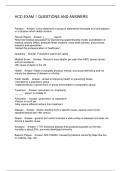
HCD EXAM 1 QUESTIONS AND ANSWERS
Paradox - Answer -a true statement or group of statements that leads to a contradiction
or a situation which defies intuition.
Flexner Report - Answer -(_______ report)
Reformed medical eduacation by abandoning apprenticeship model, accreditation of
medical schools (AMA), graduate fewer students, close weak schools, and promote
research and specialities
"started the professionalism of healthcare"
Quackery - Answer -Fraudulent claims are called
Medical Errors - Answer --Result in more deaths per year than AIDS, breast cancer,
and car accidents.
-8th cause of death in the US
Health - Answer -State of complete physical, mental, and social well-being and not
merely the absence of disease or infirmity
Public Health - Answer --aimed at improving health or preventing illness
-intended for a population group
-implemented by a government or group accountable to a population group
Treatment - Answer -(prevention vs. treatment)
______ : person is already ill
Prevention - Answer -(prevention vs. treatment)
-Person is not ill yet
-May require different actions than treatment
Disease - Answer --illness resulting from a specific cause; causes could not be
identified before late 19th century
Illness - Answer --general term which includes a wide variety of diseases and does not
denote a specific cause.
Smallpox - Answer -1775: infectious disease that produces pustules on the skin;
mortality is about 50%; survivors developed immunity
Bubonic Plaque - Answer -500-1500AC: Caused by bacteria carried by fleas that live
on rodents, esp. rats
, Cholera - Answer -1848: infectious disease caused by a bacterium resulting in severe
diarrhea and dehydration that can result in death
John Snow - Answer --Used the scientific method to investigate problems.
-Tested the hypothesis that cholera was transmitted by contaminated water
Scientific Method - Answer -Example of the ________ :
asking a question then collecting and analyzing data to answer the question
Humoralism - Answer -Natural balance in the body
Infectious (disease, causes of death in which century?) - Answer -19th century: major
cause of death
Chronic (disease, causes of death in which century?) - Answer -21st century: major
cause of death
2 Major Hallmarks (20th century) - Answer -1. Government involvement in healthcare
2. Prepaid Health Services (3rd Party Payments)
Barriers (existing in health care) - Answer -traditional roles; communication; time;
competence; trust; proximity; tradition
1965 - Answer -Medicare/ Medicaid Instituted in this year
Patient (centered care) - Answer -Focus and Power of patient rather than the on the
provider.
Profession - Answer -Altruistic values; specialized knowledge; licensing;
Occupation - Answer -principle activity that earn money for a person;
task oriented;
Multidisciplinary (care) - Answer -working sequentially;
communicating through medical record
Interdisciplinary (care) - Answer -working collaboratively;
communicating among themselves with patient;
better outcomes and satisfaction.
Continuity (of care) - Answer -Interdisciplinary care and collaborative care;
single patient, over time.
Medical Home - Answer -(patient-centered) primary care;
interdisciplinary care: collaborative relationships;
Better health and lower cost.
Paradox - Answer -a true statement or group of statements that leads to a contradiction
or a situation which defies intuition.
Flexner Report - Answer -(_______ report)
Reformed medical eduacation by abandoning apprenticeship model, accreditation of
medical schools (AMA), graduate fewer students, close weak schools, and promote
research and specialities
"started the professionalism of healthcare"
Quackery - Answer -Fraudulent claims are called
Medical Errors - Answer --Result in more deaths per year than AIDS, breast cancer,
and car accidents.
-8th cause of death in the US
Health - Answer -State of complete physical, mental, and social well-being and not
merely the absence of disease or infirmity
Public Health - Answer --aimed at improving health or preventing illness
-intended for a population group
-implemented by a government or group accountable to a population group
Treatment - Answer -(prevention vs. treatment)
______ : person is already ill
Prevention - Answer -(prevention vs. treatment)
-Person is not ill yet
-May require different actions than treatment
Disease - Answer --illness resulting from a specific cause; causes could not be
identified before late 19th century
Illness - Answer --general term which includes a wide variety of diseases and does not
denote a specific cause.
Smallpox - Answer -1775: infectious disease that produces pustules on the skin;
mortality is about 50%; survivors developed immunity
Bubonic Plaque - Answer -500-1500AC: Caused by bacteria carried by fleas that live
on rodents, esp. rats
, Cholera - Answer -1848: infectious disease caused by a bacterium resulting in severe
diarrhea and dehydration that can result in death
John Snow - Answer --Used the scientific method to investigate problems.
-Tested the hypothesis that cholera was transmitted by contaminated water
Scientific Method - Answer -Example of the ________ :
asking a question then collecting and analyzing data to answer the question
Humoralism - Answer -Natural balance in the body
Infectious (disease, causes of death in which century?) - Answer -19th century: major
cause of death
Chronic (disease, causes of death in which century?) - Answer -21st century: major
cause of death
2 Major Hallmarks (20th century) - Answer -1. Government involvement in healthcare
2. Prepaid Health Services (3rd Party Payments)
Barriers (existing in health care) - Answer -traditional roles; communication; time;
competence; trust; proximity; tradition
1965 - Answer -Medicare/ Medicaid Instituted in this year
Patient (centered care) - Answer -Focus and Power of patient rather than the on the
provider.
Profession - Answer -Altruistic values; specialized knowledge; licensing;
Occupation - Answer -principle activity that earn money for a person;
task oriented;
Multidisciplinary (care) - Answer -working sequentially;
communicating through medical record
Interdisciplinary (care) - Answer -working collaboratively;
communicating among themselves with patient;
better outcomes and satisfaction.
Continuity (of care) - Answer -Interdisciplinary care and collaborative care;
single patient, over time.
Medical Home - Answer -(patient-centered) primary care;
interdisciplinary care: collaborative relationships;
Better health and lower cost.