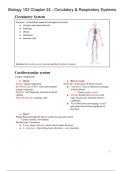
Biology 102 Chapter 24 - Circulatory & Respiratory Systems
Circulatory System
Function - to distribute materials throughout the body.
● Oxygen and carbon dioxide
● Nutrients
● Wastes
● Hormones
● Immune cells
Includes the cardiovascular system and the lymphatic system.
Cardiovascular system
3 major components:
● Blood: ● Blood vessels:
Plasma: liquid component There are 3 main types of blood vessels:
Red blood cells (RBC): bind and transport ■ Capillaries: sites of chemical exchange
oxygen molecules with the blood.
Platelets: cell fragments involved in blood ○ Form capillary beds.
clotting ■ Arteries branch into arterioles and
White blood cells: immune cells carry blood away from the heart to
capillaries.
■ Veins form from converging venules
and return blood from capillaries to
the heart.
● Heart:
Pumps blood through the blood vessels by muscular action
Cardiac muscle: involuntary
Divided into 4 chambers:
● 2 atria (sing. antrium) -where blood enters the heart
● 2 ventricles - where blood exits the heart – very muscular
1
, Biology 102 Chapter 24 - Circulatory & Respiratory Systems
Major blood vessels
Pulmonary arteries The right ventricle (R.V) pumps blood to the lungs via the pulmonary
Pulmonary veins arteries.
Aorta Oxygenated blood returns to the heart via the pulmonary veins.
Vena cava Enters the Left Atrium (L.A).
Oxygenated - red Blood passes from the L.A to the Left Ventricle (L.V).
Deoxygenated - blue L.V pumps blood into the aorta which leads to the systemic circuit.
Deoxygenated blood returns to the right atrium (R.A) via the vena
Superior vena cava: cava.
upper body Blood passes from the R.A to the R.V and the double circuit repeats.
Inferior vena cava: Valves between heart chambers prevent backflow.
lower body
2
Circulatory System
Function - to distribute materials throughout the body.
● Oxygen and carbon dioxide
● Nutrients
● Wastes
● Hormones
● Immune cells
Includes the cardiovascular system and the lymphatic system.
Cardiovascular system
3 major components:
● Blood: ● Blood vessels:
Plasma: liquid component There are 3 main types of blood vessels:
Red blood cells (RBC): bind and transport ■ Capillaries: sites of chemical exchange
oxygen molecules with the blood.
Platelets: cell fragments involved in blood ○ Form capillary beds.
clotting ■ Arteries branch into arterioles and
White blood cells: immune cells carry blood away from the heart to
capillaries.
■ Veins form from converging venules
and return blood from capillaries to
the heart.
● Heart:
Pumps blood through the blood vessels by muscular action
Cardiac muscle: involuntary
Divided into 4 chambers:
● 2 atria (sing. antrium) -where blood enters the heart
● 2 ventricles - where blood exits the heart – very muscular
1
, Biology 102 Chapter 24 - Circulatory & Respiratory Systems
Major blood vessels
Pulmonary arteries The right ventricle (R.V) pumps blood to the lungs via the pulmonary
Pulmonary veins arteries.
Aorta Oxygenated blood returns to the heart via the pulmonary veins.
Vena cava Enters the Left Atrium (L.A).
Oxygenated - red Blood passes from the L.A to the Left Ventricle (L.V).
Deoxygenated - blue L.V pumps blood into the aorta which leads to the systemic circuit.
Deoxygenated blood returns to the right atrium (R.A) via the vena
Superior vena cava: cava.
upper body Blood passes from the R.A to the R.V and the double circuit repeats.
Inferior vena cava: Valves between heart chambers prevent backflow.
lower body
2