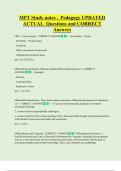
MPT Study notes – Pedagogy UPDATED
ACTUAL Questions and CORRECT
Answers
UDL - Core Concepts - CORRECT ANSWER - - Universality + Equity
- Flexibility + Inclusiveness
- Simplicity
- Safety (emotional and physical)
- Appropriately designed space
(pg. 14-15 of LFA)
Differentiated Instruction (What do students differ significantly on?) - CORRECT
ANSWER - - Strengths
- Interests
- Learning Styles
- Readiness to learn
(pg. 17 of LFA)
Differentiated Instruction. Three broad related concepts in differentiated approach to instruction
are: - CORRECT ANSWER - 1. A safe and non threatening learning environment
encourages learning.
2. Learners must be appropriately challenged.
3. Learners must be able to make meaning of new ideas and skills through significant association
with elements of previous knowledge and experience.
(pg. 17 LFA)
Differentiation and Vygotsky - CORRECT ANSWER - Differentiated instruction is
heavily borrowed from Zone of Proximal Development by Vygotsky. Basically having students
work in a zone that's hard, but not too hard and can be done with instruction with the goal of
moving the student along in their knowledge. This is also referred to as scaffolding.
,(Pg 18 LFA)
What can be differentiated for Differentiated Instruction? - CORRECT ANSWER --
Content
- Process
- Products
- Affect/Environment
(PG. 17 LFA)
Differentiated Instruction includes: - CORRECT ANSWER - - Providing alternative
instructional and assessment activities
- Challenging students at an appropriate level
- Using a variety of groupings to meet student needs.
(PG 18 LFA)
Differentiated Instruction does NOT include - CORRECT ANSWER - - Doing something
different for every student in the classroom
- Disorderly or undisciplined student activity
- Using groups that never change or isolating students who are struggling
- Never engaging in whole-class activities with all students participating in the same endeavor.
(PG 18 LFA)
UDL and DI share the following things: - CORRECT ANSWER - - Taking into account
the background and experiences of all students to meet their diverse interests, aptitudes, and
learning goals.
- Varying the form of assessment and instructional materials
- Using various types of media
- Provide opportunities for different activities and demonstration of learning
,- Provide a safe and supportive learning environment.
(PG 22 LFA)
What can the tiered approach do? - CORRECT ANSWER - • facilitate early identification
of both students who may be at risk and students who may be in need of greater challenges;
• ensure appropriate and timely intervention to address these students' needs and significantly
reduce the likelihood that they will develop more intractable problems in the future.
(PG 24 LFA)
Tier 1 of the tiered approach - CORRECT ANSWER - Assessment and instruction are
planned in relation to the curriculum, DI, and UDL. Teacher observes and monitors student
progress and makes note of students who are having difficulties.
(PG 24 LFA)
Tier 2 of the tiered approach - CORRECT ANSWER - On the basis of assessment results,
differentiation and interventions are planned for students facing difficulties. Student progress in
response to these interventions are monitored and adjusted as necessary.
(PG 24 LFA)
Tier 3 of the tiered approach (The final tier) - CORRECT ANSWER - For students that
require intense support to meet learning goals, even more personalized and precise instruction
and assessment are planned, often with the help of the in-school team or other resources.
Monitoring of progress continues.
(PG 24 LFA)
Assessment FOR learning in context to LFA - CORRECT ANSWER - Assessment for
learning is designed to give teachers information to modify and differentiate teaching and
learning activities. It acknowledges that individual students learn in idiosyncratic ways, but it
also recognizes that there are predictable patterns and pathways that many students follow.
(PG 27 LFA)
, Assessment FOR learning in context to GS - CORRECT ANSWER - Diagnostic
assessment: occurs before instruction begins so teachers can determine students' readiness to
learn new knowledge and skills, as well as obtain information about their interests and learning
preferences.
Formative assessment: • occurs frequently and in an ongoing manner during instruction, while
students are still gaining knowledge and practising skills.
(PG 31 GS)
Assessment AS learning in context to LFA - CORRECT ANSWER - Assessment as
learning is a process of developing and supporting metacognition for students. Assessment as
learning focuses on the role of the student as the critical connector between assessment and
learning. When students are active, engaged, and critical assessors, they make sense of
information, relate it to prior knowledge, and use it for new learning.
(PG 27 LFA)
Assessment AS learning in context to GS - CORRECT ANSWER - Formative assessment:
• occurs frequently and in an ongoing manner during instruction, with support, modelling, and
guidance from the teacher.
(PG 31 GS)
Assessment OF learning in context to LFA - CORRECT ANSWER - Assessment of
learning is summative in nature and is used to confirm what students know and can do, to
demonstrate whether they have achieved the curriculum outcomes, and, occasionally, to show
how they are placed in relation to others.
(PG 27 LFA)
ACTUAL Questions and CORRECT
Answers
UDL - Core Concepts - CORRECT ANSWER - - Universality + Equity
- Flexibility + Inclusiveness
- Simplicity
- Safety (emotional and physical)
- Appropriately designed space
(pg. 14-15 of LFA)
Differentiated Instruction (What do students differ significantly on?) - CORRECT
ANSWER - - Strengths
- Interests
- Learning Styles
- Readiness to learn
(pg. 17 of LFA)
Differentiated Instruction. Three broad related concepts in differentiated approach to instruction
are: - CORRECT ANSWER - 1. A safe and non threatening learning environment
encourages learning.
2. Learners must be appropriately challenged.
3. Learners must be able to make meaning of new ideas and skills through significant association
with elements of previous knowledge and experience.
(pg. 17 LFA)
Differentiation and Vygotsky - CORRECT ANSWER - Differentiated instruction is
heavily borrowed from Zone of Proximal Development by Vygotsky. Basically having students
work in a zone that's hard, but not too hard and can be done with instruction with the goal of
moving the student along in their knowledge. This is also referred to as scaffolding.
,(Pg 18 LFA)
What can be differentiated for Differentiated Instruction? - CORRECT ANSWER --
Content
- Process
- Products
- Affect/Environment
(PG. 17 LFA)
Differentiated Instruction includes: - CORRECT ANSWER - - Providing alternative
instructional and assessment activities
- Challenging students at an appropriate level
- Using a variety of groupings to meet student needs.
(PG 18 LFA)
Differentiated Instruction does NOT include - CORRECT ANSWER - - Doing something
different for every student in the classroom
- Disorderly or undisciplined student activity
- Using groups that never change or isolating students who are struggling
- Never engaging in whole-class activities with all students participating in the same endeavor.
(PG 18 LFA)
UDL and DI share the following things: - CORRECT ANSWER - - Taking into account
the background and experiences of all students to meet their diverse interests, aptitudes, and
learning goals.
- Varying the form of assessment and instructional materials
- Using various types of media
- Provide opportunities for different activities and demonstration of learning
,- Provide a safe and supportive learning environment.
(PG 22 LFA)
What can the tiered approach do? - CORRECT ANSWER - • facilitate early identification
of both students who may be at risk and students who may be in need of greater challenges;
• ensure appropriate and timely intervention to address these students' needs and significantly
reduce the likelihood that they will develop more intractable problems in the future.
(PG 24 LFA)
Tier 1 of the tiered approach - CORRECT ANSWER - Assessment and instruction are
planned in relation to the curriculum, DI, and UDL. Teacher observes and monitors student
progress and makes note of students who are having difficulties.
(PG 24 LFA)
Tier 2 of the tiered approach - CORRECT ANSWER - On the basis of assessment results,
differentiation and interventions are planned for students facing difficulties. Student progress in
response to these interventions are monitored and adjusted as necessary.
(PG 24 LFA)
Tier 3 of the tiered approach (The final tier) - CORRECT ANSWER - For students that
require intense support to meet learning goals, even more personalized and precise instruction
and assessment are planned, often with the help of the in-school team or other resources.
Monitoring of progress continues.
(PG 24 LFA)
Assessment FOR learning in context to LFA - CORRECT ANSWER - Assessment for
learning is designed to give teachers information to modify and differentiate teaching and
learning activities. It acknowledges that individual students learn in idiosyncratic ways, but it
also recognizes that there are predictable patterns and pathways that many students follow.
(PG 27 LFA)
, Assessment FOR learning in context to GS - CORRECT ANSWER - Diagnostic
assessment: occurs before instruction begins so teachers can determine students' readiness to
learn new knowledge and skills, as well as obtain information about their interests and learning
preferences.
Formative assessment: • occurs frequently and in an ongoing manner during instruction, while
students are still gaining knowledge and practising skills.
(PG 31 GS)
Assessment AS learning in context to LFA - CORRECT ANSWER - Assessment as
learning is a process of developing and supporting metacognition for students. Assessment as
learning focuses on the role of the student as the critical connector between assessment and
learning. When students are active, engaged, and critical assessors, they make sense of
information, relate it to prior knowledge, and use it for new learning.
(PG 27 LFA)
Assessment AS learning in context to GS - CORRECT ANSWER - Formative assessment:
• occurs frequently and in an ongoing manner during instruction, with support, modelling, and
guidance from the teacher.
(PG 31 GS)
Assessment OF learning in context to LFA - CORRECT ANSWER - Assessment of
learning is summative in nature and is used to confirm what students know and can do, to
demonstrate whether they have achieved the curriculum outcomes, and, occasionally, to show
how they are placed in relation to others.
(PG 27 LFA)