

COGNITIVE
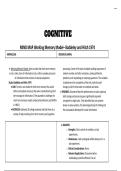
MIND MAP Working Memory Model– Baddeley and Hitch 1974
KNOWLEDGE RESEARCH (AMFA)
● Working Memory Model: Aims to state that short term memory processing. Some of the tasks included recalling sequences of
is not a static store of information, but a rather complex processor random number and letter variations, solving arithmetic
of information that consists of several subsystems. problems, and responding to reasoning questions. The variables
Study: Baddeley and Hitch 1974 included were the complexity of the task, (which would
● AIM: To test a new model of short term memory that could change), and the time taken to complete said tasks.
define and explain processes that were involved during short ● FINDINGS: Discovered that the performance on tasks requiring
term storage of information. (They wanted to challenge the both storage and processing was significantly impaired
short term memory model conducted by Atkinson and Shiffrin compared to single tasks. They identified two sub systems
in 1968.) known as slave systems, the phonological loop for talking and
● METHODS: Gathered 20 college students and had them do a the visuospatial sketchpad for visual information.
variety of tasks involving short term memory and cognitive
● ANALYSIS:
o Strengths: Strict control of variables, via lab
experiments.
o Weaknesses: Lacks ecological validity because it is a
lab experiment.
o Ethical Considerations: None.
o Relevant Applications: Discovered when
multitasking could be effective if at all.
, MIND MAP Reconstructive Memory– Loftus & Palmer (1974)
KNOWLEDGE RESEARCH (AMFA)
● Memory is reconstructive, meaning it is inherently Study: Loftus & Palmer (1974)
unreliable. ● Reconstructive Memory: Retrieval of a memory ● AIM: Whether leading questions can change eye
requires the brain to rebuild it. AKA reconstruction. witness reports.
● Misinformation Effect: When one piece of information ● METHODS: People were shown a video of a car crash. They
distorts memory. were asked how fast they thought the car was going.
● Memory retrieval is reconstructive and memory encoding People were asked with different verbs to see if the
is constructive. answer would change.
● Loftus (1997), seeing if you can plant a fake memory of ● FINDINGS: When asked with smash collided bumped hit
being lost in the mall. contacted the answer changed. (Highest guess to lowest
guess) 40 mph all the way down to 31 mph.
● ANALYSIS:
o Strengths: Broad Real-life applications, isolated ind.
Variable
o Weaknesses: Only college students were asked,
low ecological validity due to only watching a
video, and
differing responses could be due to response bias.
o Ethical Considerations: The use of deception.
o Relevant Applications: This can make eyewitness
testimony in court unreliable. If people’s answers can
be changed based on leading questions.
MIND MAP Flashbulb Memory– Brown & Kulik (1977)
KNOWLEDGE RESEARCH (AMFA)
, ● Flashbulb Memory: Vivid detail in memories typically after Study: Brown & Kulik (1977)
a traumatic event ● AIM: To investigate whether dramatic and personally
● Emotion is a major contributor to flash bulb memory. ● significant events can create flashbulb memories.
Emotion: A complex experience which results in changes. ● METHODS: The researchers used a retrospective
Generally a response to a situation perceived as important. questionnaire to assess the memories of 80 American
participants for the circumstances in which they learned of
public events. The questionnaire tested their memories of
ten major events, including the assassination of John F.
Kennedy, that had taken place 14 years earlier.
● FINDINGS: Memories for such events were particularly
detailed, vivid, and long-lasting. People remembered where
they were, what they were doing and how they heard about
the event. Flashbulb memories are qualitatively different from
other memories, allowing people to remember minor details
of an event that they would otherwise forget.
● ANALYSIS:
o Strengths: 80 participants isn’t large, but is a solid
amount for this study.
o Weaknesses: The vividness of the memories could be
a result of news and other medias describing the
events,
researchers may have mistaken participant confidence
and the supposed vividness of flashbulb memories for
accuracy.
o Ethical Considerations: There are no ethical
considerations.
o Relevant Applications: Helps in understanding PTSD
and trauma as these memories are often caused by
trauma. Can help improve eyewitness testimony.
MIND MAP Working Memory Model– Baddeley and Hitch 1974
KNOWLEDGE RESEARCH (AMFA)
● Working Memory Model: Aims to state that short term memory processing. Some of the tasks included recalling sequences of
is not a static store of information, but a rather complex processor random number and letter variations, solving arithmetic
of information that consists of several subsystems. problems, and responding to reasoning questions. The variables
Study: Baddeley and Hitch 1974 included were the complexity of the task, (which would
● AIM: To test a new model of short term memory that could change), and the time taken to complete said tasks.
define and explain processes that were involved during short ● FINDINGS: Discovered that the performance on tasks requiring
term storage of information. (They wanted to challenge the both storage and processing was significantly impaired
short term memory model conducted by Atkinson and Shiffrin compared to single tasks. They identified two sub systems
in 1968.) known as slave systems, the phonological loop for talking and
● METHODS: Gathered 20 college students and had them do a the visuospatial sketchpad for visual information.
variety of tasks involving short term memory and cognitive
● ANALYSIS:
o Strengths: Strict control of variables, via lab
experiments.
o Weaknesses: Lacks ecological validity because it is a
lab experiment.
o Ethical Considerations: None.
o Relevant Applications: Discovered when
multitasking could be effective if at all.
, MIND MAP Reconstructive Memory– Loftus & Palmer (1974)
KNOWLEDGE RESEARCH (AMFA)
● Memory is reconstructive, meaning it is inherently Study: Loftus & Palmer (1974)
unreliable. ● Reconstructive Memory: Retrieval of a memory ● AIM: Whether leading questions can change eye
requires the brain to rebuild it. AKA reconstruction. witness reports.
● Misinformation Effect: When one piece of information ● METHODS: People were shown a video of a car crash. They
distorts memory. were asked how fast they thought the car was going.
● Memory retrieval is reconstructive and memory encoding People were asked with different verbs to see if the
is constructive. answer would change.
● Loftus (1997), seeing if you can plant a fake memory of ● FINDINGS: When asked with smash collided bumped hit
being lost in the mall. contacted the answer changed. (Highest guess to lowest
guess) 40 mph all the way down to 31 mph.
● ANALYSIS:
o Strengths: Broad Real-life applications, isolated ind.
Variable
o Weaknesses: Only college students were asked,
low ecological validity due to only watching a
video, and
differing responses could be due to response bias.
o Ethical Considerations: The use of deception.
o Relevant Applications: This can make eyewitness
testimony in court unreliable. If people’s answers can
be changed based on leading questions.
MIND MAP Flashbulb Memory– Brown & Kulik (1977)
KNOWLEDGE RESEARCH (AMFA)
, ● Flashbulb Memory: Vivid detail in memories typically after Study: Brown & Kulik (1977)
a traumatic event ● AIM: To investigate whether dramatic and personally
● Emotion is a major contributor to flash bulb memory. ● significant events can create flashbulb memories.
Emotion: A complex experience which results in changes. ● METHODS: The researchers used a retrospective
Generally a response to a situation perceived as important. questionnaire to assess the memories of 80 American
participants for the circumstances in which they learned of
public events. The questionnaire tested their memories of
ten major events, including the assassination of John F.
Kennedy, that had taken place 14 years earlier.
● FINDINGS: Memories for such events were particularly
detailed, vivid, and long-lasting. People remembered where
they were, what they were doing and how they heard about
the event. Flashbulb memories are qualitatively different from
other memories, allowing people to remember minor details
of an event that they would otherwise forget.
● ANALYSIS:
o Strengths: 80 participants isn’t large, but is a solid
amount for this study.
o Weaknesses: The vividness of the memories could be
a result of news and other medias describing the
events,
researchers may have mistaken participant confidence
and the supposed vividness of flashbulb memories for
accuracy.
o Ethical Considerations: There are no ethical
considerations.
o Relevant Applications: Helps in understanding PTSD
and trauma as these memories are often caused by
trauma. Can help improve eyewitness testimony.


