PHYSICS
MOTION
LENGTH AND TIME
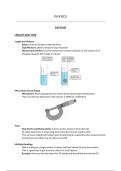
Length and Volume
- Rulers: Used to measure small distances
- Tape Measure: Used to measure large distances
- Measuring Cylinders: Used to measure the volume of liquids, or the volume of an
irregular shape by the change in volume
Micrometre Screw Gauge
- Micrometre: Most appropriate instrument when measuring small distances
- They can measure distances to the nearest 1/100th of a millimetre
Time
- Stop Clocks and Stopwatches: Can be used to measure time intervals
- An important factor in measuring time intervals is human reaction time
- This can have a significant impact upon measurements, especially when measurements
involved are very short (e.g. less than a second)
Multiple Readings
- Take a reading of a large number of values, and then divide them by the number
- This is a good way to get accurate values for small figures
- Example: Measure the time taken for 10 swings and then divide that time by 10
,MOTION
Speed = Total Distance / Total Time
Speed - The distance moved by an object each second. Measured in metres per second.
Velocity - Similar to speed, but includes a direction (direction of travel) as well as its value (its
magnitude). Two objects can have equal speeds but might have opposite velocities, if they are
travelling in opposite directions.
Acceleration = Change in Velocity / Total Time
Speed-Time Graphs
- If the line is horizontal, the speed is constant (no acceleration)
- If the line slopes upwards, then the object is accelerating
- If the line goes down, then the object is decelerating
Distance-Time Graphs
- A horizontal line means that the object is stationary
- A straight line means the object is moving at constant speed
- If the gradient increases, the object is speeding up (accelerating)
- If the gradient decreases, the object is slowing down (decelerating)
- If the line is going down, the object is moving backwards
,Calculating Acceleration on a Speed-Time Graph
Acceleration = Gradient = Rise/Run
- Lines that slope downwards have negative gradients (negative acceleration or
deceleration)
- If the gradient of the line changes, then the acceleration is changing
- A line with a constant gradient represents constant acceleration
- A curved line represents changing acceleration, either decreasing (if gradient gets
smaller) or increasing (if gradient gets larger)
Calculating Distance
- Distance travelled by an object can be found by determining the area below the graph
Freefall
- In the absence of air resistance, all objects fall with the same acceleration, regardless of
their mass
- Acceleration is equal to the gravitational field strength and is approximately 10 m/s2
- If air resistance remains insignificant, the speed of a falling object will increase at a
steady rate, getting larger the longer it falls for
- Acceleration for a body near to the Earth is constant
, Terminal Velocity in a Parachutist
- Initially, air resistance is small and there’s a downwards unbalanced force (acceleration)
- As the skydiver speeds up, the air resistance increases
- Eventually, air resistance balances the weight, so the skydiver travels at constant speed
MASS AND WEIGHT
- Mass - Measured in kilograms, kg. This is the amount of matter in an object
- Weight - Measured in newtons, N. The force of gravity on a mass
- Size of force depends on the gravitational field strength, g
Weight (N) = Mass (kg) x Gravity (N/kg)
w=mxg
- Earth is the source of a gravitational field
- The gravitational force on unit mass is ‘g’, and is measured in N/kg
- The gravitational field strength on Earth is 10N/kg
Comparing Weight and Mass
- The weight (and hence mass) of two objects can be compared using a balance
Significance of Mass
- The mass of an object opposes an attempt to change that object’s motion
- The greater the mass of an object, the more difficult it is to change speed or direction
- Mass is also the source of an object’s weight (the force of gravity on a mass)
- The greater the mass, the greater the weight
MOTION
LENGTH AND TIME
Length and Volume
- Rulers: Used to measure small distances
- Tape Measure: Used to measure large distances
- Measuring Cylinders: Used to measure the volume of liquids, or the volume of an
irregular shape by the change in volume
Micrometre Screw Gauge
- Micrometre: Most appropriate instrument when measuring small distances
- They can measure distances to the nearest 1/100th of a millimetre
Time
- Stop Clocks and Stopwatches: Can be used to measure time intervals
- An important factor in measuring time intervals is human reaction time
- This can have a significant impact upon measurements, especially when measurements
involved are very short (e.g. less than a second)
Multiple Readings
- Take a reading of a large number of values, and then divide them by the number
- This is a good way to get accurate values for small figures
- Example: Measure the time taken for 10 swings and then divide that time by 10
,MOTION
Speed = Total Distance / Total Time
Speed - The distance moved by an object each second. Measured in metres per second.
Velocity - Similar to speed, but includes a direction (direction of travel) as well as its value (its
magnitude). Two objects can have equal speeds but might have opposite velocities, if they are
travelling in opposite directions.
Acceleration = Change in Velocity / Total Time
Speed-Time Graphs
- If the line is horizontal, the speed is constant (no acceleration)
- If the line slopes upwards, then the object is accelerating
- If the line goes down, then the object is decelerating
Distance-Time Graphs
- A horizontal line means that the object is stationary
- A straight line means the object is moving at constant speed
- If the gradient increases, the object is speeding up (accelerating)
- If the gradient decreases, the object is slowing down (decelerating)
- If the line is going down, the object is moving backwards
,Calculating Acceleration on a Speed-Time Graph
Acceleration = Gradient = Rise/Run
- Lines that slope downwards have negative gradients (negative acceleration or
deceleration)
- If the gradient of the line changes, then the acceleration is changing
- A line with a constant gradient represents constant acceleration
- A curved line represents changing acceleration, either decreasing (if gradient gets
smaller) or increasing (if gradient gets larger)
Calculating Distance
- Distance travelled by an object can be found by determining the area below the graph
Freefall
- In the absence of air resistance, all objects fall with the same acceleration, regardless of
their mass
- Acceleration is equal to the gravitational field strength and is approximately 10 m/s2
- If air resistance remains insignificant, the speed of a falling object will increase at a
steady rate, getting larger the longer it falls for
- Acceleration for a body near to the Earth is constant
, Terminal Velocity in a Parachutist
- Initially, air resistance is small and there’s a downwards unbalanced force (acceleration)
- As the skydiver speeds up, the air resistance increases
- Eventually, air resistance balances the weight, so the skydiver travels at constant speed
MASS AND WEIGHT
- Mass - Measured in kilograms, kg. This is the amount of matter in an object
- Weight - Measured in newtons, N. The force of gravity on a mass
- Size of force depends on the gravitational field strength, g
Weight (N) = Mass (kg) x Gravity (N/kg)
w=mxg
- Earth is the source of a gravitational field
- The gravitational force on unit mass is ‘g’, and is measured in N/kg
- The gravitational field strength on Earth is 10N/kg
Comparing Weight and Mass
- The weight (and hence mass) of two objects can be compared using a balance
Significance of Mass
- The mass of an object opposes an attempt to change that object’s motion
- The greater the mass of an object, the more difficult it is to change speed or direction
- Mass is also the source of an object’s weight (the force of gravity on a mass)
- The greater the mass, the greater the weight