CHEMISTRY
THE PARTICULATE NATURE OF MATTER
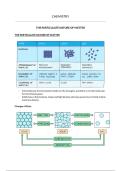
THE PARTICULATE NATURE OF MATTER
- Intermolecular forces between solids are the strongest, and there is no intermolecular
forces between gases
- Solids have a fixed volume, shape and high density, whereas gases have no fixed volume
and a low density
Changes of State
, State Change Description
Melting - Melting is when a solid changes into a liquid
- Requires heat energy which transforms into kinetic energy,
allowing particles to move
- Occurs at the melting point, which is unique to each solid
Evaporation - When a liquid changes into a gas
- Evaporation only occurs at the surface of liquid
- High energy particles can escape from the surface at low
temperature (before boiling)
- Occurs over a range of temperatures; heating speeds up the
process (kinetic energy)
Boiling - Boiling is when a liquid changes into a gas
- Requires heat which causes bubbles of gas to form below
surface which allows liquid particles to escape from the
surface and from within the liquid
- Occurs at the boiling point, which is unique to each pure
liquid
Freezing - Freezing is when a liquid changes into a solid
- Same temperature as melting point
- Requires a significant decrease in temperature (loss of
thermal energy)
- Occurs at the freezing point, which is unique for each pure
substance
Condensation - When a gas changes into a liquid on cooling
- When a gas is cooled, its particles lose energy and when
they bump into each other, they lack the energy to bounce
away again, instead grouping together
Sublimation - When a solid changes directly into a gas
- This happens to only a few solids (e.g. iodine or solid carbon
dioxide)
- The reverse reaction is called de-sublimation or deposition
Atoms, Molecules & Ions
Atom - The smallest particles of an element that consists of electrons surrounding a nucleus
that contains protons and neutrons
Molecule - A group of two or more atoms chemically joined together forming an identifiable
unit which retains the properties and composition of the substance
Ion - An electrically charged atom or group of atoms formed by the loss or gain of electrons,
which takes place to gain a full outer shell of electrons
,DIFFUSION
Diffusion supports the theory that all matter is made up of tiny, moving particles.
Diffusion in Gases
- After 5 minutes, the bromine gas has diffused from the bottom jar to the top jar
- The air and bromine particles are moving randomly and there are large gaps
- Therefore the particles can easily mix together
Diffusion in Liquids
, - The water and potassium manganate (VII) particles are moving randomly and the
particles can slide over each other
- The particles can therefore easily mix together
- Diffusion in liquids is slower than in gases because the particles in a liquid are closely
packed together and move more slowly
Dependence of Rate of Diffusion on Molecular Mass
- The smaller the molecular mass, the less energy it needs to move
- At the same rate, molecules with lower mass will move faster than molecules with more
mass
- The smaller the molecular mass, the greater the rate of diffusion
EXPERIMENTAL TECHNIQUES
MEASUREMENT
Time
- Can be measured using a stopwatch or stopwatch
- They are usually accurate to one or two decimal places
- The units of time normally used are seconds or minutes
- Different units may be used for extremely slow reactions (e.g. rusting)
Temperature
- Measured with a thermometer
Readings are normally given to the nearest degree Celsius
- Digital thermometers are more precise than traditional thermometers
- Traditional thermometers rely on uniform expansion and are more accurate as digital
thermometers often need to be re-calibrated
Mass
- Mass is measured using a digital balance
- Readings are usually given to two decimal places - must be tared (set to 0) before use
- The standard unit of mass is kilograms (kg) or grams (g)
- 1 kilogram = 1000 grams
Volume (Liquids)
- Can be determined using various apparatus, depending on the level of accuracy needed
- For approximate volumes where accuracy isn’t important, measuring cylinders are used
- Has a scale (graduated) and are available in 25m3, 50cm3, 100cm3, 250cm3
- Pipettes are the most accurate way of measuring a fixed volume of liquid
- They are usually in 10cm3 or 25cm3
- Burettes are the most accurate way of measuring a variable volume of liquid
- Between 0cm3 and 50cm3 (e.g. in a titration)
THE PARTICULATE NATURE OF MATTER
THE PARTICULATE NATURE OF MATTER
- Intermolecular forces between solids are the strongest, and there is no intermolecular
forces between gases
- Solids have a fixed volume, shape and high density, whereas gases have no fixed volume
and a low density
Changes of State
, State Change Description
Melting - Melting is when a solid changes into a liquid
- Requires heat energy which transforms into kinetic energy,
allowing particles to move
- Occurs at the melting point, which is unique to each solid
Evaporation - When a liquid changes into a gas
- Evaporation only occurs at the surface of liquid
- High energy particles can escape from the surface at low
temperature (before boiling)
- Occurs over a range of temperatures; heating speeds up the
process (kinetic energy)
Boiling - Boiling is when a liquid changes into a gas
- Requires heat which causes bubbles of gas to form below
surface which allows liquid particles to escape from the
surface and from within the liquid
- Occurs at the boiling point, which is unique to each pure
liquid
Freezing - Freezing is when a liquid changes into a solid
- Same temperature as melting point
- Requires a significant decrease in temperature (loss of
thermal energy)
- Occurs at the freezing point, which is unique for each pure
substance
Condensation - When a gas changes into a liquid on cooling
- When a gas is cooled, its particles lose energy and when
they bump into each other, they lack the energy to bounce
away again, instead grouping together
Sublimation - When a solid changes directly into a gas
- This happens to only a few solids (e.g. iodine or solid carbon
dioxide)
- The reverse reaction is called de-sublimation or deposition
Atoms, Molecules & Ions
Atom - The smallest particles of an element that consists of electrons surrounding a nucleus
that contains protons and neutrons
Molecule - A group of two or more atoms chemically joined together forming an identifiable
unit which retains the properties and composition of the substance
Ion - An electrically charged atom or group of atoms formed by the loss or gain of electrons,
which takes place to gain a full outer shell of electrons
,DIFFUSION
Diffusion supports the theory that all matter is made up of tiny, moving particles.
Diffusion in Gases
- After 5 minutes, the bromine gas has diffused from the bottom jar to the top jar
- The air and bromine particles are moving randomly and there are large gaps
- Therefore the particles can easily mix together
Diffusion in Liquids
, - The water and potassium manganate (VII) particles are moving randomly and the
particles can slide over each other
- The particles can therefore easily mix together
- Diffusion in liquids is slower than in gases because the particles in a liquid are closely
packed together and move more slowly
Dependence of Rate of Diffusion on Molecular Mass
- The smaller the molecular mass, the less energy it needs to move
- At the same rate, molecules with lower mass will move faster than molecules with more
mass
- The smaller the molecular mass, the greater the rate of diffusion
EXPERIMENTAL TECHNIQUES
MEASUREMENT
Time
- Can be measured using a stopwatch or stopwatch
- They are usually accurate to one or two decimal places
- The units of time normally used are seconds or minutes
- Different units may be used for extremely slow reactions (e.g. rusting)
Temperature
- Measured with a thermometer
Readings are normally given to the nearest degree Celsius
- Digital thermometers are more precise than traditional thermometers
- Traditional thermometers rely on uniform expansion and are more accurate as digital
thermometers often need to be re-calibrated
Mass
- Mass is measured using a digital balance
- Readings are usually given to two decimal places - must be tared (set to 0) before use
- The standard unit of mass is kilograms (kg) or grams (g)
- 1 kilogram = 1000 grams
Volume (Liquids)
- Can be determined using various apparatus, depending on the level of accuracy needed
- For approximate volumes where accuracy isn’t important, measuring cylinders are used
- Has a scale (graduated) and are available in 25m3, 50cm3, 100cm3, 250cm3
- Pipettes are the most accurate way of measuring a fixed volume of liquid
- They are usually in 10cm3 or 25cm3
- Burettes are the most accurate way of measuring a variable volume of liquid
- Between 0cm3 and 50cm3 (e.g. in a titration)