week 1 - lecture 1
Today's class is about catching up. It will be a recap of the last course.
Collection of data has led to more people doing empirical work today. It is a very fast growing field.
You should be familiar with data.
Logistics of the class:
- Meet twice a week (tuesdays 15-17 and thursdays 9--13)
- Final exam counts 100%
In the exam there will be more multiple choice questions than in the exam of the first course.
, week 2 - lecture 2
Arrow's impossibility theorem:
If we have multiple members compete, rational choices of the individual level do not necessarily translate to
rational choices on the aggregate level.
The theory is named after the American economist Kenneth Arrow. wikipedia
When voters have three or more distinct alternatives (options), no ranked voting electoral system can
convert the ranked preferences of individuals into a community-wide (complete and transitive) ranking while
also meeting a specified set of criteria: unrestricted domain, non-dictatorship, Pareto efficiency, and
independence of irrelevant alternatives.
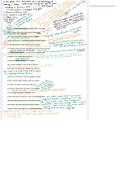
Last week's graph: S
As parties start negotiating, according to Coasian O
f-
CE
• C
bargaining. They wil collaborate because of this. §
I
Wherever you end up on the lines of the triangle,
it is Pareto efficient. This is because whenever
you move, someone is worse off.
•
For Kaldor-Hicks, the points at the lines of the BE
• B
triangle are inefficient. This is because if you
were to end up in the middle of the triangle, it
would be more efficient. Getting in the middle
means getting closer to some of the bliss points, CH
which means that the most people wil get most. BH healthcare
Ideally you would prefer the absolute middle of
the triangle. You want more. 3 party political system: bargaining and coalitions
Kaldor-Hicks: all of the functions are concave.
concave
convex
Today's class is about catching up. It will be a recap of the last course.
Collection of data has led to more people doing empirical work today. It is a very fast growing field.
You should be familiar with data.
Logistics of the class:
- Meet twice a week (tuesdays 15-17 and thursdays 9--13)
- Final exam counts 100%
In the exam there will be more multiple choice questions than in the exam of the first course.
, week 2 - lecture 2
Arrow's impossibility theorem:
If we have multiple members compete, rational choices of the individual level do not necessarily translate to
rational choices on the aggregate level.
The theory is named after the American economist Kenneth Arrow. wikipedia
When voters have three or more distinct alternatives (options), no ranked voting electoral system can
convert the ranked preferences of individuals into a community-wide (complete and transitive) ranking while
also meeting a specified set of criteria: unrestricted domain, non-dictatorship, Pareto efficiency, and
independence of irrelevant alternatives.
Last week's graph: S
As parties start negotiating, according to Coasian O
f-
CE
• C
bargaining. They wil collaborate because of this. §
I
Wherever you end up on the lines of the triangle,
it is Pareto efficient. This is because whenever
you move, someone is worse off.
•
For Kaldor-Hicks, the points at the lines of the BE
• B
triangle are inefficient. This is because if you
were to end up in the middle of the triangle, it
would be more efficient. Getting in the middle
means getting closer to some of the bliss points, CH
which means that the most people wil get most. BH healthcare
Ideally you would prefer the absolute middle of
the triangle. You want more. 3 party political system: bargaining and coalitions
Kaldor-Hicks: all of the functions are concave.
concave
convex