

Study unit 3: Varied strategies for effective classroom management
Section 3.1 –
Managing the
classroom
environment
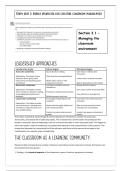
LEADERSHIP APPROACHES
Leadership style: Advantages: Disadvantages
Autocratic Leadership Quick decision-making. Can reduce creativity and
innovation.
Explanation: The leader makes Clear direction and expectations.
decisions alone, giving clear Lowers team morale if overused.
instructions and expecting strict Works well in crisis or with
compliance. inexperienced teams. Risk of dependency on the leader.
Democratic Leadership Increases motivation and job Slower decision making
satisfaction
Explanation: The leader involves Can cause conflict if opinions differ
team members in decision-making, Promotes creativity and innovation
encouraging participation and Less effective in emergencies
feedback. Builds teamwork and trust
Laissez-faire Leadership Encourages independence and Can lead to lack of direction and
creativity. confusion.
Explanation: The leader provides
minimal direction, allowing team Works well with highly skilled and Risk of low productivity if team
members to make decisions and self-motivated teams. members are unmotivated.
work independently.
Fosters innovation and personal Leader may appear uninvolved or
growth. absent.
Three basic leadership styles (Kruger & Van Schalkwyk) are introduced, namely the autocratic,
democratic, and laissez-faire leadership styles. The characteristics of the leader will predispose the
leader to a specific style of leadership, such as a more democratic or more autocratic style. The degree to
which the leader’s style of leadership is accepted will depend on the characteristics of the learners. The
interaction between the characteristics of the educator and those of the learners thus leads to the
manifestation of a specific style of leadership.
THE CLASSROOM AS A LEARNING COMMUNITY:
Research data indicates that a number of factors could influence the classroom climate. The factors can
be clustered into four groups :
1. Ecology – the physical aspects of the classroom: space, furniture, equipment, etcetera
,2. Milieu – that part of the classroom that can be described as the “feeling" of the class
3. Social system – the formal and informal rules that guide interpersonal relationships in the classroom
4. Culture – the values, beliefs, systems, and norms existing in the classroom.
Features of a learning community:
• Classroom properties
• Classroom Processes
• Classroom Structures
Three dimensions
of classrooms
• Teachers who are successful at creating a good atmosphere in the classroom exhibit the
following human relationship skills: communication skills, fostering a sense if individual
importance, fostering a sense of belonging.
• The dev. of a positive learning environment happens in stages.
Building stages for a positive classroom climate:
• Educators should strive for consistency !!
• This can be achieved by understanding that there are different consequential stages in building a
positive climate in the class.
1. The establishment phase:
The focus is preventative, the educators aims at minimising disruptions by having a balance of
rights, responsibilities, rules and routines. The agendas you set at this stage determines your
success in implementing a classroom management plan. At this stage, learners are psychologically
and developmentally ready for the educators to clarify how the class is suppose to work.
2. The consolidation phase:
It is NB that the teacher to continue to teach, encourage and maintain what was establish.
3. The cohesive phase:
This phase is characterised by strong relational ties with the class and a positive working knowledge
of the class and its individual dynamics. Class management has now moved into a relational phase.
To build effective relationships requires effort, commitment and skill (building rapport with learners).
By establishing rapport, you are making connections with learnersat an emotional level. Learners
are comfortable with you and trust you.
,Managing the physical environment:
• The way a class is arranged, communicates the message about expectatioons of how the room
should be used.
• When organizing layout of class, teacher must keep the following into consideration: visibility,
flexibility, aesthetics, accessibility and comfort.
Seating formations:
Horizontal rows • Independent word presentations and
recitations
• Learners focus on the educator
• Work more easily in pairs
• Good for drmondtrations
• A poor arrangement for large group interaction
Clusters of 4 and circle arrangement • Best for learner interaction
• Allows for individual work
• Circles are good for discussions
• Clusters permit learners to talk and help and
do group tasks
• Not conducive to whole-group presentations
Stack formation • Learners sit close together near the focus of
attention
• Used for short periods of time as its not
comfortable
• Created a feeling of group cohesion
• Helpful for demonstrations, brainstorming
sessions
• Useful for seeing a small visual aid.
Managing resources for effective teaching:
• Class sizes are an issue for teachers recently.
• The problem is quality (instruction) vs quantity.
• Large classes bring the following issues : they do not know whether they are progressing or not,
they do not know how to improve, they don’t have the opportunity to read widely, the, lack of
opportunity for discussion, teacher unable to cope with variety of learners and their particular
learning needs.
• A key aspect of managing learning in a large classroom is often the production of appropriate
resources.
• Resources are often the lens through which learners view the learning area and the lesson.
• Your materials and media should be:
• Accurate
Resources should be tied to the age • Well laid out
and ability range of the class, the • Readable
time available, the teaching strategy, • Interesting and varied
layout and the likely reactions of the • Linked to the outcomes and contents of the
learners lesson
• Sufficient
• Used constructively
, Independence strategies:
• One way to address the problems of managing learning in a large class, is to use “independence”
strategies by which learners are motivated to become independent learners.
The flipped classroom
• Another way to manage large classes is to apply the “flipped” classroom model, which is
becoming popular due to the advancement of technology in the classroom.
• Implementing a flipped classroom in a big class size, may boost academic attainment as it
enables more focused teaching and learning to take place.
• The flipped classrooms online learning material enables teachers to coach large classes as
learners engage with the topic through the internet while for its in-class teaching approach,
small-group discussions, peer-learning and enquiry-learning can be used to engage learners in
their learning, especially for a big class size.
• The flipped classroom promotes an environment that
In short, a flipped classroom means that
increases the interaction btw learners and teachers and
learners watch the lesson at home, and then
do the application or homework in class what
engages learners in learning through application and practice.
teachers are available. • Uses a learner-centred approach.
• Limitations: requires careful prep, prerecording lessons require skill/time, out-of-class and in-
class learning need to be carefully integrated, concerns on access to internet, responsibilities of
learner to watch the lesson.
Establishing the socioemotional environment:
Definition:
A socioemotional environment refers to the
overall emotional and social climate in a
setting (such as a classroom, workplace, or
home) that influences how people feel,
interact, and build relationships.
It includes aspects like support, trust,
respect, sense of belonging, and emotional
well-being.
• “The quality of the educator–learner relationship therefore, has a dramatic effect on whether
a learner’s personal needs are met in the classroom”. Communication is essential for any
relationship, especially for the relationship between educator and learner. In fact, effective
communication skills form the foundation of sound
classroom management.
Communication:
• Communication skills form the foundation for sound class
management.
Section 3.1 –
Managing the
classroom
environment
LEADERSHIP APPROACHES
Leadership style: Advantages: Disadvantages
Autocratic Leadership Quick decision-making. Can reduce creativity and
innovation.
Explanation: The leader makes Clear direction and expectations.
decisions alone, giving clear Lowers team morale if overused.
instructions and expecting strict Works well in crisis or with
compliance. inexperienced teams. Risk of dependency on the leader.
Democratic Leadership Increases motivation and job Slower decision making
satisfaction
Explanation: The leader involves Can cause conflict if opinions differ
team members in decision-making, Promotes creativity and innovation
encouraging participation and Less effective in emergencies
feedback. Builds teamwork and trust
Laissez-faire Leadership Encourages independence and Can lead to lack of direction and
creativity. confusion.
Explanation: The leader provides
minimal direction, allowing team Works well with highly skilled and Risk of low productivity if team
members to make decisions and self-motivated teams. members are unmotivated.
work independently.
Fosters innovation and personal Leader may appear uninvolved or
growth. absent.
Three basic leadership styles (Kruger & Van Schalkwyk) are introduced, namely the autocratic,
democratic, and laissez-faire leadership styles. The characteristics of the leader will predispose the
leader to a specific style of leadership, such as a more democratic or more autocratic style. The degree to
which the leader’s style of leadership is accepted will depend on the characteristics of the learners. The
interaction between the characteristics of the educator and those of the learners thus leads to the
manifestation of a specific style of leadership.
THE CLASSROOM AS A LEARNING COMMUNITY:
Research data indicates that a number of factors could influence the classroom climate. The factors can
be clustered into four groups :
1. Ecology – the physical aspects of the classroom: space, furniture, equipment, etcetera
,2. Milieu – that part of the classroom that can be described as the “feeling" of the class
3. Social system – the formal and informal rules that guide interpersonal relationships in the classroom
4. Culture – the values, beliefs, systems, and norms existing in the classroom.
Features of a learning community:
• Classroom properties
• Classroom Processes
• Classroom Structures
Three dimensions
of classrooms
• Teachers who are successful at creating a good atmosphere in the classroom exhibit the
following human relationship skills: communication skills, fostering a sense if individual
importance, fostering a sense of belonging.
• The dev. of a positive learning environment happens in stages.
Building stages for a positive classroom climate:
• Educators should strive for consistency !!
• This can be achieved by understanding that there are different consequential stages in building a
positive climate in the class.
1. The establishment phase:
The focus is preventative, the educators aims at minimising disruptions by having a balance of
rights, responsibilities, rules and routines. The agendas you set at this stage determines your
success in implementing a classroom management plan. At this stage, learners are psychologically
and developmentally ready for the educators to clarify how the class is suppose to work.
2. The consolidation phase:
It is NB that the teacher to continue to teach, encourage and maintain what was establish.
3. The cohesive phase:
This phase is characterised by strong relational ties with the class and a positive working knowledge
of the class and its individual dynamics. Class management has now moved into a relational phase.
To build effective relationships requires effort, commitment and skill (building rapport with learners).
By establishing rapport, you are making connections with learnersat an emotional level. Learners
are comfortable with you and trust you.
,Managing the physical environment:
• The way a class is arranged, communicates the message about expectatioons of how the room
should be used.
• When organizing layout of class, teacher must keep the following into consideration: visibility,
flexibility, aesthetics, accessibility and comfort.
Seating formations:
Horizontal rows • Independent word presentations and
recitations
• Learners focus on the educator
• Work more easily in pairs
• Good for drmondtrations
• A poor arrangement for large group interaction
Clusters of 4 and circle arrangement • Best for learner interaction
• Allows for individual work
• Circles are good for discussions
• Clusters permit learners to talk and help and
do group tasks
• Not conducive to whole-group presentations
Stack formation • Learners sit close together near the focus of
attention
• Used for short periods of time as its not
comfortable
• Created a feeling of group cohesion
• Helpful for demonstrations, brainstorming
sessions
• Useful for seeing a small visual aid.
Managing resources for effective teaching:
• Class sizes are an issue for teachers recently.
• The problem is quality (instruction) vs quantity.
• Large classes bring the following issues : they do not know whether they are progressing or not,
they do not know how to improve, they don’t have the opportunity to read widely, the, lack of
opportunity for discussion, teacher unable to cope with variety of learners and their particular
learning needs.
• A key aspect of managing learning in a large classroom is often the production of appropriate
resources.
• Resources are often the lens through which learners view the learning area and the lesson.
• Your materials and media should be:
• Accurate
Resources should be tied to the age • Well laid out
and ability range of the class, the • Readable
time available, the teaching strategy, • Interesting and varied
layout and the likely reactions of the • Linked to the outcomes and contents of the
learners lesson
• Sufficient
• Used constructively
, Independence strategies:
• One way to address the problems of managing learning in a large class, is to use “independence”
strategies by which learners are motivated to become independent learners.
The flipped classroom
• Another way to manage large classes is to apply the “flipped” classroom model, which is
becoming popular due to the advancement of technology in the classroom.
• Implementing a flipped classroom in a big class size, may boost academic attainment as it
enables more focused teaching and learning to take place.
• The flipped classrooms online learning material enables teachers to coach large classes as
learners engage with the topic through the internet while for its in-class teaching approach,
small-group discussions, peer-learning and enquiry-learning can be used to engage learners in
their learning, especially for a big class size.
• The flipped classroom promotes an environment that
In short, a flipped classroom means that
increases the interaction btw learners and teachers and
learners watch the lesson at home, and then
do the application or homework in class what
engages learners in learning through application and practice.
teachers are available. • Uses a learner-centred approach.
• Limitations: requires careful prep, prerecording lessons require skill/time, out-of-class and in-
class learning need to be carefully integrated, concerns on access to internet, responsibilities of
learner to watch the lesson.
Establishing the socioemotional environment:
Definition:
A socioemotional environment refers to the
overall emotional and social climate in a
setting (such as a classroom, workplace, or
home) that influences how people feel,
interact, and build relationships.
It includes aspects like support, trust,
respect, sense of belonging, and emotional
well-being.
• “The quality of the educator–learner relationship therefore, has a dramatic effect on whether
a learner’s personal needs are met in the classroom”. Communication is essential for any
relationship, especially for the relationship between educator and learner. In fact, effective
communication skills form the foundation of sound
classroom management.
Communication:
• Communication skills form the foundation for sound class
management.


