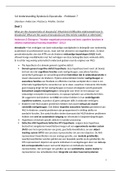
Introduction to Finance and Accounting
Semester 1b – summary
Chapter 1: Financial Statements
1.1Balance Sheet
The balance sheet is an overview of the financial situation of a company at a particular
moment in time.
Each financial transaction that happens influences the balance sheet balance sheet
mutations.
Assets resources that a company owns, displayed on the debit side of balance sheet, you
always put them from highest to lowest.
Assets that can be used more than once are known as non-current assets or fixed
assets. Examples of these assets are cars, equipment, buildings etc.
Assets that can be used only once are knows as current assets, examples of these
assets are inventory.
Financing Sources Always on the credit side
Equity: amount of money that the owners have invested in the company
Non-current liabilities: long term financial obligations of the company to others (long
term loan/ mortgage)
Current liabilities: short term obligations, amounts the company still needs to pay to
the owner, trade payables, short term (within 1 year)
Assets: equity + liabilities
There must always be an equilibrium on the balance sheet, this means that the debit and
credit side are equal.
Accounts receivable debit
Trade Payable credit
The equity increases when
- There is a direct investment by the owner
- There is reinvestment of the profit in the business
Equity decreases when
- Direct capital withdrawal by owner
- Business realizes a loss
Equity = assets – debts
Equity = original equity +/- profit/loss + capital injections – capital withdrawals
Sometimes you need to calculate the depreciation. This is only done for non-current assets.
You calculate the depreciation by:
(value- scrap value)/ amount of periods
Redemption = paying back money you borrowed ( = paying back a loan)
Receivables → when you don’t receive the cash yet but do deliver the product already
Pre-paid → when you have paid for something already.
, 1.2 Income Statement
= profit and loss statement, it shows the revenues and expenses over a certain period of
time.
Revenues Monetary value of goods and services sold
Expenses Monetary value of production means used.
Having revenues is not the same as receiving money.
Cash Basis Accounting: only recognizes a transaction when you spend or receive money
(e.g. when you cash a check) this form of accounting is better if you deal with customers and
have a lot of transactions.
Accrual Basis Accounting: recognizes a transaction when money is earned buy noy
exchanged (e.g. sending an invoice) this method is best if you deal with large businesses
and don’t always get paid right away.
Depreciation = the loss of value of tangible fixed assets.
This is an expense because you used the asset and now Symbols
it is worth less, depreciation is never a payment. A Annuity
Sales
Expenses P Perpetuity
COGS
S Sum (singleProfit
Gross amount)
- Cost of goods sold cost of producing or R Discount
Overhead (expressed
rate in %) (6% =
costs + depreciation
acquiring the goods or services sold. 0.06)
- Operating expenses expenses related to the EBIT
N Number of periods
Interest
operations of the company like: selling, general & G Growth
administrative expenses, salaries, rent, property EBT rate (expressed in %)
PV Present
Tax Value
taxes, depreciation
- Financing expenses interest expenses, lease FV Future
Net Value
income
expenses
- Income tax the income is taxed by the government
Gross Profit = the difference between revenue and costs of goods sold
Costs of producing and acquiring goods or services are charged to the income statement in
the period they are sold
1.3 Cash Flow Statement
Receipts = all the money that flows into the firm over a certain period
Payments = all the money that flows out of the firm over a certain period.
Net Cash Flow difference between cash receipts and cash payments
Chapter 2: Time Value of Money
2.1 Simple and Compound Interest
Simple Interest is calculated by:
Interest = principal * interest rate * number of periods
With compound interest you also gain interest over interest. You can calculate this with the
following formulas:
Future Value = S * (1 + r) n
Present Value = S * (1/(1+r)n)
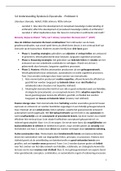
Semester 1b – summary
Chapter 1: Financial Statements
1.1Balance Sheet
The balance sheet is an overview of the financial situation of a company at a particular
moment in time.
Each financial transaction that happens influences the balance sheet balance sheet
mutations.
Assets resources that a company owns, displayed on the debit side of balance sheet, you
always put them from highest to lowest.
Assets that can be used more than once are known as non-current assets or fixed
assets. Examples of these assets are cars, equipment, buildings etc.
Assets that can be used only once are knows as current assets, examples of these
assets are inventory.
Financing Sources Always on the credit side
Equity: amount of money that the owners have invested in the company
Non-current liabilities: long term financial obligations of the company to others (long
term loan/ mortgage)
Current liabilities: short term obligations, amounts the company still needs to pay to
the owner, trade payables, short term (within 1 year)
Assets: equity + liabilities
There must always be an equilibrium on the balance sheet, this means that the debit and
credit side are equal.
Accounts receivable debit
Trade Payable credit
The equity increases when
- There is a direct investment by the owner
- There is reinvestment of the profit in the business
Equity decreases when
- Direct capital withdrawal by owner
- Business realizes a loss
Equity = assets – debts
Equity = original equity +/- profit/loss + capital injections – capital withdrawals
Sometimes you need to calculate the depreciation. This is only done for non-current assets.
You calculate the depreciation by:
(value- scrap value)/ amount of periods
Redemption = paying back money you borrowed ( = paying back a loan)
Receivables → when you don’t receive the cash yet but do deliver the product already
Pre-paid → when you have paid for something already.
, 1.2 Income Statement
= profit and loss statement, it shows the revenues and expenses over a certain period of
time.
Revenues Monetary value of goods and services sold
Expenses Monetary value of production means used.
Having revenues is not the same as receiving money.
Cash Basis Accounting: only recognizes a transaction when you spend or receive money
(e.g. when you cash a check) this form of accounting is better if you deal with customers and
have a lot of transactions.
Accrual Basis Accounting: recognizes a transaction when money is earned buy noy
exchanged (e.g. sending an invoice) this method is best if you deal with large businesses
and don’t always get paid right away.
Depreciation = the loss of value of tangible fixed assets.
This is an expense because you used the asset and now Symbols
it is worth less, depreciation is never a payment. A Annuity
Sales
Expenses P Perpetuity
COGS
S Sum (singleProfit
Gross amount)
- Cost of goods sold cost of producing or R Discount
Overhead (expressed
rate in %) (6% =
costs + depreciation
acquiring the goods or services sold. 0.06)
- Operating expenses expenses related to the EBIT
N Number of periods
Interest
operations of the company like: selling, general & G Growth
administrative expenses, salaries, rent, property EBT rate (expressed in %)
PV Present
Tax Value
taxes, depreciation
- Financing expenses interest expenses, lease FV Future
Net Value
income
expenses
- Income tax the income is taxed by the government
Gross Profit = the difference between revenue and costs of goods sold
Costs of producing and acquiring goods or services are charged to the income statement in
the period they are sold
1.3 Cash Flow Statement
Receipts = all the money that flows into the firm over a certain period
Payments = all the money that flows out of the firm over a certain period.
Net Cash Flow difference between cash receipts and cash payments
Chapter 2: Time Value of Money
2.1 Simple and Compound Interest
Simple Interest is calculated by:
Interest = principal * interest rate * number of periods
With compound interest you also gain interest over interest. You can calculate this with the
following formulas:
Future Value = S * (1 + r) n
Present Value = S * (1/(1+r)n)