

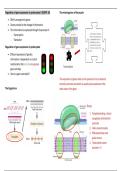
Regulation of gene expression in prokaryotes I (KCSPK 16) The missing piece of the puzzle
• DNA is arranged into genes
• Genes provide for the storage of information
• This information is expressed through the process of:
- Transcription
- Translation
Regulation of gene expression in prokaryotes
• E=icient expression of genetic
information is dependent on control
mechanisms that promote or suppress
gene activities
• How is a gene controlled?
The expression of genes relies on the presence of a cis element
termed a promoter and which is usually found upstream of the
The big picture start codon of the gene
Recap
1. Template binding: s factor
recognizes and binds the
promoter
2. Helix unwinds locally
3. RNA polymerase core
gains access
4. Transcription starts
(position +1)
, Regulation of gene expression in prokaryotes
• Early studies in bacteria and yeast: easy to culture and
mutate, noticed fluctuating protein levels in response to
environmental conditions
• Adaptation hypothesis: lactose in growth medium induces
expression of enzymes specific for lactose metabolism
• Constitutive, inducible, repressible systems, negative or
positive control
- Negative control – expression happens unless actively
suppressed
- Positive control – expression is suppressed unless
actively stimulated
The lac operon
Inducible system: lactose metabolism in E. coli • Prokaryotic genes with related functions are organized in
• Lactose = galactose + glucose groups and are expressed in a coordinated fashion (operon)
• Enzymes responsible for lac metabolism:
- Lac- → 5-10 copies
- Lac+ → 1000s of copies
• Enzymes are therefore inducible
- Lactose is the inducer
• DNA is arranged into genes
• Genes provide for the storage of information
• This information is expressed through the process of:
- Transcription
- Translation
Regulation of gene expression in prokaryotes
• E=icient expression of genetic
information is dependent on control
mechanisms that promote or suppress
gene activities
• How is a gene controlled?
The expression of genes relies on the presence of a cis element
termed a promoter and which is usually found upstream of the
The big picture start codon of the gene
Recap
1. Template binding: s factor
recognizes and binds the
promoter
2. Helix unwinds locally
3. RNA polymerase core
gains access
4. Transcription starts
(position +1)
, Regulation of gene expression in prokaryotes
• Early studies in bacteria and yeast: easy to culture and
mutate, noticed fluctuating protein levels in response to
environmental conditions
• Adaptation hypothesis: lactose in growth medium induces
expression of enzymes specific for lactose metabolism
• Constitutive, inducible, repressible systems, negative or
positive control
- Negative control – expression happens unless actively
suppressed
- Positive control – expression is suppressed unless
actively stimulated
The lac operon
Inducible system: lactose metabolism in E. coli • Prokaryotic genes with related functions are organized in
• Lactose = galactose + glucose groups and are expressed in a coordinated fashion (operon)
• Enzymes responsible for lac metabolism:
- Lac- → 5-10 copies
- Lac+ → 1000s of copies
• Enzymes are therefore inducible
- Lactose is the inducer


