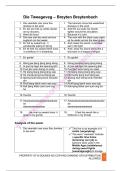
Die Tweegeveg – Breyten Breytenbach
1. Die vaandels roer soos flou 1. The banners move like weak/tired
donkies in die wind donkeys in the wind
2. En die son trek sy wolke stywer 2. And the sun pulls his clouds
om sy skouers, tighter around his shoulders
3. Want dis koud 3. Because it is cold
4. Die man met die swart oë kom 4. The man with the black eyes sighs
sugtend oor die kweek as he walks across the lawn/grass
5. En hef sy swaard op, ‘n 5. And raises his sword, a petrified
versteende paling in die lig eel in the light
6. En ek trek my swaard blink soos 6. And I draw my sword shiny like a
‘n proefbuis of ‘n draaktong test tube or a dragon’s tongue
7. En garde! 7. En garde!
8. Kleng jaa tjeng tjang tjeng kleng 8. Kleng jaa tjeng tjang tjeng kleng
9. Ai joei tsji tsjan bik sjoening tjôrr 9. Ai joei tsji tsjan bik sjoening tjôrr
10. Fuut tjen wam kieng oo sssip 10. Fuut tjen wam kieng oo sssip
11. Hû klang klang klang tjing ssip 11. Hû klang klang klang tjing ssip
12. Hû merde tjong fuut kleng jaa 12. Hû merde tjong fuut kleng jaa
13. Sjoeng klub kieng konk hoender 13. Sjoeng klub kieng konk hoender
dirr dirr
14. Rruff tjang tijenk warn aaa ssip 14. Rruff tjang tijenk warn aaa ssip
15. Kak tjeng kleks zem zum ung 15. Kak tjeng kleks zem zum ung ha
ha
16. Touché 16. Touché
17. Aaaaaaaaaaaaaaaaaaaaaaaaa 17. Aaaaaaaaaaaaaaaaaaaaaaaaaaa
aa aa
aaaaaaaaaaaaaaaa aaaaaaaaaaaaaaaaaa
18. (ek voel sy swaard soos ‘n 18. (I feel his sword like a
graat in my gorrel) fishbone in my throat)
Analysis of the poem
1. Die vaandels roer soos flou donkies This line is an example of a
in die wind simile (vergelyking).
The word “vaandels” indicate
a specific time frame
(beraming van tyd) as
banners were used in the
Middle Ages (middeleeue)
during sword fights
(swaardgevegte) to divulge
PROPERTY OF M SOUNES NO COPYING SHARING OR DISTRIBUTION
1
ALLOWED
, (gee) certain details or
information about the two
people in the dual
(tweegeveg) such as the
status of the fighter (vegter),
their religion (geloof) and if
they were of noble descent
(adellike afkoms). The
banners basically served as
identifiers (identifiseerders).
The way (manier) the banners
move (beweeg) indicates (dui
aan) that it is not a very
strong (sterk) wind as it is
being compared to (vergelyk
met) “weak donkeys”,
signifying that there is very
little (min) movement
(beweging).
Alliteration of the v/f-sound
(klank)
2. En die son trek sy wolke stywer om This is an example of
sy skouers, personification
(personifikasie). It also
provides (verskaf) the reader
with more background
(agtergrond) as to the
conditions (kondisies)
surrounding the weather
(die weersomstandighede)
of this dual (tweegeveg): it
was cloudy (bewolk).
This serves (dien) to create
(skep) a tense
(spanningsvolle)
atmosphere (atmosfeer)
filled with anticipation
(afwagting).
The sun being cold is also an
example of a contradiction
(kontras).
The s-alliteration adds to this
anticipation (afwagting).
3. Want dis koud Elaborating on why the sun is
using the clouds to “cover”
him: it is cold.
PROPERTY OF M SOUNES NO COPYING SHARING OR DISTRIBUTION
2
ALLOWED
1. Die vaandels roer soos flou 1. The banners move like weak/tired
donkies in die wind donkeys in the wind
2. En die son trek sy wolke stywer 2. And the sun pulls his clouds
om sy skouers, tighter around his shoulders
3. Want dis koud 3. Because it is cold
4. Die man met die swart oë kom 4. The man with the black eyes sighs
sugtend oor die kweek as he walks across the lawn/grass
5. En hef sy swaard op, ‘n 5. And raises his sword, a petrified
versteende paling in die lig eel in the light
6. En ek trek my swaard blink soos 6. And I draw my sword shiny like a
‘n proefbuis of ‘n draaktong test tube or a dragon’s tongue
7. En garde! 7. En garde!
8. Kleng jaa tjeng tjang tjeng kleng 8. Kleng jaa tjeng tjang tjeng kleng
9. Ai joei tsji tsjan bik sjoening tjôrr 9. Ai joei tsji tsjan bik sjoening tjôrr
10. Fuut tjen wam kieng oo sssip 10. Fuut tjen wam kieng oo sssip
11. Hû klang klang klang tjing ssip 11. Hû klang klang klang tjing ssip
12. Hû merde tjong fuut kleng jaa 12. Hû merde tjong fuut kleng jaa
13. Sjoeng klub kieng konk hoender 13. Sjoeng klub kieng konk hoender
dirr dirr
14. Rruff tjang tijenk warn aaa ssip 14. Rruff tjang tijenk warn aaa ssip
15. Kak tjeng kleks zem zum ung 15. Kak tjeng kleks zem zum ung ha
ha
16. Touché 16. Touché
17. Aaaaaaaaaaaaaaaaaaaaaaaaa 17. Aaaaaaaaaaaaaaaaaaaaaaaaaaa
aa aa
aaaaaaaaaaaaaaaa aaaaaaaaaaaaaaaaaa
18. (ek voel sy swaard soos ‘n 18. (I feel his sword like a
graat in my gorrel) fishbone in my throat)
Analysis of the poem
1. Die vaandels roer soos flou donkies This line is an example of a
in die wind simile (vergelyking).
The word “vaandels” indicate
a specific time frame
(beraming van tyd) as
banners were used in the
Middle Ages (middeleeue)
during sword fights
(swaardgevegte) to divulge
PROPERTY OF M SOUNES NO COPYING SHARING OR DISTRIBUTION
1
ALLOWED
, (gee) certain details or
information about the two
people in the dual
(tweegeveg) such as the
status of the fighter (vegter),
their religion (geloof) and if
they were of noble descent
(adellike afkoms). The
banners basically served as
identifiers (identifiseerders).
The way (manier) the banners
move (beweeg) indicates (dui
aan) that it is not a very
strong (sterk) wind as it is
being compared to (vergelyk
met) “weak donkeys”,
signifying that there is very
little (min) movement
(beweging).
Alliteration of the v/f-sound
(klank)
2. En die son trek sy wolke stywer om This is an example of
sy skouers, personification
(personifikasie). It also
provides (verskaf) the reader
with more background
(agtergrond) as to the
conditions (kondisies)
surrounding the weather
(die weersomstandighede)
of this dual (tweegeveg): it
was cloudy (bewolk).
This serves (dien) to create
(skep) a tense
(spanningsvolle)
atmosphere (atmosfeer)
filled with anticipation
(afwagting).
The sun being cold is also an
example of a contradiction
(kontras).
The s-alliteration adds to this
anticipation (afwagting).
3. Want dis koud Elaborating on why the sun is
using the clouds to “cover”
him: it is cold.
PROPERTY OF M SOUNES NO COPYING SHARING OR DISTRIBUTION
2
ALLOWED