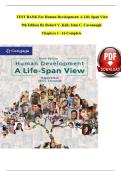
TEST BANK For Human Development: A Life-Span
pp m pp m pp m pp m pp m pp m pp
View
9th Edition By Robert V. Kail; John C. Cavanaugh
Chapters 1 - 16 Complete
pp pp pp pp
,TableOfContents
1. The Study of Human Development.
m m m m
Part I: PRENATALSDEVELOPMENT, INFANCY, AND EARLY CHILDHOOD.
m m m m m m
2. Biological Foundations: Heredity, Prenatal Development, and Birth.
m m m m m m
3. Tools for Exploring the World: Physical, Perceptual, and Motor Development.
m m m m m m m m m
4. The Emergence of Thought and Language: Cognitive Development in Infancy and Early Childhood.
m m m m m m m m m m m m
5. Entering the Social World: Socioemotional Development in Infancy and Early Childhood.
m m m m m m m m m m
Part II: SCHOOL-AGE CHILDREN AND ADOLESCENTS.
m m m m m
6. Off to School: Cognitive and Physical Development in Middle Childhood.
m m m m m m m m m
7. Expanding Social Horizons: Socioemotional Development in Middle Childhood.
m m m m m m m
8. Rites of Passage: Physical and Cognitive Development in Adolescence.
m m m m m m m m
9. Moving Into the Adult Social World: Socioemotional Development in Adolescence.
m m m m m m m m m
Part III: YOUNG AND MIDDLE ADULTHOOD.
m m m m m
10. Becoming an Adult: Physical, Cognitive, and Personality Development in Young Adulthood.
m m m m m m m m m m
11. Being With Others: Forming Relationships in Young and Middle Adulthood.
m m m m m m m m m
12. Work, Leisure, and Retirement.
m m m
13. Making It in Midlife: The Biopsychosocial Challenges of MiddleSAdulthood.
m m m m m m m m
Part IV: LATE ADULTHOOD.
m m m
14. The Personal Context of Later Life: Physical, Cognitive, and Mental Health Issues.
m m m m m m m m m m m
15. Social Aspects of Later Life: Psychosocial, Retirement, Relationship, and Societal Issues.
m m m m m m m m m m
,16. The Final Passage: Dying and Bereavement.
m m m m m
, 1. The Study of Human Development.
S S S S
The scientific study of human development can best be described as
m m m m m mpmm m mp m mpmm
ANSWER:a. m multidisciplinary
b. Focused on groups rather than individuals
mpm m m m mmm
c. non-theoretical
d. emphasizing m stability over change m m
2. Whichtermdoesnotbelonginthisgroup? p p
a. experiential
b. nurture
c. environmental
ANSWER:d. hereditary m
3. Dr. Kim takes a strong nature position with regard to theSorigins of intellectual dis
m m m m m m m m m m m m m
abilities. Therefore, she would most likely hypothesize that her son‘s intellectu al dis ability
m m m m m m m m m m m m m m
(formally known as mental retardation) is due to
m m pp m m m m
a. her m parenting style m
ANSWER:b.his m genes
c. his exposure to a toxic chemical prior to birth
m m m m m m m m
d. his exposure to Rubella prior to birth
m m m m m m
4.The notion that development is best described in terms of a series of abrupt shif ts in
m m m m m m m m m m m m m m m m
behavior best fits with the approach.
m m m m m m
a. nature
b. nurture
c. continuity
ANSWER:d. m discontinuity
5.Cleo, a director of a daycare, uses terms like ―pre-K,‖ ―K-3,‖ and the
m m m m m m m m m m m m
―upper- elementary.‖ These ideasare mostcompatible witha
m m view. m m m
pp m pp m pp m pp m pp m pp m pp
View
9th Edition By Robert V. Kail; John C. Cavanaugh
Chapters 1 - 16 Complete
pp pp pp pp
,TableOfContents
1. The Study of Human Development.
m m m m
Part I: PRENATALSDEVELOPMENT, INFANCY, AND EARLY CHILDHOOD.
m m m m m m
2. Biological Foundations: Heredity, Prenatal Development, and Birth.
m m m m m m
3. Tools for Exploring the World: Physical, Perceptual, and Motor Development.
m m m m m m m m m
4. The Emergence of Thought and Language: Cognitive Development in Infancy and Early Childhood.
m m m m m m m m m m m m
5. Entering the Social World: Socioemotional Development in Infancy and Early Childhood.
m m m m m m m m m m
Part II: SCHOOL-AGE CHILDREN AND ADOLESCENTS.
m m m m m
6. Off to School: Cognitive and Physical Development in Middle Childhood.
m m m m m m m m m
7. Expanding Social Horizons: Socioemotional Development in Middle Childhood.
m m m m m m m
8. Rites of Passage: Physical and Cognitive Development in Adolescence.
m m m m m m m m
9. Moving Into the Adult Social World: Socioemotional Development in Adolescence.
m m m m m m m m m
Part III: YOUNG AND MIDDLE ADULTHOOD.
m m m m m
10. Becoming an Adult: Physical, Cognitive, and Personality Development in Young Adulthood.
m m m m m m m m m m
11. Being With Others: Forming Relationships in Young and Middle Adulthood.
m m m m m m m m m
12. Work, Leisure, and Retirement.
m m m
13. Making It in Midlife: The Biopsychosocial Challenges of MiddleSAdulthood.
m m m m m m m m
Part IV: LATE ADULTHOOD.
m m m
14. The Personal Context of Later Life: Physical, Cognitive, and Mental Health Issues.
m m m m m m m m m m m
15. Social Aspects of Later Life: Psychosocial, Retirement, Relationship, and Societal Issues.
m m m m m m m m m m
,16. The Final Passage: Dying and Bereavement.
m m m m m
, 1. The Study of Human Development.
S S S S
The scientific study of human development can best be described as
m m m m m mpmm m mp m mpmm
ANSWER:a. m multidisciplinary
b. Focused on groups rather than individuals
mpm m m m mmm
c. non-theoretical
d. emphasizing m stability over change m m
2. Whichtermdoesnotbelonginthisgroup? p p
a. experiential
b. nurture
c. environmental
ANSWER:d. hereditary m
3. Dr. Kim takes a strong nature position with regard to theSorigins of intellectual dis
m m m m m m m m m m m m m
abilities. Therefore, she would most likely hypothesize that her son‘s intellectu al dis ability
m m m m m m m m m m m m m m
(formally known as mental retardation) is due to
m m pp m m m m
a. her m parenting style m
ANSWER:b.his m genes
c. his exposure to a toxic chemical prior to birth
m m m m m m m m
d. his exposure to Rubella prior to birth
m m m m m m
4.The notion that development is best described in terms of a series of abrupt shif ts in
m m m m m m m m m m m m m m m m
behavior best fits with the approach.
m m m m m m
a. nature
b. nurture
c. continuity
ANSWER:d. m discontinuity
5.Cleo, a director of a daycare, uses terms like ―pre-K,‖ ―K-3,‖ and the
m m m m m m m m m m m m
―upper- elementary.‖ These ideasare mostcompatible witha
m m view. m m m