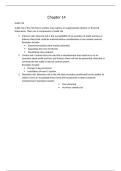
Chapter 14
Audit risk
Audit risk is the risk that an auditor may express an inappropriate opinion on financial
statements. There are 3 components of audit risk
1. Inherent risk: Inherent risk is the susceptibility of an assertion of profit and loss or
balance sheet that could be material before consideration of any related controls.
Examples include:
Events/transactions that involve estimates
Expanding into new territories
Developing new products
2. Control risk: Control risk is the risk that a misstatement that could occur in an
assertion about profit and loss and balance sheet will not be prevented, detected or
corrected by the entity’s internal control system.
Examples include:
Change in key personnel
Installation of new I.T system
3. Detection risk: Detection risk is the risk that procedure performed by the auditor to
reduce risk to an acceptably lower level will not prevent or detect material
misstatement. Examples include:
Poor planning
Incorrect sample size
, Audit risk examples:
1. Increased revenue or capital expenditure, there is a risk that items are incorrectly
treated as capital or revenue in financial statement
2. First year of audit/new audit client. This is an increased detection risk as auditor may
not detect issues due to lack of understanding of the entity.
3. Increase in provisions and contingent liabilities, there is a risk due to the inherent
nature of these items
4. Decline in business/industry/margins or increase in competition. There is a risk of
going concern issues
5. Increased bank loans. There is a risk of that loan being incorrectly split between
current and non current liability
6. Elimination of layer of management or employees made redundant. There is a risk
that the companies may not have made a proper provision as per I.A.S 37
7. Assets/inventories ordered or procured at the year end with no certainty that they
will be there at the year end. This creates a risk of over/under statement of assets
8. There are various locations for storage of inventory. There is a risk that 100%
verification is not possible
9. Some inventory warehouses are owned and some are rented there is a risk that
rented warehouses may be listed in P.P.E
10. Introduction of new accounting/I.T systems during the year. There is a risk that new
systems may not completely get the data from the old systems creating a control risk.
11. Revaluation of assets during the year. His creates a risk of assets getting over/under
valued in the financial statements
12. A doubtful/dubious product being manufactured. This creates an inherent risk due to
laws and regulations
13. Top management/personnel left the company close to the balance sheet date. This
creates a risk of errors due to a high work load on the rest of the management and
staff creating a control risk
14. Default of major customers. This creates a risk of receivables being overstated
15. Significant internal control weaknesses in sales/purchase system which creates a risk
of over/under stating of assets leading to increased control risk.
16. Out of court settlements being done this creates a risk that earlier provision created
might have been overstated
17. If there is work in progress in the company this creates an inherent risk that
inventory is over/under stated
18. Issue of shares, which creates the risk that the amount is incorrectly split between
ordinary shares and share premiums
19. Short time period for completion of audit which creates risks of errors not being
identified due to pressure leading to increased detection risk
20. Sales/profit related bonuses being offered which creates the risk of
sales/profits/assets being overstated
21. Inventory not being valued at lower of cost or N.R.V which creates a risk of inventory
being over/under stated
Audit risk
Audit risk is the risk that an auditor may express an inappropriate opinion on financial
statements. There are 3 components of audit risk
1. Inherent risk: Inherent risk is the susceptibility of an assertion of profit and loss or
balance sheet that could be material before consideration of any related controls.
Examples include:
Events/transactions that involve estimates
Expanding into new territories
Developing new products
2. Control risk: Control risk is the risk that a misstatement that could occur in an
assertion about profit and loss and balance sheet will not be prevented, detected or
corrected by the entity’s internal control system.
Examples include:
Change in key personnel
Installation of new I.T system
3. Detection risk: Detection risk is the risk that procedure performed by the auditor to
reduce risk to an acceptably lower level will not prevent or detect material
misstatement. Examples include:
Poor planning
Incorrect sample size
, Audit risk examples:
1. Increased revenue or capital expenditure, there is a risk that items are incorrectly
treated as capital or revenue in financial statement
2. First year of audit/new audit client. This is an increased detection risk as auditor may
not detect issues due to lack of understanding of the entity.
3. Increase in provisions and contingent liabilities, there is a risk due to the inherent
nature of these items
4. Decline in business/industry/margins or increase in competition. There is a risk of
going concern issues
5. Increased bank loans. There is a risk of that loan being incorrectly split between
current and non current liability
6. Elimination of layer of management or employees made redundant. There is a risk
that the companies may not have made a proper provision as per I.A.S 37
7. Assets/inventories ordered or procured at the year end with no certainty that they
will be there at the year end. This creates a risk of over/under statement of assets
8. There are various locations for storage of inventory. There is a risk that 100%
verification is not possible
9. Some inventory warehouses are owned and some are rented there is a risk that
rented warehouses may be listed in P.P.E
10. Introduction of new accounting/I.T systems during the year. There is a risk that new
systems may not completely get the data from the old systems creating a control risk.
11. Revaluation of assets during the year. His creates a risk of assets getting over/under
valued in the financial statements
12. A doubtful/dubious product being manufactured. This creates an inherent risk due to
laws and regulations
13. Top management/personnel left the company close to the balance sheet date. This
creates a risk of errors due to a high work load on the rest of the management and
staff creating a control risk
14. Default of major customers. This creates a risk of receivables being overstated
15. Significant internal control weaknesses in sales/purchase system which creates a risk
of over/under stating of assets leading to increased control risk.
16. Out of court settlements being done this creates a risk that earlier provision created
might have been overstated
17. If there is work in progress in the company this creates an inherent risk that
inventory is over/under stated
18. Issue of shares, which creates the risk that the amount is incorrectly split between
ordinary shares and share premiums
19. Short time period for completion of audit which creates risks of errors not being
identified due to pressure leading to increased detection risk
20. Sales/profit related bonuses being offered which creates the risk of
sales/profits/assets being overstated
21. Inventory not being valued at lower of cost or N.R.V which creates a risk of inventory
being over/under stated