PHSC 211 Chapter 16 Quiz (Fall 2020)– Liberty University (A grade) | Elements of Earth Science
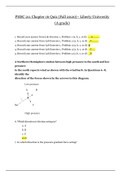
PHSC 211 Chapter 16 Quiz (Fall 2020)– Liberty University (A grade) 1. Record your answer from Lab Exercise 1, Problem 1 (a, b, c, or d): __A____. 2. Record your answer from Lab Exercise 1, Problem 2 (a, b, c, or d): _C____. 3. Record your answer from Lab Exercise 1, Problem 3 (a, b, c, or d): B 4. Record your answer from Lab Exercise 1, Problem 4 (a, b, c, or d): _C__. 5. Record your answer from Lab Exercise 1, Problem 5 (a, b, c, or d): _D A Northern Hemisphere station between high pressure to the south and low pressure to the north reports wind as shown with the wind barb. In Questions 6–8, identify the direction of the forces shown by the arrows in this diagram. Low pressure A B DC High pressure 6. Which direction is friction acting in? a. A b. B c. C d. D 7. In which direction is the pressure gradient force acting? a. A b. B c. C d. D 8. In which direction is the Coriolis effect acting? a. A b. B c. C d. D 9. Also referring to the diagram before Question 6, what wind direction is being reported by this station? a. Northeast b. Southwest c. Southeast d. Northwest 10. Record your answer from Lab Exercise 2, Problem 1: __occluded________. 11. Record your answer from Lab Exercise #2, Problem 3: _warm________. 12. Record your answer from Lab Exercise #2, Problem 4: _cold_______. 13. Record your answer from Lab Exercise #2, Problem 5: upper level_____. 14. What would be the best tool to locate a dry line? a. Contoured analysis of surface temperatures b. Contoured analysis of surface dew point c. Both (a) and (b) d. Neither (a) nor (b) 15. Record your answer from Lab Exercise 3, Problem 1 (30, 40, 50, 60) ___30_____. 16. Record your answer from Lab Exercise 3, Problem 2 (B, F, G, H) ____F_________. 17. Record your answer from Lab Exercise 3, Problem 3 (B, F, G, H) ___H__________. 18. Record your answer from Lab Exercise 3, Question 5 (A, E, F, J) ___A______. 19. Record your answer from Lab Exercise 3, Question 6 (A, C, D, J) _D__________. 20. Record your answer from Lab Exercise 3, Question 7 (A, C, D, J) _A___(D)____. 21. Record your answer from Lab Exercise 3, Question 9 (D, G, H, I) ___D___________. 22. Record your answer from Lab Exercise 3, Question 10 (A, B, G, J) _J__(B)_____. 23. Record your answer from Lab Exercise 3, Question 11 (A, B, H, I) ______H____. 24. Record your answer from Lab Exercise 3, Question 12 (A, E, H, J) ____J_(E)____. 25. Which tool is most helpful in forecasting the weather 3 days from now? a. Surface weather maps to locate frontal positions b. Trends of temperatures and dew point at individual stations c. Satellite and radar imagery d. Numerical weather models 26. Name and describe three differences between cold and warm fronts. The main difference between cold and warm fronts is the temperature. A cold front is coupled with colder, drier weather while a warm front is coupled with warmer, more humid weather. Cold fronts can generally be found in sharp surface trench whereas warm fronts can be found in a broader trench of low pressure. Cold fronts are more dense, and the air moves swiftly to replace the warm air and warm fronts move more slowly.
Written for
- Institution
- Liberty University
- Course
- Elements of Earth Science (PHSC211)
Document information
- Uploaded on
- January 10, 2021
- Number of pages
- 3
- Written in
- 2020/2021
- Type
- Exam (elaborations)
- Contains
- Questions & answers
Subjects
-
phsc 211 chapter 16 quiz
-
elements of earth science
-
phsc 211 chapter 16 quiz fall 2020– liberty university a grade
-
phsc 211 chapter 16 quiz fall 2020
-
name and describe three differences between c

Document also available in package deal