Neuropsychology notes
Distinction neurologic and clinical populations – knowing there is an organic
deficit and seeing the results vs seeing the results and investigating organic
deficit.
Part 1 – Introduction
Chapter 1
History
Antiquity – philosophy x empiricism
Aristotle: observing and building theories. Heart is seat of intelligence, brain is
cooling mechanism. No anatomical studying due to ancient Greek beliefs,
animals instead. All animals have a heart -> important for intelligence. Heart
produces heat -> heat is intelligence. Bigger heart and head -> more
intelligence.
Hippocrates: father of modern medicine. Brain is for mental functions by
observing humans with head injuries (lesion observation).
Herophilus: anatomical based observations. Described nervous system. Cell
theory / ventricle theory.
Galen: dissection (mostly animals) and comparative anatomy. Problem: he
extended the animal structures to humans which is incorrect. Mapped ventricular
system and cranial nerves and distinguished sensory and motor nerves.
Brain behaviour debates where should we locate the soul or mind, how does it
affect the body and which organs play a role in this. Ancient Greek three forms of
souls:
1. Survival via food intake (present in plants)
2. Activities of an organism in relation to environment (in animals)
3. Distinguishing between good and bad.
Humans have all three.
Cell theory of mind: cavities in the brain were the site of the mind. Structures:
the first cell received information from various senses, the second cell interprets
it (input), the third cell stores the image (memory). Base of cognitive psychology.
Middle ages – gross anatomy established, some idea that brain was important
for mental function, no specific brain-behaviour theory. Little progress because:
the soul had no physical basis
human experimentation was forbidden
scientific method not fully established.
Renaissance – scientific method + localisation of soul.
Vesalius: founder of human anatomy. Detailed drawings. Based on Aristotle and
Galen. Empirically based.
Descartes: more conceptual. Mind-body dualism. Religion. I think therefore I am -
> given by divine entity. You can study the body without touching the sacred soul
because separate. Animals are mechanical, based on instinct and reflex. Body is
machine, humans have a soul (pineal gland). Influenced empirical physiology.
,Gall: mental functions are independently localised (versus holistic brain).
Phrenology. Materialistic since he did not consider the soul, but beginning of the
relationship between brain and behaviour due to patients who had impaired
behaviour due to brain damage e.g. Phineas Gage.
Modern history
End 18th century: more knowledge about structure, brain-behaviour relation
still unclear, no conceptual framework that ties both together and views heavily
influenced by religious and political ideas.
19th century: brain mapping, language problems in France and German.
Charcot: neurology professor. Described and categorized neurological disorders
e.g. multiple sclerosis. Developed systematic examination: developing common
questions to compare people. Clinical anatomical method. Two part methodology
linking clinical signs with anatomical lesions.
Broca: approved and used Charcot’s method. Identified critical language
production area. methods of behavioural observation and post mortem anatomy.
Supported localisation.
Wernicke: identified language comprehension brain area. he also proposed that
brain regions are connected through pathways. Double dissociation.
Disconnection aphasia, when it is not an area problem but a connection problem
and the information doesn’t travel well.
Lissauer: identified two stages in recognising objects, one for recognising
individual features and the second one to combine them into a whole. Problem
with first -> apperceptive agnosia, problem with second -> associative agnosia
(conceptual, semantic information fails so you can draw but not recognise).
Jackson: hierarchical organisation of the brain. Journal of neurology. Different
types of epilepsy. Broca should not confuse the location of a lesion that resulted
in a specific loss of a function with the location of a function.
Galton: racist, he wanted to prove some people were superior to others.
Measuring intelligence and comparing people: mathematical concepts into
psychology. Psychometric assessment.
20th century: guns revolutionise neuropsychology, strict localisation fades
away. During the world wars people suffered a lot of head injuries. Realisations
that followed: the brain functions as an integrated whole (holism) -> head injuries
resulting in a range of difficulties.
Goldstein: holistic, worked with soldiers. Instead of simply reacting to stimulus,
other processes also influence behaviour such as experience, emotions and
motivation.
Wundt: experimental psychology. Contribution to fundamental processes such as
perception, attention and cognitive control.
Donders: developed reaction tasks and subtraction method (chapter 3).
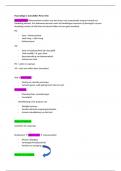
Modern - Luria: studied soldiers, pioneered systems view of brain function,
developed a comprehensive assessment battery. Developed rehabilitation
protocols. Functional units:
, Differences with now: we don’t think the entire back of the brain is for one thing
etc, but the general division makes sense. Hierarchical network: each of these
units is hierarchical organised. Anterior = output, posterior = input.
Primary -> input, secondary -> processing, tertiary -> integration. In line with
now (V1, 2, 3 etc more complex). E.g. unit one input of image unit two
decomposition of image unit three semantic processing.
Fodor: modularity – brain processes that operate independently (phrenology).
Turned away from holism and connectionism. Language is innate, no awareness
of it and no control. Module: 1) can only process certain information 2) is innate
and 3) carries out its work regardless of what other processes are occurring and
4) is computationally autonomous and has its own architecture.
Milner: 105. Worked with H.M. epilepsy. Established dissociation between different
aspects of memory.
Test battery: Halstead research into effect of brain injury on intelligence ->
battery of tests known as the Halstead-Reitan neuropsychological battery.
Neuropsychology as an independent discipline: due to
1. Work of Norman Geschwind, looking for double dissociations.
2. Research of Sperry into split brain surgery.
Neuropsychological tests development:
Luria – alternating figure tests.
Benton – standardised methods to measure and quantify things.
Milner – tests with H.M.
Cognitive theory development:
Zangwill – integration of both assessment and intervention for brain injured
patients. Warrington – combined patient care with scientific research. Scientist
practioner.
Wilson – applied Baddeley’s working memory theory in practice, translating
theoretical knowledge into diagnosis and treatment. Also ecologically valid tests.
Lessons learned
Diaschisis: Greek for shocked through, brain injury or disease may have more
widespread effects:
- differences in organisation may influence information processing. E.g. cortical
Distinction neurologic and clinical populations – knowing there is an organic
deficit and seeing the results vs seeing the results and investigating organic
deficit.
Part 1 – Introduction
Chapter 1
History
Antiquity – philosophy x empiricism
Aristotle: observing and building theories. Heart is seat of intelligence, brain is
cooling mechanism. No anatomical studying due to ancient Greek beliefs,
animals instead. All animals have a heart -> important for intelligence. Heart
produces heat -> heat is intelligence. Bigger heart and head -> more
intelligence.
Hippocrates: father of modern medicine. Brain is for mental functions by
observing humans with head injuries (lesion observation).
Herophilus: anatomical based observations. Described nervous system. Cell
theory / ventricle theory.
Galen: dissection (mostly animals) and comparative anatomy. Problem: he
extended the animal structures to humans which is incorrect. Mapped ventricular
system and cranial nerves and distinguished sensory and motor nerves.
Brain behaviour debates where should we locate the soul or mind, how does it
affect the body and which organs play a role in this. Ancient Greek three forms of
souls:
1. Survival via food intake (present in plants)
2. Activities of an organism in relation to environment (in animals)
3. Distinguishing between good and bad.
Humans have all three.
Cell theory of mind: cavities in the brain were the site of the mind. Structures:
the first cell received information from various senses, the second cell interprets
it (input), the third cell stores the image (memory). Base of cognitive psychology.
Middle ages – gross anatomy established, some idea that brain was important
for mental function, no specific brain-behaviour theory. Little progress because:
the soul had no physical basis
human experimentation was forbidden
scientific method not fully established.
Renaissance – scientific method + localisation of soul.
Vesalius: founder of human anatomy. Detailed drawings. Based on Aristotle and
Galen. Empirically based.
Descartes: more conceptual. Mind-body dualism. Religion. I think therefore I am -
> given by divine entity. You can study the body without touching the sacred soul
because separate. Animals are mechanical, based on instinct and reflex. Body is
machine, humans have a soul (pineal gland). Influenced empirical physiology.
,Gall: mental functions are independently localised (versus holistic brain).
Phrenology. Materialistic since he did not consider the soul, but beginning of the
relationship between brain and behaviour due to patients who had impaired
behaviour due to brain damage e.g. Phineas Gage.
Modern history
End 18th century: more knowledge about structure, brain-behaviour relation
still unclear, no conceptual framework that ties both together and views heavily
influenced by religious and political ideas.
19th century: brain mapping, language problems in France and German.
Charcot: neurology professor. Described and categorized neurological disorders
e.g. multiple sclerosis. Developed systematic examination: developing common
questions to compare people. Clinical anatomical method. Two part methodology
linking clinical signs with anatomical lesions.
Broca: approved and used Charcot’s method. Identified critical language
production area. methods of behavioural observation and post mortem anatomy.
Supported localisation.
Wernicke: identified language comprehension brain area. he also proposed that
brain regions are connected through pathways. Double dissociation.
Disconnection aphasia, when it is not an area problem but a connection problem
and the information doesn’t travel well.
Lissauer: identified two stages in recognising objects, one for recognising
individual features and the second one to combine them into a whole. Problem
with first -> apperceptive agnosia, problem with second -> associative agnosia
(conceptual, semantic information fails so you can draw but not recognise).
Jackson: hierarchical organisation of the brain. Journal of neurology. Different
types of epilepsy. Broca should not confuse the location of a lesion that resulted
in a specific loss of a function with the location of a function.
Galton: racist, he wanted to prove some people were superior to others.
Measuring intelligence and comparing people: mathematical concepts into
psychology. Psychometric assessment.
20th century: guns revolutionise neuropsychology, strict localisation fades
away. During the world wars people suffered a lot of head injuries. Realisations
that followed: the brain functions as an integrated whole (holism) -> head injuries
resulting in a range of difficulties.
Goldstein: holistic, worked with soldiers. Instead of simply reacting to stimulus,
other processes also influence behaviour such as experience, emotions and
motivation.
Wundt: experimental psychology. Contribution to fundamental processes such as
perception, attention and cognitive control.
Donders: developed reaction tasks and subtraction method (chapter 3).
Modern - Luria: studied soldiers, pioneered systems view of brain function,
developed a comprehensive assessment battery. Developed rehabilitation
protocols. Functional units:
, Differences with now: we don’t think the entire back of the brain is for one thing
etc, but the general division makes sense. Hierarchical network: each of these
units is hierarchical organised. Anterior = output, posterior = input.
Primary -> input, secondary -> processing, tertiary -> integration. In line with
now (V1, 2, 3 etc more complex). E.g. unit one input of image unit two
decomposition of image unit three semantic processing.
Fodor: modularity – brain processes that operate independently (phrenology).
Turned away from holism and connectionism. Language is innate, no awareness
of it and no control. Module: 1) can only process certain information 2) is innate
and 3) carries out its work regardless of what other processes are occurring and
4) is computationally autonomous and has its own architecture.
Milner: 105. Worked with H.M. epilepsy. Established dissociation between different
aspects of memory.
Test battery: Halstead research into effect of brain injury on intelligence ->
battery of tests known as the Halstead-Reitan neuropsychological battery.
Neuropsychology as an independent discipline: due to
1. Work of Norman Geschwind, looking for double dissociations.
2. Research of Sperry into split brain surgery.
Neuropsychological tests development:
Luria – alternating figure tests.
Benton – standardised methods to measure and quantify things.
Milner – tests with H.M.
Cognitive theory development:
Zangwill – integration of both assessment and intervention for brain injured
patients. Warrington – combined patient care with scientific research. Scientist
practioner.
Wilson – applied Baddeley’s working memory theory in practice, translating
theoretical knowledge into diagnosis and treatment. Also ecologically valid tests.
Lessons learned
Diaschisis: Greek for shocked through, brain injury or disease may have more
widespread effects:
- differences in organisation may influence information processing. E.g. cortical