rs
te
as
m
iz
qu
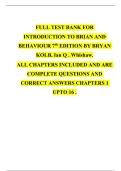
, Test Bank for An Introduction to Brain and Behavior 6th Bryan Kolb , Ian Q. Whishaw ,
G. Campbell Teskey
Table of Contents
Chapter 1 What Are the Origins of Brain and Behavior?
Chapter 2 What Is the Nervous System’s Functional Anatomy?
Chapter 3 What Are the Nervous System’s Functional Units?
Chapter 4 How Do Neurons Use Electrical Signals to Transmit Information?
qu
Chapter 5 How Do Neurons Communicate and Adapt?
Chapter 6 How Do Drugs and Hormones Influence the Brain and Behavior?
iz
Chapter 7 How Do We Study the Brain’s Structures and Functions?
Chapter 8 How Does the Nervous System Develop and Adapt?
m
Chapter 9 How Do We Sense, Perceive, and See the World?
Chapter 10 How Do We Hear, Speak, and Make Music?
as
Chapter 11 How Does the Nervous System Respond to Stimulation and Produce Movement?
Chapter 12 What Causes Emotional and Motivated Behavior?
te
Chapter 13 Why Do We Sleep and Dream?
Chapter 14 How Do We Learn and Remember?
rs
Chapter 15 How Does the Brain Think?
Chapter 16 What Happens When the Brain Misbehaves?
,Chapter 1 – What are the origins of Brain and Behaviour?
1. Brain abnormalities can be related to:
A) 500 disorders.
B) 1000 disorders.
C) 1500 disorders.
D) more than 2,000 disorders.
2. All the nerve processes radiating out beyond the brain and spinal cord as well as all the
neurons outside the brain and spinal cord constitute the:
qu
A) nervous system.
B) central nervous system.
C) peripheral nervous system.
D) external nervous system.
iz
m
3. Which is NOT part of the peripheral nervous system?
A) sensory receptors in the skin
B) connections to motor neurons
as
C) sensory and motor connections to internal organs (e.g., the stomach)
D) the spinal cord
te
4. The set of brain structures responsible for most of our unconscious behaviors is called:
A) the cerebral hemisphere.
B) the brainstem.
rs
C) the cerebrum.
D) the cerebellum.
5. The postulation that we make subliminal movements of our larynx and muscles when
we imagine was expounded by:
A) D. O. Hebb.
B) Edmond Jacobson.
C) Irenäus Eibl-Eibesfeldt.
Page 1
, D) Fred Linge.
6. “Behavior consists of patterns in time” is a definition of behavior expounded by:
A) D. O. Hebb.
B) Edmond Jacobson.
C) Irenäus Eibl-Eibesfeldt.
D) Fred Linge.
qu
7. Patterns in time can be made up of:
A) movements.
B) thinking.
C) both movements and thinking.
iz
D) neither movements nor thinking.
m
8. Animals with smaller brains and simpler nervous systems have mostly _____ behaviors,
whereas animals with larger brains and more complex nervous systems have mostly
_____ behaviors.
as
A) learned; inherited
B) inherited; learned
C) innate; inherited
D) learned; innate
te
9. Crossbill birds have a beak that is designed to eat pine cones. If we trim the beak, the
rs
behavior disappears. This example illustrates:
A) fixed behavior.
B) flexible behavior.
C) learned behavior.
D) adaptive behavior.
10. The sucking response observed in newborn human infants is an example of a(n):
A) learned response.
Page 2
te
as
m
iz
qu
, Test Bank for An Introduction to Brain and Behavior 6th Bryan Kolb , Ian Q. Whishaw ,
G. Campbell Teskey
Table of Contents
Chapter 1 What Are the Origins of Brain and Behavior?
Chapter 2 What Is the Nervous System’s Functional Anatomy?
Chapter 3 What Are the Nervous System’s Functional Units?
Chapter 4 How Do Neurons Use Electrical Signals to Transmit Information?
qu
Chapter 5 How Do Neurons Communicate and Adapt?
Chapter 6 How Do Drugs and Hormones Influence the Brain and Behavior?
iz
Chapter 7 How Do We Study the Brain’s Structures and Functions?
Chapter 8 How Does the Nervous System Develop and Adapt?
m
Chapter 9 How Do We Sense, Perceive, and See the World?
Chapter 10 How Do We Hear, Speak, and Make Music?
as
Chapter 11 How Does the Nervous System Respond to Stimulation and Produce Movement?
Chapter 12 What Causes Emotional and Motivated Behavior?
te
Chapter 13 Why Do We Sleep and Dream?
Chapter 14 How Do We Learn and Remember?
rs
Chapter 15 How Does the Brain Think?
Chapter 16 What Happens When the Brain Misbehaves?
,Chapter 1 – What are the origins of Brain and Behaviour?
1. Brain abnormalities can be related to:
A) 500 disorders.
B) 1000 disorders.
C) 1500 disorders.
D) more than 2,000 disorders.
2. All the nerve processes radiating out beyond the brain and spinal cord as well as all the
neurons outside the brain and spinal cord constitute the:
qu
A) nervous system.
B) central nervous system.
C) peripheral nervous system.
D) external nervous system.
iz
m
3. Which is NOT part of the peripheral nervous system?
A) sensory receptors in the skin
B) connections to motor neurons
as
C) sensory and motor connections to internal organs (e.g., the stomach)
D) the spinal cord
te
4. The set of brain structures responsible for most of our unconscious behaviors is called:
A) the cerebral hemisphere.
B) the brainstem.
rs
C) the cerebrum.
D) the cerebellum.
5. The postulation that we make subliminal movements of our larynx and muscles when
we imagine was expounded by:
A) D. O. Hebb.
B) Edmond Jacobson.
C) Irenäus Eibl-Eibesfeldt.
Page 1
, D) Fred Linge.
6. “Behavior consists of patterns in time” is a definition of behavior expounded by:
A) D. O. Hebb.
B) Edmond Jacobson.
C) Irenäus Eibl-Eibesfeldt.
D) Fred Linge.
qu
7. Patterns in time can be made up of:
A) movements.
B) thinking.
C) both movements and thinking.
iz
D) neither movements nor thinking.
m
8. Animals with smaller brains and simpler nervous systems have mostly _____ behaviors,
whereas animals with larger brains and more complex nervous systems have mostly
_____ behaviors.
as
A) learned; inherited
B) inherited; learned
C) innate; inherited
D) learned; innate
te
9. Crossbill birds have a beak that is designed to eat pine cones. If we trim the beak, the
rs
behavior disappears. This example illustrates:
A) fixed behavior.
B) flexible behavior.
C) learned behavior.
D) adaptive behavior.
10. The sucking response observed in newborn human infants is an example of a(n):
A) learned response.
Page 2