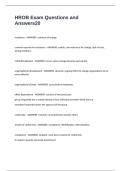
HROB Exam Questions and
Answers20
resistence - ANSWERS -common of change
common reasons for resistance - ANSWERS -politics, low tolerance for change, lack of trust,
strong emotions,
institutionalization - ANSWERS -occurs when change becomes permanent
organizational development - ANSWERS -planned, ongoing effort to change organizations to be
more effective
organizational climate - ANSWERS -perceived by employees
effect dependence - ANSWERS -consists of two processes:
group frequently has a vested interest in how individual members think and act
members frequently desire the approval of the group
conformity - ANSWERS -rewards, no punishment, pleases others
3 types of conformity - ANSWERS -compliance, identification, internalization
compliance - ANSWERS -simplest, most direct motive for conformity
to acquire rewards and avoid punishment
,identification - ANSWERS -an imitation process
established members serve as models
internalization - ANSWERS -truly accepted the beliefs, attitudes, and values of the norm
strong organizational cultures are - ANSWERS -high in consensus, consistency, and in values and
beliefs
fit - ANSWERS -a congruency between values, attitudes, and beliefs of individual and target (job,
organization, group)
psychological contract - ANSWERS -beliefs of employees regarding the reciprocal obligations and
promises between them and organization
approaches to socialization - ANSWERS -realistic job preview, orientation programs, mentoring,
proactive socialization
mentorship - ANSWERS -more beneficial for people of minorities than of majority
uncertainty reduction theory - ANSWERS -newcomers are motivated to reduce their uncertainty
so that the work environment becomes more predictable and understandable
stages of socialization - ANSWERS -anticipatory, encounter, role management
anticipatory stage of socialization - ANSWERS -before joining an organization, prejudgements
encounter stage of socialization - ANSWERS -begins day-to-day reality
, role management stage of socialization - ANSWERS -managing connections in/out of work
ROPES - ANSWERS -realistic orientation program for entry stress
proactive socialization - ANSWERS -newcomers play an active role in their socialization through
proactive behaviours like feedback and information seeking
groups - ANSWERS -complex social structure designed to achieve a common goal through
interdependence
exert influence
formal group - ANSWERS -a designated work group defined by an organization's structure
informal group - ANSWERS -group formed by employees for task forces or project teams
stages of group development - ANSWERS -forming, storming, norming, performing, adjourning
not always linear
forming - ANSWERS -established a team, happens quickly
storming - ANSWERS -conflict arises, role ambiguity, resolution for conflict
norming - ANSWERS -designated responsibilities, clear direction for goals
performing - ANSWERS -doing the work, longest stage
Answers20
resistence - ANSWERS -common of change
common reasons for resistance - ANSWERS -politics, low tolerance for change, lack of trust,
strong emotions,
institutionalization - ANSWERS -occurs when change becomes permanent
organizational development - ANSWERS -planned, ongoing effort to change organizations to be
more effective
organizational climate - ANSWERS -perceived by employees
effect dependence - ANSWERS -consists of two processes:
group frequently has a vested interest in how individual members think and act
members frequently desire the approval of the group
conformity - ANSWERS -rewards, no punishment, pleases others
3 types of conformity - ANSWERS -compliance, identification, internalization
compliance - ANSWERS -simplest, most direct motive for conformity
to acquire rewards and avoid punishment
,identification - ANSWERS -an imitation process
established members serve as models
internalization - ANSWERS -truly accepted the beliefs, attitudes, and values of the norm
strong organizational cultures are - ANSWERS -high in consensus, consistency, and in values and
beliefs
fit - ANSWERS -a congruency between values, attitudes, and beliefs of individual and target (job,
organization, group)
psychological contract - ANSWERS -beliefs of employees regarding the reciprocal obligations and
promises between them and organization
approaches to socialization - ANSWERS -realistic job preview, orientation programs, mentoring,
proactive socialization
mentorship - ANSWERS -more beneficial for people of minorities than of majority
uncertainty reduction theory - ANSWERS -newcomers are motivated to reduce their uncertainty
so that the work environment becomes more predictable and understandable
stages of socialization - ANSWERS -anticipatory, encounter, role management
anticipatory stage of socialization - ANSWERS -before joining an organization, prejudgements
encounter stage of socialization - ANSWERS -begins day-to-day reality
, role management stage of socialization - ANSWERS -managing connections in/out of work
ROPES - ANSWERS -realistic orientation program for entry stress
proactive socialization - ANSWERS -newcomers play an active role in their socialization through
proactive behaviours like feedback and information seeking
groups - ANSWERS -complex social structure designed to achieve a common goal through
interdependence
exert influence
formal group - ANSWERS -a designated work group defined by an organization's structure
informal group - ANSWERS -group formed by employees for task forces or project teams
stages of group development - ANSWERS -forming, storming, norming, performing, adjourning
not always linear
forming - ANSWERS -established a team, happens quickly
storming - ANSWERS -conflict arises, role ambiguity, resolution for conflict
norming - ANSWERS -designated responsibilities, clear direction for goals
performing - ANSWERS -doing the work, longest stage