----------------------------------------
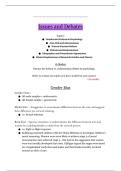
Issues and Debates
Topics:
● Gender and Culture in Psychology
● Free Will and Determinism
● Nature-Nurture Debate
● Holism and Reductionism
● Idiographic and Nomothetic Approaches
● Ethical Implications of Research Studies and Theory
16 Marker
Discuss the holism vs. reductionism debate in psychology.
Refer to at least two topics you have studied in your answer
(16 marks)
Gender Bias
Gender bias :
● All-male samples = androcentric
● All-female sample = gynocentric
Alph a bias → Exaggerates or overestimates differences between the sexes and suggests
these differences are real and enduring.
● i.e: Sexual selection
B eta bias → Ignores, minimises or underestimates the difference between men and
women by excluding females or males from the research process.
● i.e: Fight or flight response
● Kohlberg presented children with the Heinz Dilemma to investigate children’s
moral reasoning. Women were more likely to achieve stage 3 of moral
reasoning but men achieved stage 4 - this lead to the suggestion that women
were less morally developed than men. Gjilligan argued his stages were based
on a longitudinal study that used males and that female morality revolved
around an ethic of care.
,An dr ocentr ism → being centred on, or dominated by, males or the male viewpoint.
This can be conscious or unconscious. In the past, most psychologists were male, and the
theories they produced tended to represent a male view of the world.
Un iver sality → Any underlying characteristic of human beings that is capable of being
applied to all, despite differences of experience and upbringing.
To reduce alpha bias, we need to change the publication of results. Results that find
gender differences are more likely to be published over those that don’t. This can be
addressed through careful peer review, that analyses for gender bias. To reduce beta
bias, we can include females participants in research or do not generalise results
from male only studies to females and vice versa.
Ao3
- A problem with gender bias research is the potential negative impact on
women’s well-being when research is biased towards men. For example,
thousands of autistic girls and women have gone undiagnosed, as it was
previously thought that autism was to affect men at a ratio of 10:1 however
this was because studies were only carried out on males. As a result, girls and
women have gone underdiagnosed. Additionally, it is thought that girls and
women present symptoms differently to males as they may be better at hiding
symptoms. Consequently, this means that girls and women are not accessing
the support and help they need; which could then lead to further issues with
their mental health. Evidence to support this found that 23% of women
hospitalised for anorexia had also met the criteria for autism. This
demonstrates a real-life negative implication of the use of gender bias
research, something what ought to be addressed.
- A limitation is that research challenging gender biases may not be published.
Formanowicz et al. (2018) analysed more than 1000 articles relating to gender
bias published over 8 years and found that research on gender bias is funded
less often and is published by less prestigious journals. This was still true
when gender bias was compared with other forms of bias, such as culture bias
and when factors such as the gender of the author and the methodology used
was controlled for. The consequence of this is that fewer scholars become
aware of gender bias or apply it to their own work. This therefore suggests that
gender bias in psychological research may not be taken as seriously as other
forms of bias so is likely to continue to decrease the validity of research for a
long time.
, + That said, many modern researchers now recognise the effect their own
values and assumptions have on their own work, known as reflexivity.
For instance in their study of the lack of women in executive positions
in accounting firms, Dambrin and Lambert (2008) included reflection
on how their gender related experiences influenced their reading of
events. Therefore, there may be more awareness of the issue of gender
bias than was originally thought.
- Another limitation is that the issue of gender bias promotes sexism within the
research process. Women remain underrepresented in university
departments, particular in science. This means that research is more likely to
be conducted by males and this may disadvantage female participants. For
example, a male researcher may expect women to be irrational and unable to
complete complex tasks (Nicolson, 1995) and such expectations are likely to
mean that female participants underperform in research studies. This means
that the institutional structures and methods of psychology may produce
findings that are gender biassed. It is therefore necessary to ensure that
research investigations are not gender biassed to further reduce the presence
of gender bias within research.
- Due to psychology being a male dominated area, questions relating to women
may not even be considered (i.e post-partum depression). Also, there is a
publication bias since male researchers are more likely to have their studies
published than females - perpetuating an androcentric, male-dominated
viewpoint.
- One issue with gender bias is that gender differences are often presented as
fixed and enduring when they are not. Maccoby and Jacklin (1974) presented
the findings of several gender studies - conducting a metaanalysis - which
concluded that girls have superior verbal ability, whereas boys have better
spatial ability. They suggested that these differences are hardwired into the
brain before birth. However Joel et al. (2015) used brain scanning techniques
and found no such gender differences in brain structure or processing. This is
a limitation as gender bias research such as Maccoby and Jacklin may have
been popularised because it fitted existing stereotypes of girls as speakers and
boys as doers. This therefore suggests that we should be wary of accepting
research findings as biological facts when they might be better explained as
social stereotypes that lack validity.
+ However, research that suggests the popular social stereotype that
females are better at multitasking may have some biological truth to it.
It seems that a woman's brain may benefit from better connections
Issues and Debates
Topics:
● Gender and Culture in Psychology
● Free Will and Determinism
● Nature-Nurture Debate
● Holism and Reductionism
● Idiographic and Nomothetic Approaches
● Ethical Implications of Research Studies and Theory
16 Marker
Discuss the holism vs. reductionism debate in psychology.
Refer to at least two topics you have studied in your answer
(16 marks)
Gender Bias
Gender bias :
● All-male samples = androcentric
● All-female sample = gynocentric
Alph a bias → Exaggerates or overestimates differences between the sexes and suggests
these differences are real and enduring.
● i.e: Sexual selection
B eta bias → Ignores, minimises or underestimates the difference between men and
women by excluding females or males from the research process.
● i.e: Fight or flight response
● Kohlberg presented children with the Heinz Dilemma to investigate children’s
moral reasoning. Women were more likely to achieve stage 3 of moral
reasoning but men achieved stage 4 - this lead to the suggestion that women
were less morally developed than men. Gjilligan argued his stages were based
on a longitudinal study that used males and that female morality revolved
around an ethic of care.
,An dr ocentr ism → being centred on, or dominated by, males or the male viewpoint.
This can be conscious or unconscious. In the past, most psychologists were male, and the
theories they produced tended to represent a male view of the world.
Un iver sality → Any underlying characteristic of human beings that is capable of being
applied to all, despite differences of experience and upbringing.
To reduce alpha bias, we need to change the publication of results. Results that find
gender differences are more likely to be published over those that don’t. This can be
addressed through careful peer review, that analyses for gender bias. To reduce beta
bias, we can include females participants in research or do not generalise results
from male only studies to females and vice versa.
Ao3
- A problem with gender bias research is the potential negative impact on
women’s well-being when research is biased towards men. For example,
thousands of autistic girls and women have gone undiagnosed, as it was
previously thought that autism was to affect men at a ratio of 10:1 however
this was because studies were only carried out on males. As a result, girls and
women have gone underdiagnosed. Additionally, it is thought that girls and
women present symptoms differently to males as they may be better at hiding
symptoms. Consequently, this means that girls and women are not accessing
the support and help they need; which could then lead to further issues with
their mental health. Evidence to support this found that 23% of women
hospitalised for anorexia had also met the criteria for autism. This
demonstrates a real-life negative implication of the use of gender bias
research, something what ought to be addressed.
- A limitation is that research challenging gender biases may not be published.
Formanowicz et al. (2018) analysed more than 1000 articles relating to gender
bias published over 8 years and found that research on gender bias is funded
less often and is published by less prestigious journals. This was still true
when gender bias was compared with other forms of bias, such as culture bias
and when factors such as the gender of the author and the methodology used
was controlled for. The consequence of this is that fewer scholars become
aware of gender bias or apply it to their own work. This therefore suggests that
gender bias in psychological research may not be taken as seriously as other
forms of bias so is likely to continue to decrease the validity of research for a
long time.
, + That said, many modern researchers now recognise the effect their own
values and assumptions have on their own work, known as reflexivity.
For instance in their study of the lack of women in executive positions
in accounting firms, Dambrin and Lambert (2008) included reflection
on how their gender related experiences influenced their reading of
events. Therefore, there may be more awareness of the issue of gender
bias than was originally thought.
- Another limitation is that the issue of gender bias promotes sexism within the
research process. Women remain underrepresented in university
departments, particular in science. This means that research is more likely to
be conducted by males and this may disadvantage female participants. For
example, a male researcher may expect women to be irrational and unable to
complete complex tasks (Nicolson, 1995) and such expectations are likely to
mean that female participants underperform in research studies. This means
that the institutional structures and methods of psychology may produce
findings that are gender biassed. It is therefore necessary to ensure that
research investigations are not gender biassed to further reduce the presence
of gender bias within research.
- Due to psychology being a male dominated area, questions relating to women
may not even be considered (i.e post-partum depression). Also, there is a
publication bias since male researchers are more likely to have their studies
published than females - perpetuating an androcentric, male-dominated
viewpoint.
- One issue with gender bias is that gender differences are often presented as
fixed and enduring when they are not. Maccoby and Jacklin (1974) presented
the findings of several gender studies - conducting a metaanalysis - which
concluded that girls have superior verbal ability, whereas boys have better
spatial ability. They suggested that these differences are hardwired into the
brain before birth. However Joel et al. (2015) used brain scanning techniques
and found no such gender differences in brain structure or processing. This is
a limitation as gender bias research such as Maccoby and Jacklin may have
been popularised because it fitted existing stereotypes of girls as speakers and
boys as doers. This therefore suggests that we should be wary of accepting
research findings as biological facts when they might be better explained as
social stereotypes that lack validity.
+ However, research that suggests the popular social stereotype that
females are better at multitasking may have some biological truth to it.
It seems that a woman's brain may benefit from better connections