Exam 5 Form 2
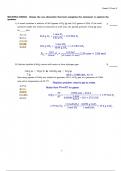
MULTIPLE CHOICE. Choose the one alternative that best completes the statement or answers the
question.
1) A vessel contains a mixture of 26.0 grams of H2 (g) and 18.2 grams of CH4. If the total 1)
pressure inside the vessel is measured at 2.24 atm, the partial pressure of Hp (g) must
be atm.
A) 4.1 1 molH
) 415 26.0 g H, * 2 =12.9 Mol H,
B) 31.4 2029gH,
C) 0.181
D)2
E) 28.9 182. 9=g CH, * *+ 16,04
—2 g sCH, _= 1 1. 13 Mot 0 cH 4
Part 12.9 mol
Py = P, = 2.24 atm = 2.06 mol
2 Whole (12.9 mol+1.1 mol)
2) Calcium hydride (CaHg) reacts with water to form hydrogen gas: 2)
CaHyp (s) + 2H9O () @ Ca(OH)s (aq) + 2H9 (g)
?9 45.0L, 0.995 atm, 32 °C
How many grams of CaHo are needed to generate 45.0 L of Hy gas at a pressure of 0.995
atm and a temperature of 32 °C? ,
P Reaction problem: need to get to moles
A) 75.3
) Moles from PV=nRT for gases
B) 151
EliSiEs PV 0.995 atm * 45.0 L
D) 0.894 n(H,) = T T a2t = 1.79 mol H,
E) 53.3 0'08206m0l T * (32 + 273.15)K
(1 molCaH,) 42.094 g CaH,
1.79 mol H, * * =376 gCaH,
2mol H2 1 molCaH,
, 3) Which one of the following should have the lowest boiling point? 3)
A) CHy
B) Lil The lowest boiling point will have the weakest
C) HaO intermolecular forces
D) CoH5COOH CH4 only has dispersion forces.
E) PClg The other molecules are polar, have H-bonding, or are
lonic compounds
4) List the compounds in decreasing boiling point order. 4)
CH30 CH3 Kr CH3CN
A) Kr > CH3CN > CH30 CH3 The lowest boiling point will have the weakest
B) CH30 CH3 > Kr > CH3CN intermolecular forces.
C) CH30 CH3 > CH3CN > Kr It would help to draw the Lewis structures for this one.
CH;CN and CH;OCH, are both polar molecules, BUT the
D) CH3CN > CH30 CH3 > Kr
CH,CN is more polar than CH;OCH,; because of the
E) Kr > CH30 CH3 > CH3CN distribution of the dipoles. Consequently, CH;CN has the
highest BP, then CH;OCH,, and then Kr which only has
dispersion forces.
5) What is the predominant intermolecular force in NaNO3? 5)
A) ion-dipole attraction
B) London-dispersion forces
C) ionic bonding
D) hydrogen bonding
E) dipole-dipole attraction NaNO; has a metal and would have ionic bonding.
MULTIPLE CHOICE. Choose the one alternative that best completes the statement or answers the
question.
1) A vessel contains a mixture of 26.0 grams of H2 (g) and 18.2 grams of CH4. If the total 1)
pressure inside the vessel is measured at 2.24 atm, the partial pressure of Hp (g) must
be atm.
A) 4.1 1 molH
) 415 26.0 g H, * 2 =12.9 Mol H,
B) 31.4 2029gH,
C) 0.181
D)2
E) 28.9 182. 9=g CH, * *+ 16,04
—2 g sCH, _= 1 1. 13 Mot 0 cH 4
Part 12.9 mol
Py = P, = 2.24 atm = 2.06 mol
2 Whole (12.9 mol+1.1 mol)
2) Calcium hydride (CaHg) reacts with water to form hydrogen gas: 2)
CaHyp (s) + 2H9O () @ Ca(OH)s (aq) + 2H9 (g)
?9 45.0L, 0.995 atm, 32 °C
How many grams of CaHo are needed to generate 45.0 L of Hy gas at a pressure of 0.995
atm and a temperature of 32 °C? ,
P Reaction problem: need to get to moles
A) 75.3
) Moles from PV=nRT for gases
B) 151
EliSiEs PV 0.995 atm * 45.0 L
D) 0.894 n(H,) = T T a2t = 1.79 mol H,
E) 53.3 0'08206m0l T * (32 + 273.15)K
(1 molCaH,) 42.094 g CaH,
1.79 mol H, * * =376 gCaH,
2mol H2 1 molCaH,
, 3) Which one of the following should have the lowest boiling point? 3)
A) CHy
B) Lil The lowest boiling point will have the weakest
C) HaO intermolecular forces
D) CoH5COOH CH4 only has dispersion forces.
E) PClg The other molecules are polar, have H-bonding, or are
lonic compounds
4) List the compounds in decreasing boiling point order. 4)
CH30 CH3 Kr CH3CN
A) Kr > CH3CN > CH30 CH3 The lowest boiling point will have the weakest
B) CH30 CH3 > Kr > CH3CN intermolecular forces.
C) CH30 CH3 > CH3CN > Kr It would help to draw the Lewis structures for this one.
CH;CN and CH;OCH, are both polar molecules, BUT the
D) CH3CN > CH30 CH3 > Kr
CH,CN is more polar than CH;OCH,; because of the
E) Kr > CH30 CH3 > CH3CN distribution of the dipoles. Consequently, CH;CN has the
highest BP, then CH;OCH,, and then Kr which only has
dispersion forces.
5) What is the predominant intermolecular force in NaNO3? 5)
A) ion-dipole attraction
B) London-dispersion forces
C) ionic bonding
D) hydrogen bonding
E) dipole-dipole attraction NaNO; has a metal and would have ionic bonding.