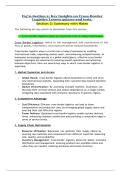
D470-Section 2: Key Insights on Cross-Border Logistics Lesson quizzes and tests.
D470-Section 2: Key Insights on Cross-Border
Logistics Lesson quizzes and tests.
Section 2: Summary with Notes
The following are key points to remember from this section:
• Cross-border logistics plays an important role in today's businesses.
Cross Border Logistics- refers to the management and coordination of the
flow of goods, information, and resources across national boundaries.
Cross-border logistics plays a crucial role in today's businesses by enabling
international trade, expanding market reach, and enhancing competitiveness. As
businesses increasingly operate in a global marketplace, effective cross-border
logistics strategies are essential for ensuring smooth operations and achieving
business objectives. Here are several key ways in which cross-border logistics is
important:
1. Market Expansion and Access
• Global Reach: Cross-border logistics allows businesses to enter and serve
new international markets, expanding their customer base beyond domestic
boundaries.
• Market Diversification: By accessing multiple markets, businesses can
diversify their revenue streams and reduce dependence on a single market,
mitigating risks associated with economic downturns in specific regions.
2. Competitive Advantage
• Cost Efficiency: Efficient cross-border logistics can lead to lower
transportation and production costs by leveraging global supply chains and
sourcing from cost-effective regions.
• Faster Delivery: Optimized cross-border logistics enable quicker delivery
times, enhancing customer satisfaction and providing a competitive edge in
terms of service levels.
3. Supply Chain Optimization
• Resource Utilization: Businesses can optimize their supply chains by
sourcing raw materials and components from different countries, balancing
cost, quality, and availability.
• Inventory Management: Cross-border logistics allows for better inventory
distribution and management, ensuring products are available where and
when they are needed, reducing stockouts and excess inventory.
D470-Section 2: Key Insights on Cross-Border Logistics Lesson quizzes and tests.
,D470-Section 2: Key Insights on Cross-Border Logistics Lesson quizzes and tests.
4. Innovation and Collaboration
• Access to Innovation: Engaging in cross-border trade exposes businesses
to new technologies, processes, and innovations that can be integrated into
their operations.
• Collaboration Opportunities: International partnerships and collaborations
can lead to shared expertise, joint ventures, and co-development of products,
enhancing business capabilities.
5. Regulatory Compliance and Risk Management
• Navigating Regulations: Effective cross-border logistics involves
understanding and complying with various international trade regulations,
customs requirements, and import/export laws, ensuring smooth and lawful
operations.
• Risk Mitigation: By diversifying suppliers and production locations across
different countries, businesses can mitigate risks associated with political
instability, natural disasters, and other disruptions.
6. Customer Experience and Satisfaction
• Meeting Demand: Cross-border logistics ensures that businesses can meet
customer demand globally, providing timely and reliable delivery of products.
• Localized Service: Businesses can offer localized products and services
tailored to specific regional preferences and cultural nuances, improving
customer satisfaction and loyalty.
7. Economic Impact
• Global Trade Facilitation: Cross-border logistics supports global trade by
facilitating the movement of goods between countries, contributing to
economic growth and development.
• Employment Opportunities: The logistics and transportation sectors create
jobs and drive economic activity in both exporting and importing countries.
Challenges in Cross-Border Logistics
1. Regulatory Complexity: Navigating different regulatory environments,
customs procedures, and trade policies can be complex and time-consuming.
2. Logistics Infrastructure: Variations in infrastructure quality across
countries can impact transportation efficiency and reliability.
D470-Section 2: Key Insights on Cross-Border Logistics Lesson quizzes and tests.
, D470-Section 2: Key Insights on Cross-Border Logistics Lesson quizzes and tests.
3. Cultural Differences: Understanding and adapting to cultural differences in
business practices, consumer behavior, and communication is essential for
successful international operations.
4. Currency Fluctuations: Exchange rate volatility can affect pricing, costs,
and profitability, requiring effective currency risk management strategies.
5. Security Concerns: Ensuring the security of goods in transit, particularly in
regions with higher risks of theft, piracy, or geopolitical instability, is critical.
Strategies for Effective Cross-Border Logistics
1. Partner with Experienced Providers: Collaborate with logistics service
providers who have expertise in international shipping, customs brokerage,
and compliance.
2. Leverage Technology: Utilize advanced technologies such as
Transportation Management Systems (TMS), Warehouse Management
Systems (WMS), and real-time tracking to enhance visibility and efficiency.
3. Streamline Customs Processes: Invest in customs automation and work
closely with customs brokers to expedite clearance processes and reduce
delays.
4. Optimize Supply Chain Networks: Design supply chain networks that
strategically position warehouses and distribution centers near key markets
to reduce lead times and transportation costs.
5. Risk Management: Develop contingency plans and diversify supply sources
to mitigate risks associated with cross-border operations.
Example Implementation
A company looking to expand its market reach to Europe might:
1. Market Analysis: Conduct thorough market research to understand
demand, competition, and regulatory requirements in target European
countries.
2. Select Logistics Partners: Choose experienced logistics providers with
strong networks in Europe to handle transportation, warehousing, and
customs clearance.
3. Compliance and Documentation: Ensure all necessary documentation,
such as certificates of origin, import licenses, and compliance with EU
regulations, is in place.
4. Technology Integration: Implement TMS and WMS solutions to manage
international shipments, track inventory, and provide real-time visibility to
customers.
5. Continuous Monitoring: Regularly review logistics performance, customer
feedback, and market conditions to make necessary adjustments and
improvements.
D470-Section 2: Key Insights on Cross-Border Logistics Lesson quizzes and tests.
D470-Section 2: Key Insights on Cross-Border
Logistics Lesson quizzes and tests.
Section 2: Summary with Notes
The following are key points to remember from this section:
• Cross-border logistics plays an important role in today's businesses.
Cross Border Logistics- refers to the management and coordination of the
flow of goods, information, and resources across national boundaries.
Cross-border logistics plays a crucial role in today's businesses by enabling
international trade, expanding market reach, and enhancing competitiveness. As
businesses increasingly operate in a global marketplace, effective cross-border
logistics strategies are essential for ensuring smooth operations and achieving
business objectives. Here are several key ways in which cross-border logistics is
important:
1. Market Expansion and Access
• Global Reach: Cross-border logistics allows businesses to enter and serve
new international markets, expanding their customer base beyond domestic
boundaries.
• Market Diversification: By accessing multiple markets, businesses can
diversify their revenue streams and reduce dependence on a single market,
mitigating risks associated with economic downturns in specific regions.
2. Competitive Advantage
• Cost Efficiency: Efficient cross-border logistics can lead to lower
transportation and production costs by leveraging global supply chains and
sourcing from cost-effective regions.
• Faster Delivery: Optimized cross-border logistics enable quicker delivery
times, enhancing customer satisfaction and providing a competitive edge in
terms of service levels.
3. Supply Chain Optimization
• Resource Utilization: Businesses can optimize their supply chains by
sourcing raw materials and components from different countries, balancing
cost, quality, and availability.
• Inventory Management: Cross-border logistics allows for better inventory
distribution and management, ensuring products are available where and
when they are needed, reducing stockouts and excess inventory.
D470-Section 2: Key Insights on Cross-Border Logistics Lesson quizzes and tests.
,D470-Section 2: Key Insights on Cross-Border Logistics Lesson quizzes and tests.
4. Innovation and Collaboration
• Access to Innovation: Engaging in cross-border trade exposes businesses
to new technologies, processes, and innovations that can be integrated into
their operations.
• Collaboration Opportunities: International partnerships and collaborations
can lead to shared expertise, joint ventures, and co-development of products,
enhancing business capabilities.
5. Regulatory Compliance and Risk Management
• Navigating Regulations: Effective cross-border logistics involves
understanding and complying with various international trade regulations,
customs requirements, and import/export laws, ensuring smooth and lawful
operations.
• Risk Mitigation: By diversifying suppliers and production locations across
different countries, businesses can mitigate risks associated with political
instability, natural disasters, and other disruptions.
6. Customer Experience and Satisfaction
• Meeting Demand: Cross-border logistics ensures that businesses can meet
customer demand globally, providing timely and reliable delivery of products.
• Localized Service: Businesses can offer localized products and services
tailored to specific regional preferences and cultural nuances, improving
customer satisfaction and loyalty.
7. Economic Impact
• Global Trade Facilitation: Cross-border logistics supports global trade by
facilitating the movement of goods between countries, contributing to
economic growth and development.
• Employment Opportunities: The logistics and transportation sectors create
jobs and drive economic activity in both exporting and importing countries.
Challenges in Cross-Border Logistics
1. Regulatory Complexity: Navigating different regulatory environments,
customs procedures, and trade policies can be complex and time-consuming.
2. Logistics Infrastructure: Variations in infrastructure quality across
countries can impact transportation efficiency and reliability.
D470-Section 2: Key Insights on Cross-Border Logistics Lesson quizzes and tests.
, D470-Section 2: Key Insights on Cross-Border Logistics Lesson quizzes and tests.
3. Cultural Differences: Understanding and adapting to cultural differences in
business practices, consumer behavior, and communication is essential for
successful international operations.
4. Currency Fluctuations: Exchange rate volatility can affect pricing, costs,
and profitability, requiring effective currency risk management strategies.
5. Security Concerns: Ensuring the security of goods in transit, particularly in
regions with higher risks of theft, piracy, or geopolitical instability, is critical.
Strategies for Effective Cross-Border Logistics
1. Partner with Experienced Providers: Collaborate with logistics service
providers who have expertise in international shipping, customs brokerage,
and compliance.
2. Leverage Technology: Utilize advanced technologies such as
Transportation Management Systems (TMS), Warehouse Management
Systems (WMS), and real-time tracking to enhance visibility and efficiency.
3. Streamline Customs Processes: Invest in customs automation and work
closely with customs brokers to expedite clearance processes and reduce
delays.
4. Optimize Supply Chain Networks: Design supply chain networks that
strategically position warehouses and distribution centers near key markets
to reduce lead times and transportation costs.
5. Risk Management: Develop contingency plans and diversify supply sources
to mitigate risks associated with cross-border operations.
Example Implementation
A company looking to expand its market reach to Europe might:
1. Market Analysis: Conduct thorough market research to understand
demand, competition, and regulatory requirements in target European
countries.
2. Select Logistics Partners: Choose experienced logistics providers with
strong networks in Europe to handle transportation, warehousing, and
customs clearance.
3. Compliance and Documentation: Ensure all necessary documentation,
such as certificates of origin, import licenses, and compliance with EU
regulations, is in place.
4. Technology Integration: Implement TMS and WMS solutions to manage
international shipments, track inventory, and provide real-time visibility to
customers.
5. Continuous Monitoring: Regularly review logistics performance, customer
feedback, and market conditions to make necessary adjustments and
improvements.
D470-Section 2: Key Insights on Cross-Border Logistics Lesson quizzes and tests.