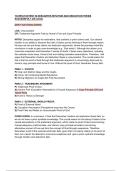
TO WHAT EXTENT IS DESCARTES INTUITION AND DEDUCTION THESIS
SUCCESSFUL? (25 marks)
(pink = out of spec content)
LOA: Unsuccessful
CR: Trademark Argument Fails by Hume’s Fork and Copy Principle
INTRO: Descartes argues for rationalism, that synthetic a priori claims exist. Our rational
intuition is our ability to discover the truth of claims just by thinking of them through reason.
He says we can put these claims into deductive arguments, where the premises entail the
conclusion in order to gain more knowledge (e.g. ‘God exists’). Although this allows us to
overcome scepticism and Descartes 3 waves of doubt, it faces many objections, including
the cartesian circle issue, Hume’s fork and making causation assumptions. Therefore, I will
argue that Descartes' intuition and deduction thesis is unsuccessful. The crucial reason for
this is that his proof of God through the trademark argument is convincingly disproved by
Hume’s copy principle and Hume’s Fork. Without the proof of God, Descartes’ theory fails.
PARA 1 - COGITO:
P) Clear and Distinct Ideas and the Cogito
A) Hume: No Continuing Mental Substance
E) Strong Objection so Cogito Not Fully Successful
PARA 2 - TRADEMARK ARGUMENT:
P) Trademark Proof of God
A) Hume’s Fork (Causation Assumptions of Causal Adequacy) + Copy Principle (CR) and
Tabula Rasa
E) Hume’s Theory is Stronger
PARA 3 - EXTERNAL WORLD PROOF:
P) Proof of External World
A) Causation Assumption (Perceptions may have No Cause)
E) Proof Fails and Relies on Unsuccessful Proof of God
CONCLUSION: In conclusion, I think that Descartes’ intuition and deduction thesis fails, so
we do not have a priori synthetic knowledge. The crucial reason for the theory’s failure is the
causal assumptions in the trademark argument, which make his proof of God unconvincing.
Causal adequacy could be false, and Hume’s copy principle provides a convincing
alternative account of how we form the concept of God through experience. Therefore,
Descartes’ proof of the external world also fails, given that it is heavily reliant on his proof of
God. As a result, his attempt to overcome scepticism and gain a priori synthetic knowledge
through intuition and deduction fails.
SUCCESSFUL? (25 marks)
(pink = out of spec content)
LOA: Unsuccessful
CR: Trademark Argument Fails by Hume’s Fork and Copy Principle
INTRO: Descartes argues for rationalism, that synthetic a priori claims exist. Our rational
intuition is our ability to discover the truth of claims just by thinking of them through reason.
He says we can put these claims into deductive arguments, where the premises entail the
conclusion in order to gain more knowledge (e.g. ‘God exists’). Although this allows us to
overcome scepticism and Descartes 3 waves of doubt, it faces many objections, including
the cartesian circle issue, Hume’s fork and making causation assumptions. Therefore, I will
argue that Descartes' intuition and deduction thesis is unsuccessful. The crucial reason for
this is that his proof of God through the trademark argument is convincingly disproved by
Hume’s copy principle and Hume’s Fork. Without the proof of God, Descartes’ theory fails.
PARA 1 - COGITO:
P) Clear and Distinct Ideas and the Cogito
A) Hume: No Continuing Mental Substance
E) Strong Objection so Cogito Not Fully Successful
PARA 2 - TRADEMARK ARGUMENT:
P) Trademark Proof of God
A) Hume’s Fork (Causation Assumptions of Causal Adequacy) + Copy Principle (CR) and
Tabula Rasa
E) Hume’s Theory is Stronger
PARA 3 - EXTERNAL WORLD PROOF:
P) Proof of External World
A) Causation Assumption (Perceptions may have No Cause)
E) Proof Fails and Relies on Unsuccessful Proof of God
CONCLUSION: In conclusion, I think that Descartes’ intuition and deduction thesis fails, so
we do not have a priori synthetic knowledge. The crucial reason for the theory’s failure is the
causal assumptions in the trademark argument, which make his proof of God unconvincing.
Causal adequacy could be false, and Hume’s copy principle provides a convincing
alternative account of how we form the concept of God through experience. Therefore,
Descartes’ proof of the external world also fails, given that it is heavily reliant on his proof of
God. As a result, his attempt to overcome scepticism and gain a priori synthetic knowledge
through intuition and deduction fails.