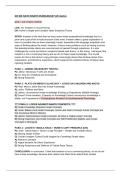
DO WE HAVE INNATE KNOWLEDGE? (25 marks)
(pink = out of spec content)
LOA: No, Innatism is Unconvincing
CR: Hume’s Simple and Complex Ideas Empiricist Theory
INTRO: Innatism is the view that we have some innate propositional knowledge that is a
priori and a part of the in-built structure of the mind. Innatism offers a good explanation of
how it is possible that we have seemingly ‘innate’ dispositions like language acquisition and
ways of thinking about the world. However, it faces many problems such as having to prove
that potential innate claims are universal and not gained through experience. It is also
challenged by Locke and Hume’s empiricist tabula rasa theory. In this essay, I will argue that
innatism is not a convincing theory and we do not have innate knowledge. The crucial
reason for this is that Hume’s copy principle convincingly shows that all ideas derive from
impressions, and therefore experience, which supports the empiricist theory of tabula rasa,
rejecting innatism.
PARA 1 - LEIBNIZ NECESSARY TRUTHS:
P) Leibniz: Necessary Truths are Innate
A) No, they are Analytical and Conceptual
E) Strong Response
PARA 2 - PLATO ON MENO’S SLAVE BOY + LOCKE ON CHILDREN AND IDIOTS:
P) Plato: Meno’s Slave Boy Has Innate Knowledge
A) Locke: Children and Idiots
C) Leibniz: Unconscious Innate Knowledge Existing as Dispositions (Marble Analogy)
E) Doesn’t Prove Innatism, (Capacity vs Knowledge) Some Unconscious Knowledge is
Ability, not Propositional + Contemporary Research in Developmental Psychology
??? PARA 3 - LOCKE AGAINST INNATE CONCEPTS: ???
P) Innate Knowledge Requires Innate Concepts
A) Locke: Babies Lack Innate Concepts, Some Lack God’s Concept, Innate Concepts are
Not Conscious Mind or Memory
C) Leibniz: Subconscious Innate Concepts, All Have a ‘Higher power’ Concept
E) Strong responses, But Innate Concepts are Still Problematic (Babies Lack Innate
Concepts is Strongest)
PARA 4 - LOCKE’S TABULA RASA + HUME’S COPY PRINCIPLE (CR):
P) Locke: Tabula Rasa + Hume’s Copy Principle + Simple and Complex Ideas
A) Missing Shade of Blue
C) Couldn’t Imagine Colour/Could Imagine by Combining Simple Ideas
A) Abstract Concepts
C) Vague because No Direct Experience
E) Strong Responses and Defense of Tabula Rasa Theory
CONCLUSION: In conclusion, I think that innatism is not a convincing theory, so we do not
have innate knowledge, because both Leibniz and Plato fail to defend their innatist
(pink = out of spec content)
LOA: No, Innatism is Unconvincing
CR: Hume’s Simple and Complex Ideas Empiricist Theory
INTRO: Innatism is the view that we have some innate propositional knowledge that is a
priori and a part of the in-built structure of the mind. Innatism offers a good explanation of
how it is possible that we have seemingly ‘innate’ dispositions like language acquisition and
ways of thinking about the world. However, it faces many problems such as having to prove
that potential innate claims are universal and not gained through experience. It is also
challenged by Locke and Hume’s empiricist tabula rasa theory. In this essay, I will argue that
innatism is not a convincing theory and we do not have innate knowledge. The crucial
reason for this is that Hume’s copy principle convincingly shows that all ideas derive from
impressions, and therefore experience, which supports the empiricist theory of tabula rasa,
rejecting innatism.
PARA 1 - LEIBNIZ NECESSARY TRUTHS:
P) Leibniz: Necessary Truths are Innate
A) No, they are Analytical and Conceptual
E) Strong Response
PARA 2 - PLATO ON MENO’S SLAVE BOY + LOCKE ON CHILDREN AND IDIOTS:
P) Plato: Meno’s Slave Boy Has Innate Knowledge
A) Locke: Children and Idiots
C) Leibniz: Unconscious Innate Knowledge Existing as Dispositions (Marble Analogy)
E) Doesn’t Prove Innatism, (Capacity vs Knowledge) Some Unconscious Knowledge is
Ability, not Propositional + Contemporary Research in Developmental Psychology
??? PARA 3 - LOCKE AGAINST INNATE CONCEPTS: ???
P) Innate Knowledge Requires Innate Concepts
A) Locke: Babies Lack Innate Concepts, Some Lack God’s Concept, Innate Concepts are
Not Conscious Mind or Memory
C) Leibniz: Subconscious Innate Concepts, All Have a ‘Higher power’ Concept
E) Strong responses, But Innate Concepts are Still Problematic (Babies Lack Innate
Concepts is Strongest)
PARA 4 - LOCKE’S TABULA RASA + HUME’S COPY PRINCIPLE (CR):
P) Locke: Tabula Rasa + Hume’s Copy Principle + Simple and Complex Ideas
A) Missing Shade of Blue
C) Couldn’t Imagine Colour/Could Imagine by Combining Simple Ideas
A) Abstract Concepts
C) Vague because No Direct Experience
E) Strong Responses and Defense of Tabula Rasa Theory
CONCLUSION: In conclusion, I think that innatism is not a convincing theory, so we do not
have innate knowledge, because both Leibniz and Plato fail to defend their innatist